
Set
God of chaos — the red god of storm and desert who murdered Osiris, yet stood in the sun's boat each night to spear the serpent of nonexistence.
Statue of the god Seth, softwood, New Kingdom (Museo Egizio, Turin, S 1249), CC0 · CC0 · source
The Animal Nobody Can Identify
Set — Egyptian Setekh or Sutekh, Greek Seth — is drawn as a creature that does not exist 5,6. The "Set animal" has a curved downturned snout, square-tipped upright ears, a stiff forked tail, and a canine body. Egyptologists have proposed the aardvark, the oryx, the saluki, the fennec, the giraffe and the wild ass; none fits, and the current consensus is that no identification is required, because a god of disorder was deliberately given a body outside the natural catalogue 5,6.
His colour is red: red like the desert that Egyptians called deshret, the Red Land, against the kemet, the Black Land of the flood plain 5,7. Red-haired people, red oxen and red donkeys carried a faint association with him, and in later ritual red-coloured objects could be destroyed as substitutes for the god 5.
What He Ruled
Set is not evil in the earliest sources; he is turbulence 5. His domain is the desert, the oases, the thunderstorm, the sandstorm, foreign lands, and the raw violence of physical strength, and he is the patron of anything outside the settled, irrigated, orderly Egyptian world 5,6. He is the child of Geb and Nut, brother to Osiris, Isis, and Nephthys, whom he takes as consort; in the New Kingdom the Levantine goddesses Anat and Astarte are also assigned to him, in keeping with his role as the god of foreigners 5,6.
Plutarch preserves a striking detail of his birth: Set does not wait to be born but tears his way out of his mother's side, "prematurely and violently" 4. Even where the Egyptian sources are silent, his fundamental characterisation is consistent — he arrives out of order 5.
His childlessness matters too. te Velde's classic study reads Set as the sterile, boundary-crossing outsider of the Egyptian pantheon: sexually aggressive, socially unattached, essential and unassimilable 5.
Murderer of His Brother
The act that defines him is the killing of Osiris. Egyptian texts state it flatly and early — the Pyramid Texts already speak of the dead god struck down by his brother and of the limbs that must be gathered — but they never narrate the murder in full, and the continuous story survives only in Plutarch's Greek 1,4,7. There Set traps Osiris in a decorated chest, throws it into the Nile, and later cuts the recovered corpse into fourteen pieces 4.
The war with Horus that follows runs for eighty years in the Ramesside tale of the Contendings, and the two gods maim each other in the process: Set tears out Horus's eye, and Horus rips away Set's testicles 1,2. The Chester Beatty version is startlingly comic — a rigged boat race, a night of attempted sexual humiliation that Isis turns back on its author, a divine court that cannot reach a decision — but its conclusion is the constitutional one: the throne goes to the son, and Set is compensated with a place in the sky 2.
Guardian of the Sun Boat
The Egyptians did not resolve this by expelling him. In the great cosmological texts Set stands at the prow of the solar barque during its passage through the night, and his violence is exactly what the sun needs: he spears Apophis, the enormous serpent of nonbeing who tries to swallow the boat each night, and no other god is strong enough for the job 3,5,6.
This is the paradox that makes Set one of the most interesting figures in any ancient religion. He is the disorder inside the system, licensed and employed by it — the destructive force that maintains the cosmos precisely by being destructive in the right direction 5. Royal texts use him accordingly: kings are praised as being "like Set" in battle, and in Old Kingdom formulae the balanced union of Egypt is expressed as the reconciliation of Horus and Set in a single person 1,5.
A God with Real Temples
Set was worshipped, not merely feared. His principal Upper Egyptian centre was Nubt (Greek Ombos) near modern Naqada, and the Delta city of Avaris held his major northern cult, where he was identified with the storm god Baal 5,6. The Nineteenth Dynasty came from that region and advertised the connection: two pharaohs were named Seti, "the Setian," a Twentieth Dynasty king was Sethnakht, "Set is victorious," and Ramesses II's famous "400-Year Stela" commemorates a Set cult at Avaris of extreme antiquity 5,6.
For most of Egyptian history, then, the murderer of Osiris held state honours. Egyptian religion could accommodate a god who was simultaneously villain, defender, and royal patron 5,7.
Becoming the Devil
That accommodation broke down late. From roughly the Third Intermediate Period, and sharply under Persian and then Greco-Roman rule, Set slid from necessary antagonist to outright enemy 5,6. Foreign occupation made a god of foreigners politically toxic, and the rise of the Osiris cult, with its intense emotional focus on the murdered god, left less room for his killer 5,7.
Images of Set were hacked out of older monuments, his name erased or replaced, and rituals developed for destroying him in effigy: red wax figures, bound animals, spitting and trampling rites, all catalogued in temple manuals 3,5. The Greeks equated him with Typhon, the monstrous adversary of Zeus, which fixed the demonic reading for the classical world and for everything downstream of it 4,6.
The modern image of Set as an Egyptian Satan comes from that final phase alone. For most of the three thousand years before it, he was something more unsettling than a devil: a god whose brutality the world was understood to require 5,7.
Continue Exploring
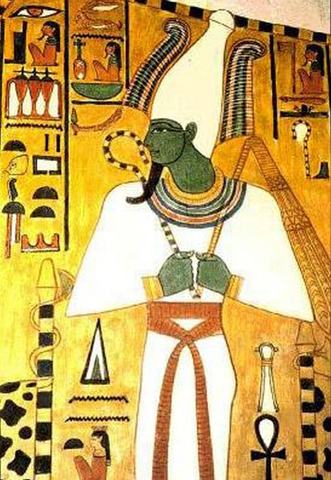
Lord of the afterlife — the murdered king remade as the first mummy, whose resurrection promised every Egyptian a life beyond the grave.
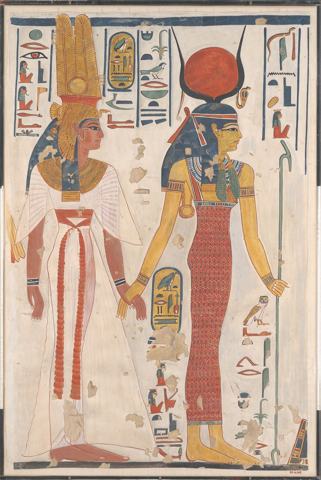
Goddess of magic — the widow whose spells restored Osiris, the mother who hid Horus in the marshes, and the one Egyptian deity Rome adopted whole.
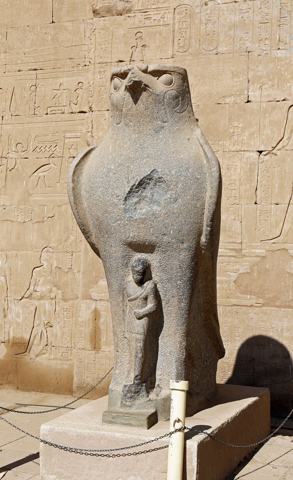
The sky falcon — god of kingship whose torn-out eye became the symbol of healing, and who won Egypt's throne from Set after eighty years of litigation.
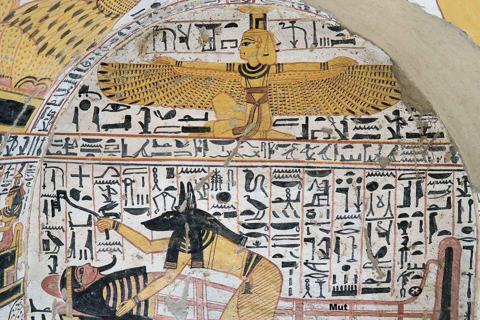
Isis's quieter sister — the mourner who helped restore Osiris, was seduced or seducer in Anubis's birth, and stood at the head of every Egyptian coffin.
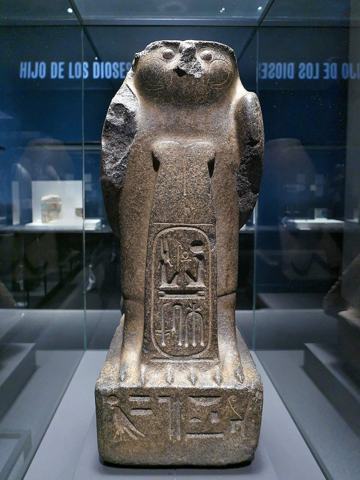
The sun itself as a god — Ra sails the sky by day, fights the serpent of chaos by night, and is reborn on the horizon every dawn.
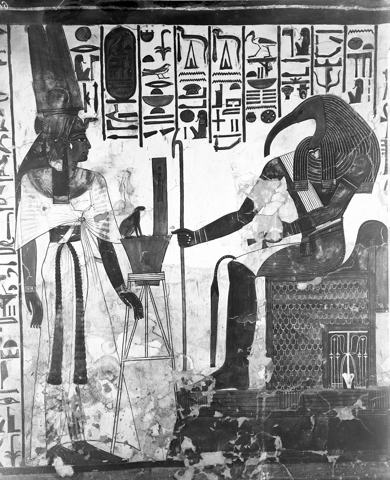
Ibis-headed lord of writing, reckoning and the moon — Thoth keeps the record at the judgment of the dead and settles the quarrels of the gods.
Also mentioned inAnubisApophis (Apep)Eye of Horus (Wedjat)Nut and Geb (Egyptian Sky and Earth)SobekTaweret (Egyptian Goddess of Childbirth)The Ennead of Heliopolis
Sources & Further Reading
- 1.Pyramid Texts (Old Kingdom, c. 2400–2300 BCE).
- 2.Papyrus Chester Beatty I, The Contendings of Horus and Seth (Ramesside, c. 1160 BCE).
- 3.The Book of Overthrowing Apophis (Papyrus Bremner-Rhind, c. 4th century BCE).
- 4.Plutarch, On Isis and Osiris (Moralia, 1st–2nd century CE).
- 5.te Velde, Herman. Seth, God of Confusion: A Study of His Role in Egyptian Mythology and Religion. Brill, 1967 (2nd ed. 1977).
- 6.Wilkinson, Richard H. The Complete Gods and Goddesses of Ancient Egypt. Thames & Hudson, 2003.
- 7.Pinch, Geraldine. Egyptian Mythology: A Guide to the Gods, Goddesses, and Traditions of Ancient Egypt. Oxford University Press, 2002.
Spot an error or have a source to suggest? Write to info@viseterna.com. We cite primary sources and modern scholarship, and we correct fast.