
Isis
Goddess of magic — the widow whose spells restored Osiris, the mother who hid Horus in the marshes, and the one Egyptian deity Rome adopted whole.
Queen Nefertari Being Led by Isis, Tomb of Nefertari, c. 1279-1213 BC; facsimile by Charles K. Wilkinson (Metropolitan Museum of Art), CC0 · CC0 · source
The Throne Made a Goddess
The Egyptian name behind the Greek Isis is Aset, written with the hieroglyph of a throne, and she wears that throne as a headdress in her earliest images 6,7. Scholars have read the sign as evidence that she began as a personification of the royal seat itself — the power that makes a king a king, and therefore the mother of every legitimate ruler 6. Unlike most major Egyptian deities she has no early home town of her own, which suggests a goddess who spread with an idea rather than out of a local shrine 6,7.
She enters the record in the Pyramid Texts as a mourner and a protector, working with her sister Nephthys over the dead king's body and lending him her strength for the journey ahead 1. Later art gives her a second headdress, the cow horns and sun disk borrowed from Hathor, and shows her with kite's wings — the shrieking mourner-bird of Egyptian funerals — spread over a coffin or the corners of a sarcophagus 6,7.
The Search and the Restoration
Her defining act is the recovery of her murdered husband. When Set kills Osiris and scatters his body, Isis hunts down the pieces, and with Nephthys and Anubis she rewraps and revives him — the first mummification and the first funeral rites 4,6. Plutarch's Greek retelling adds the celebrated details: the chest carried to Byblos, the pillar cut from the tree grown around it, and the missing phallus swallowed by fish in the Nile, for which Isis makes a replacement 4.
The Egyptian texts stress something Plutarch's version can obscure: her power in the story is verbal and technical. She is weret hekau, "great of magic," and it is her recitation, not her grief, that reassembles and reanimates 6,7. Hovering over the body as a kite she conceives Horus, which makes the resurrection an act of succession as much as of love — the dead king produces a living heir 1,4.
Mistress of Magic
The most famous demonstration of that power has nothing to do with Osiris. In a healing spell preserved on papyrus, Isis moulds a serpent from earth and the spittle of the aged sun god, sets it on Ra's path, and lets it bite him; then she offers to cure the agony only if he tells her his hidden name, which is the seat of his authority. He surrenders it, and she becomes the most potent magician among the gods 6,7. The story was not told for entertainment. It sits inside a text for treating snakebite, on the principle that reciting the myth makes its power available to the patient 7.
That practical magic is why she outlasted grander gods in daily life. Her name headed spells for fever, scorpion stings, difficult births, and infant illness; the "cippi of Horus," small stelae showing the child god gripping snakes and scorpions, were washed with water that the sick then drank, and their inscriptions call on Isis's authority 7. The Metternich Stela of the fourth century BCE preserves one of the fullest such collections, including the tale of Isis nursing her poisoned son back to life in the marshes 7.
The Mother in the Marshes
After Osiris's death Isis hides in the papyrus swamps of Chemmis in the Delta, raising Horus in secret while Set hunts them 4,7. The child is bitten, stung, feverish and constantly endangered — a divine model for every ordinary Egyptian mother's fears, and the reason the image of Isis seated with the infant Horus on her lap became one of the most reproduced objects in the ancient world 6,7.
When Horus grows and sues for his father's throne, the Ramesside tale known as the Contendings of Horus and Seth shows Isis as the shrewdest operator in the divine tribunal. She disguises herself, tricks Set into pronouncing judgment against himself, and is punished by her own son for a moment of pity toward her brother — an unexpectedly earthy, comic portrait of a goddess elsewhere treated with total gravity 3.
Temples, Philae, and the Last Hieroglyphs
Isis received her own major temples relatively late, and the greatest of them, on the island of Philae near Aswan, was substantially built under the Ptolemies and Roman emperors 6. Pilgrims came from Nubia as well as Egypt; the ritual year included the journey of her image and the annual mourning for Osiris on the neighbouring island of Biga, which was treated as his burial place 6,7.
Philae is also where ancient Egyptian religion ends in the documentary record. The last dated hieroglyphic inscription in Egypt was cut there in 394 CE, and the last known Demotic graffito in 452 CE, before the temple was finally closed under Justinian in the sixth century 6,8.
Isis in Greece and Rome
No other Egyptian deity travelled as far. Greek merchants and Egyptian sailors carried her cult across the Mediterranean from the fourth century BCE onward; by the Roman Empire there were Isis temples at Pompeii, Rome, and along the frontiers, and her sanctuaries in the capital were alternately suppressed and rebuilt as the political weather changed 8. Her festival calendar included the springtime Navigium Isidis, the ceremonial launching of a ship to open the sailing season 8.
Apuleius gives the most vivid inside account. At the climax of his novel the goddess appears to the narrator in a vision, tells him that the world worships her under many names — Minerva, Venus, Diana, Proserpina, Ceres — and that the Egyptians alone call her by her true one, and then admits him through an initiation he refuses to describe 5. Whatever its fictional frame, the passage shows what Isis had become in the Roman world: a universal goddess offering personal salvation to individuals, in an empire whose civic gods generally offered nothing of the kind 5,8.
Continue Exploring
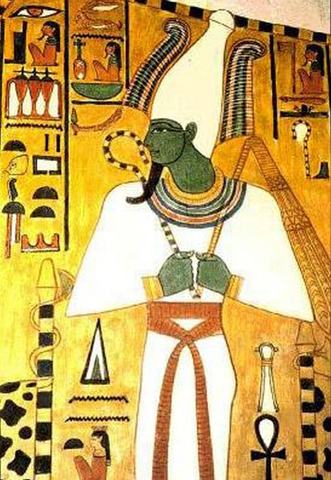
Lord of the afterlife — the murdered king remade as the first mummy, whose resurrection promised every Egyptian a life beyond the grave.
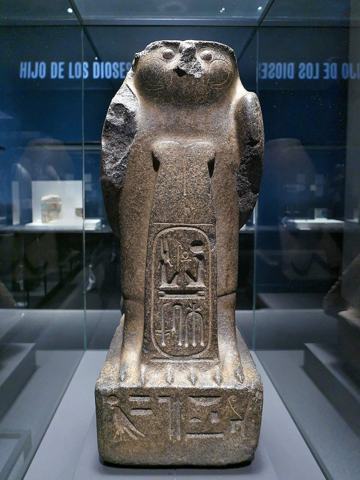
The sun itself as a god — Ra sails the sky by day, fights the serpent of chaos by night, and is reborn on the horizon every dawn.
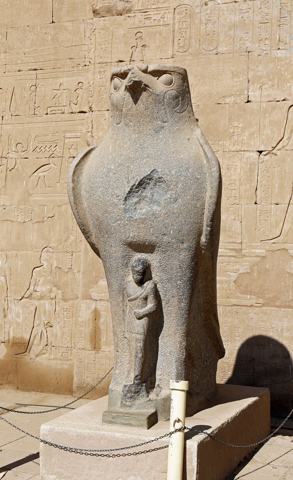
The sky falcon — god of kingship whose torn-out eye became the symbol of healing, and who won Egypt's throne from Set after eighty years of litigation.
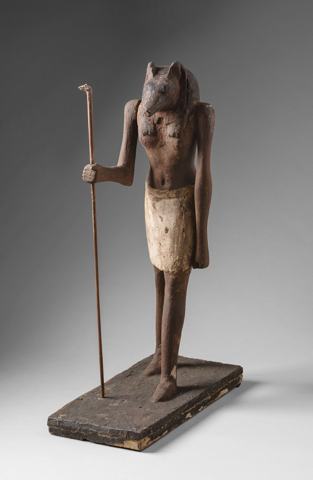
God of chaos — the red god of storm and desert who murdered Osiris, yet stood in the sun's boat each night to spear the serpent of nonexistence.
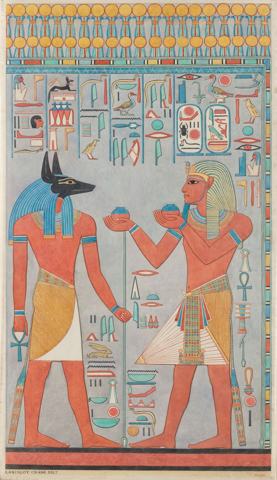
Guardian of the dead — the black jackal god who embalmed Osiris, watched over the necropolis, and weighed the heart against the feather of truth.
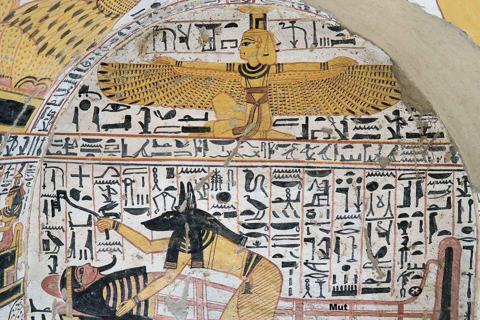
Isis's quieter sister — the mourner who helped restore Osiris, was seduced or seducer in Anubis's birth, and stood at the head of every Egyptian coffin.
Also mentioned inApophis (Apep)Nut and Geb (Egyptian Sky and Earth)The Ennead of HeliopolisThoth
Sources & Further Reading
- 1.Pyramid Texts (Old Kingdom, c. 2400–2300 BCE).
- 2.Coffin Texts (Middle Kingdom, c. 2100–1800 BCE).
- 3.Papyrus Chester Beatty I, The Contendings of Horus and Seth (Ramesside, c. 1160 BCE).
- 4.Plutarch, On Isis and Osiris (Moralia, 1st–2nd century CE).
- 5.Apuleius, Metamorphoses (The Golden Ass), Book 11 (2nd century CE).
- 6.Wilkinson, Richard H. The Complete Gods and Goddesses of Ancient Egypt. Thames & Hudson, 2003.
- 7.Pinch, Geraldine. Egyptian Mythology: A Guide to the Gods, Goddesses, and Traditions of Ancient Egypt. Oxford University Press, 2002.
- 8.Witt, R. E. Isis in the Ancient World. Johns Hopkins University Press, 1997.
Spot an error or have a source to suggest? Write to info@viseterna.com. We cite primary sources and modern scholarship, and we correct fast.