
Ammit
Devourer of the dead — the crocodile-lion-hippopotamus hybrid who crouched beside the scales and swallowed the hearts that failed the weighing.
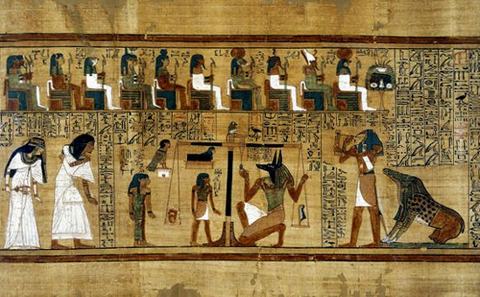
Weighing of the Heart with Ammit, Book of the Dead of Ani, c. 1275 BC (British Museum) · Public domain · source
The Name
The Egyptian name is usually transliterated Ammut or Ammit, meaning "the devourer" or, in fuller writings, "devourer of the dead" 5,6. Other captions in funerary papyri call her "Great of Death," "Eater of Hearts," and "Devourer of Shades" 6. She has no myth of her own, no parentage, no temple, and no priesthood. She exists for one purpose, in one scene, and Egyptian sources show no interest in her outside it 5,7.
That absence is the point. Ammit is not a goddess who happens to punish; she is the punishment given a body 6,8.
A Body Assembled from Three Killers
Egyptian artists built her out of the three animals most likely to kill an Egyptian: the head of a crocodile, the forequarters of a lion or leopard, and the hindquarters of a hippopotamus 5,6. All three were real hazards of the Nile valley, and all three appear elsewhere in Egyptian art as forces that had to be hunted, warded off, or ritually subdued 6,7.
Composite bodies are how Egyptian art expressed function rather than species. A god with a falcon's head is about the sky; a creature stitched from the valley's three great predators is about being eaten 6. Her scale in the papyri reinforces it — she is often drawn surprisingly small, a squat animal waiting under the balance rather than a looming monster, because the danger she represents is procedural, not dramatic 3,4.
The Hall of the Two Truths
Her scene is Spell 125 of the Book of the Dead, the best-known image to survive from ancient Egypt 1. The deceased is led into the Hall of the Two Truths and recites the "negative confession," a list of forty-two offences not committed, addressed to forty-two assessor deities 1. The heart — for Egyptians the seat of memory, intention and character, and the only major organ left in the body during mummification — is then placed on a balance against the feather of Maat, truth and cosmic order 1,7.
Anubis adjusts the scales, Thoth records the verdict, Osiris presides at the end of the hall, and Ammit crouches beside the balance waiting for a result 1,3,4. In the great New Kingdom papyri of Hunefer and Ani the composition is essentially the same, which tells us the scene was standardised and copied from pattern books rather than composed afresh 3,4,7.
What the Heart Might Say
The Egyptians took the possibility of failure seriously enough to hedge against it. Spell 30B of the Book of the Dead is a direct address to one's own heart — "do not stand up as a witness against me" — and it was routinely inscribed on a large stone heart scarab placed on the mummy's chest 1,7. The purpose was to keep the heart from volunteering anything at the tribunal.
That a whole class of amulet existed to manage this risk says something about how the judgment was understood. It was not a formality. It was a procedure that could genuinely go wrong, and Egyptians spent real money insuring against the outcome 7,8.
The Second Death
What Ammit delivers is not torture. Egyptian religion has no hell in the Christian sense, no everlasting punishment, no place where the condemned continue to suffer 6,8. To be eaten by Ammit is to be annihilated — to lose the heart, and with it identity, memory, and any further existence at all.
The Egyptians called this the "second death," and the Coffin Texts are full of spells against dying a second time, against walking upside down, against eating filth, against being deprived of one's name 2,8. Nonexistence, not agony, was the worst thing they could imagine, and the whole apparatus of tombs, offerings, spells and correctly performed rites was built to prevent it 8.
Because of this, the condemned simply vanish from the record. Egyptian funerary art almost never depicts a failed judgment. Every papyrus was made for a specific person and every one shows that person vindicated, "true of voice," proceeding to Osiris — because the papyrus was itself part of the equipment meant to produce that result 7,8.
The Sanction Behind the Whole System
Read functionally, Ammit is the enforcement clause on Maat. The negative confession is a moral code; the balance is the test; Ammit is what makes the test binding 1,8. Without her, the weighing has no consequence and the ethical claims of Egyptian religion collapse into etiquette.
Later New Kingdom compositions elaborate the machinery around her with pits of fire, knife-wielding demons and executioner gods stationed through the Duat, all of them variations on the same idea: the unjustified dead are destroyed rather than detained 6,8. Ammit is simply the earliest and clearest expression of it, and the one Egyptian artists kept drawing for over a thousand years 5,7.
Modern films, novels and games have promoted her to a scheming goddess of vengeance with plans of her own. There is no ancient basis for that. In every surviving source she does nothing at all until a heart tips the wrong way, and then she does the only thing she was made to do 5,6.
Continue Exploring
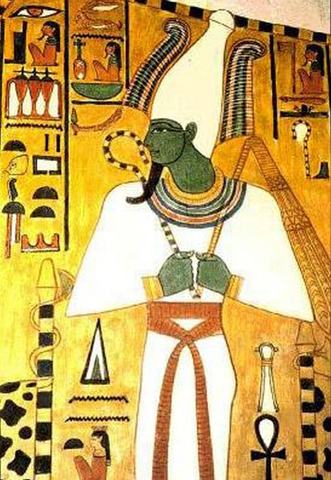
Lord of the afterlife — the murdered king remade as the first mummy, whose resurrection promised every Egyptian a life beyond the grave.
The Egyptian underworld — the night country crossed by the sun in twelve hours and by every dead Egyptian hoping to come out reborn at dawn.
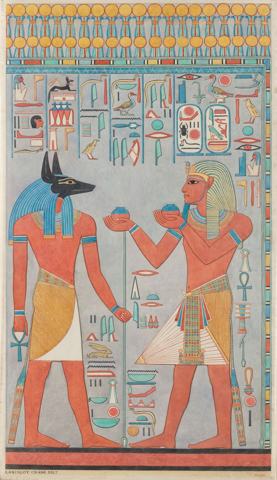
Guardian of the dead — the black jackal god who embalmed Osiris, watched over the necropolis, and weighed the heart against the feather of truth.
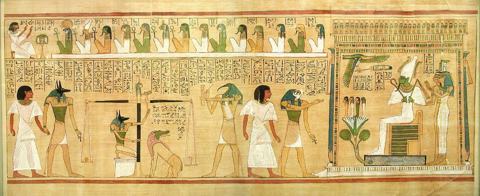
Egypt's judgment of the dead: the heart set on a scale against the feather of Maat, with oblivion waiting for whichever side tips wrong.
The New Kingdom funerary spells the Egyptians called "Going Forth by Day" — copied for the dead, and renamed the Book of the Dead by Lepsius in 1842.
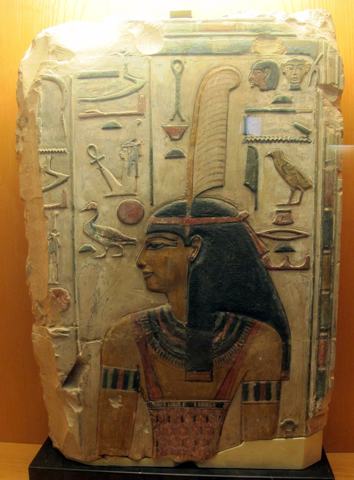
Truth and cosmic order personified — the goddess whose feather weighed every dead Egyptian's heart, and the standard every king swore to uphold.
Also mentioned inTaweret (Egyptian Goddess of Childbirth)
Sources & Further Reading
- 1.The Egyptian Book of the Dead (Book of Going Forth by Day), New Kingdom — esp. Spells 30B and 125.
- 2.Coffin Texts (Middle Kingdom, c. 2100–1800 BCE).
- 3.The Book of the Dead of Hunefer (British Museum EA 9901, c. 1275 BCE).
- 4.The Book of the Dead of Ani (British Museum EA 10470, c. 1250 BCE).
- 5.Wilkinson, Richard H. The Complete Gods and Goddesses of Ancient Egypt. Thames & Hudson, 2003.
- 6.Pinch, Geraldine. Egyptian Mythology: A Guide to the Gods, Goddesses, and Traditions of Ancient Egypt. Oxford University Press, 2002.
- 7.Taylor, John H. Death and the Afterlife in Ancient Egypt. British Museum Press, 2001.
- 8.Assmann, Jan. Death and Salvation in Ancient Egypt. Cornell University Press, 2005.
Spot an error or have a source to suggest? Write to info@viseterna.com. We cite primary sources and modern scholarship, and we correct fast.