
The Ennead of Heliopolis
The nine gods of Heliopolis's creation myth, from self-made Atum down to Osiris, Isis and Set — and the tribunal that judged their heirs.
Nut, Geb, and Shu, vignette from the Greenfield Papyrus (British Museum) · Public domain · source
Nine Gods at the City of the Sun
The Ennead is the Greek rendering of Egyptian pesedjet, simply "the nine," the group of gods worshipped as a set at Heliopolis (Egyptian Iunu), a cult centre near modern Cairo whose priesthood produced one of Egypt's oldest and most influential accounts of how the world began 1,7. Its standard nine members, arranged as a single extended family, are Atum, his children Shu and Tefnut, their children Geb and Nut, and Geb and Nut's four children Osiris, Isis, Set, and Nephthys 1,7. The whole structure is already assumed rather than explained in the Old Kingdom Pyramid Texts, which suggests the Heliopolitan genealogy had taken its canonical shape well before the earliest surviving religious writing in Egypt was composed 1.
Atum Makes Himself
Heliopolitan theology begins before the Ennead exists at all, with Nun, the inert, undifferentiated water that precedes creation. Out of it rises a mound, and on the mound the creator god Atum brings himself into being with no parent and no predecessor 1,2. What happens next is described more than one way in the surviving sources: some texts have Atum produce his first two children, Shu (air) and Tefnut (moisture), by masturbation, others by spitting or sneezing them out, and Allen's study of the cosmogonic texts treats these as parallel figurative languages for the same idea — creation as an act that costs the creator nothing but himself — rather than as competing accounts that must be reconciled 2,5. The fullest surviving version of the hymn cycle built around this moment survives on the Ptolemaic-period Papyrus Bremner-Rhind, itself understood to preserve much older Heliopolitan material 2.
Four Generations to a Family
From Shu and Tefnut come Geb, the earth, and Nut, the sky; Shu is regularly shown standing between them, physically holding the sky goddess up and separated from the earth god below her, a scene that turns the Ennead's second generation into the literal architecture of the world 2,7. Geb and Nut in turn produce the family whose stories dominate the rest of Egyptian myth: Osiris and Isis, murdered king and magician queen, and Set and Nephthys, murderer and mourner 1,7. Everything downstream of the Ennead — kingship, death, judgment, the whole machinery of Osirian religion — is, in the Heliopolitan account, simply this one family's later history 7,8.
Nine Is Not Always Nine
The number was never as fixed as it sounds. Pyramid Texts already distinguish a "Great Ennead" from a "Lesser Ennead" at Heliopolis itself, and other cult centres built their own colleges around their own local chief gods, so that "an ennead" became a flexible label for an organised group of deities rather than a single fixed roster of nine names used everywhere 1,6. Memphis offered the clearest alternative model: its theology credited creation to Ptah conceiving the world in thought and speaking it into being, a more purely intellectual account that later commentators read as a philosophical answer to Heliopolis's physical, bodily version of the same event 5,6. Hornung's warning about Egyptian theology generally applies here with particular force — these systems were not exclusive claims competing for a single truth but different lenses the same culture kept simultaneously in use 6.
A Court as Well as a Family
The Ennead is not only a genealogy; in the Contendings of Horus and Seth it acts as a sitting tribunal, hearing the dispute between Horus and Set over the throne for eighty years, writing to outside authorities for opinions, and eventually rendering judgment 3. That the college of creation is also the college of judgment is not incidental — the same nine gods who structured the cosmos are the ones Egyptian narrative trusted to settle its most consequential succession dispute, echoing the way the healed Eye of Horus itself became evidence weighed in that same case 3.
Legacy in Ritual and Belief
Long after Heliopolis had ceased to be Egypt's dominant theological centre, "the Ennead" persisted as ordinary ritual language, invoked in offering formulas and temple inscriptions as a shorthand for the full assembly of the gods, well into the Ptolemaic period 7,8. Plutarch's Greek retelling of the family's origin — Thoth winning five extra days from the moon so that Nut's forbidden children could be born — shows the genealogy still doing narrative work centuries after Heliopolis's political importance had faded, repackaged for a Greco-Roman audience that no longer worshipped at Iunu but still found the story worth telling 4.
Continue Exploring
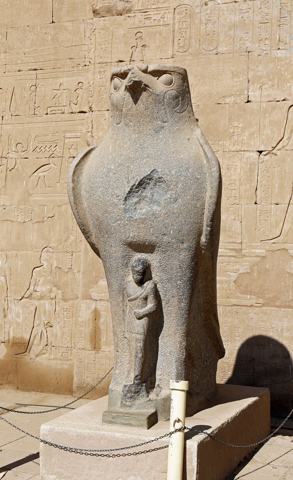
The sky falcon — god of kingship whose torn-out eye became the symbol of healing, and who won Egypt's throne from Set after eighty years of litigation.
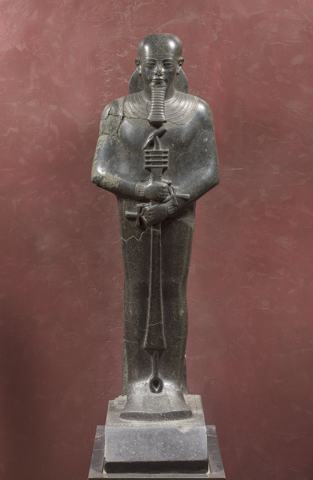
The creator who made the world by thinking it and speaking it — Ptah of Memphis, patron of sculptors and architects, and lord of the Apis bull.
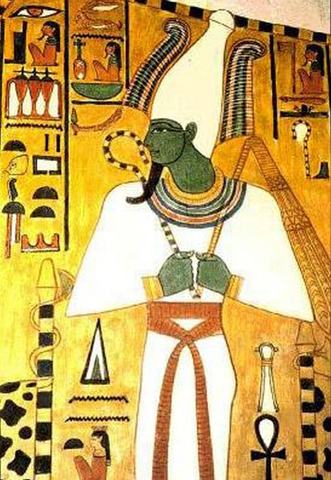
Lord of the afterlife — the murdered king remade as the first mummy, whose resurrection promised every Egyptian a life beyond the grave.
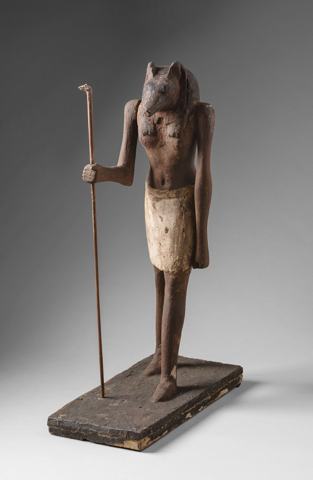
God of chaos — the red god of storm and desert who murdered Osiris, yet stood in the sun's boat each night to spear the serpent of nonexistence.
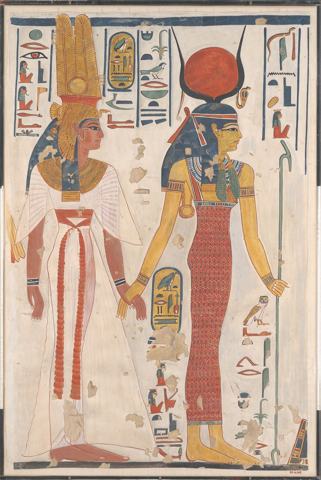
Goddess of magic — the widow whose spells restored Osiris, the mother who hid Horus in the marshes, and the one Egyptian deity Rome adopted whole.
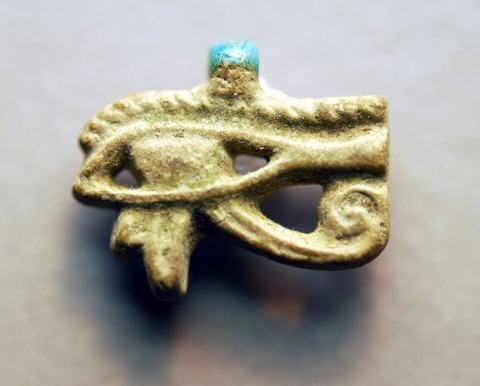
The healed eye of Horus, ancient Egypt's emblem of offering and protection — and the source of a math myth modern scholars have debunked.
Also mentioned inRa
Sources & Further Reading
- 1.Pyramid Texts (Old Kingdom, c. 2400–2300 BCE).
- 2.Papyrus Bremner-Rhind (British Museum EA 10188, Ptolemaic period; cosmogonic hymns to Atum).
- 3.Papyrus Chester Beatty I, The Contendings of Horus and Seth (Ramesside, c. 1160 BCE).
- 4.Plutarch, On Isis and Osiris (Moralia, 1st–2nd century CE).
- 5.Allen, James P. Genesis in Egypt: The Philosophy of Ancient Egyptian Creation Accounts. Yale Egyptological Studies 2. Yale Egyptological Seminar, 1988.
- 6.Hornung, Erik. Conceptions of God in Ancient Egypt: The One and the Many. Trans. John Baines. Cornell University Press, 1982.
- 7.Wilkinson, Richard H. The Complete Gods and Goddesses of Ancient Egypt. Thames & Hudson, 2003.
- 8.Pinch, Geraldine. Egyptian Mythology: A Guide to the Gods, Goddesses, and Traditions of Ancient Egypt. Oxford University Press, 2002.
Spot an error or have a source to suggest? Write to info@viseterna.com. We cite primary sources and modern scholarship, and we correct fast.