
Ptah
The creator who made the world by thinking it and speaking it — Ptah of Memphis, patron of sculptors and architects, and lord of the Apis bull.
Statue of the god Ptah, granodiorite, 18th Dynasty, c. 1390–1352 BCE (Museo Egizio, Turin, C 86) · CC0 · source
The God in the Shroud
Ptah is the most visually restrained of the great Egyptian gods. He is shown as a man wrapped like a mummy, hands free at the front, wearing a close-fitting blue skullcap and a straight, squared-off divine beard, and gripping a single tall staff that fuses three signs: the was of dominion, the djed of stability and the ankh of life. He often stands on a plinth shaped like the hieroglyph for maat, the plumb-line of truth and correct measure 5,6. No animal head, no crown of horns or plumes — the iconography of a god whose business is the making of things rather than the ruling of them.
His home was Memphis, at the junction of Upper and Lower Egypt. One of the city's names, Hut-ka-Ptah, "Mansion of the ka of Ptah", is generally accepted as the source, by way of Greek Aigyptos, of the modern word Egypt — the country named after this god's temple 5,6.
Creation by Heart and Tongue
Egypt had several creation accounts and did not treat them as competitors. The Heliopolitan version has Ra-Atum bring the world out of his own body. The Memphite version, preserved on the Shabaka Stone, argues instead that Ptah conceived the world in his heart — the Egyptian seat of thought — and brought it into being by speaking its names, so that everything from the gods to the towns to the offerings on the altar exists because Ptah thought it and said it 1,5,6.
The text goes out of its way to place Ptah above the Heliopolitan scheme, presenting Atum and the Ennead as themselves products of his conception and utterance. Commentators have often compared the argument to the Greek logos or to the opening of the Gospel of John, and Hermann Junker's edition helped make it famous as an early example of speculative theology 7. The comparison should be handled carefully: the Egyptian text is a temple document making a claim for a particular city's god, not a philosophical treatise, and the resemblance may be structural rather than genealogical 5,6.
The stone itself has a history worth telling. It is a black slab of greywacke set up by the Kushite king Shabaka in the eighth century BCE, whose introduction states that the king found a worm-eaten document and had it copied afresh onto stone. The slab was later reused as a millstone, which destroyed the text down the middle. Egyptologists once accepted the claim of great antiquity at face value and dated the composition to the Old Kingdom; linguistic study has since pushed most estimates later, to the Ramesside period or the Twenty-Fifth Dynasty itself, and the question remains genuinely open 1,5,6.
Patron of Craftsmen
Ptah's creative act is a craftsman's act, and his priesthood reflected it: the high priest of Ptah at Memphis carried the title wer kherep hemut, "Greatest of the Directors of Craftsmen" 5,6. Sculptors, metalworkers, stonemasons, carpenters and architects all worked under his authority, and the workmen of Deir el-Medina, who cut the royal tombs, left votive stelae to him in numbers.
That link extends into ritual. The Opening of the Mouth ceremony, which animated a statue or a mummy so that it could breathe, eat and see, was performed with an adze — a sculptor's tool — and the texts associate the rite with Ptah and the craft workshops where divine images were made 5,6. Making and enlivening were the same operation seen at two stages.
The famous mythologised craftsman Imhotep, architect of the Step Pyramid, was eventually deified and treated as a son of Ptah, which extended the god's reach into healing and learning 5,6.
Triad, Composites and the Apis Bull
At Memphis Ptah headed a triad with the lion-headed Sekhmet as his consort and the lotus god Nefertem as their son — the artisan, the destroyer and the fragrance of the new sun, which is about as compact a statement of Egyptian theology as the sources offer 5. In funerary religion he fused with the Memphite necropolis god Sokar and with Osiris to form Ptah-Sokar-Osiris, whose painted wooden figures, hollowed to hold a rolled papyrus, are among the most common objects in Late Period burials 5,6.
His most spectacular associate was an animal. The Apis bull, a living black bull selected by specific markings, was kept at Memphis as the herald and living manifestation of Ptah; on its death it was mummified with full ceremony and interred in the vast underground galleries of the Serapeum at Saqqara, rediscovered by Auguste Mariette in 1851 4,5,6. Herodotus describes the Apis and the outrage caused when the Persian king Cambyses was said to have wounded it, an anecdote that later Egyptian and Greek sources repeat and that modern historians treat with scepticism 4.
Greeks, Amulets and Reach
The Greeks equated Ptah with Hephaestus, the divine smith, and Herodotus refers to the great Memphite temple throughout as the temple of Hephaestus, recording that successive pharaohs added pylons and colossi to it 4,5. He also mentions the small dwarf figures kept in its precinct, comparing them to the Phoenician pataikoi — a description usually connected to the widespread Egyptian amulets of a squat, dwarf-shaped protective form of Ptah, worn against snakes, scorpions and hostile magic 4,6.
Ptah's cult was never confined to Memphis. He is attested at Ramesside sites across the empire, including the rock temples of Nubia, where the second of the sanctuaries at Abu Simbel places him among the four seated gods in the innermost chamber. For a god who made the world by having an idea about it, he did unusually well in stone.
Continue Exploring
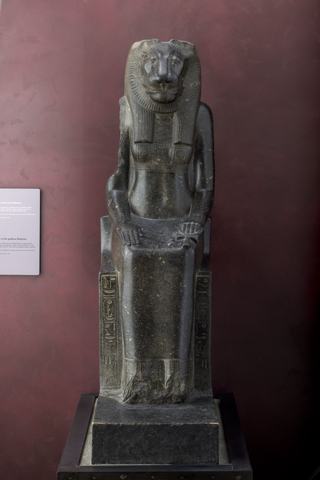
The lion-headed Eye of Ra — Sekhmet is slaughter, fever and desert heat, and the same power that heals when the gods can persuade her to stop.
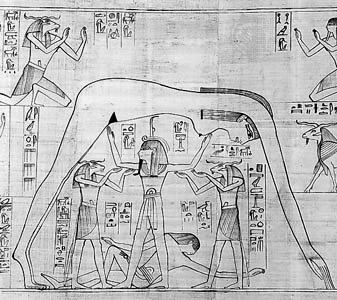
The nine gods of Heliopolis's creation myth, from self-made Atum down to Osiris, Isis and Set — and the tribunal that judged their heirs.
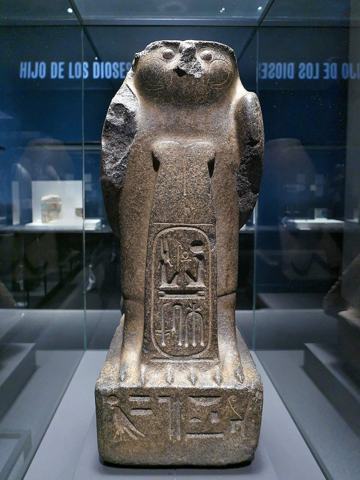
The sun itself as a god — Ra sails the sky by day, fights the serpent of chaos by night, and is reborn on the horizon every dawn.
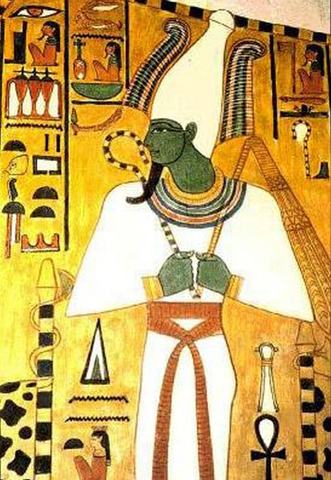
Lord of the afterlife — the murdered king remade as the first mummy, whose resurrection promised every Egyptian a life beyond the grave.
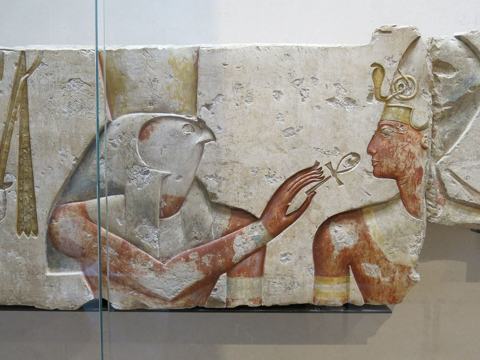
The looped cross Egyptian gods hand to kings on every temple wall, the hieroglyph for life itself, worn as an amulet for three thousand years.
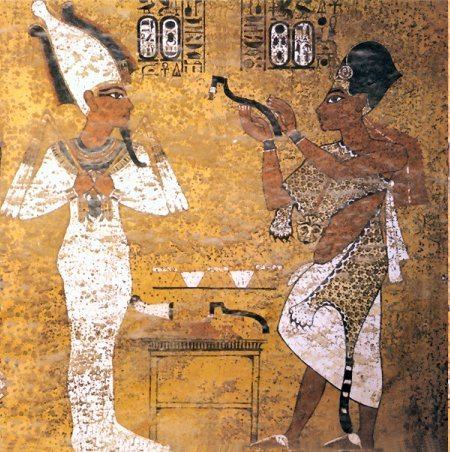
The Egyptian rite that restored a mummy's or statue's senses — touching sacred tools to its face so it could eat, see, and speak again.
Sources & Further Reading
- 1.The Memphite Theology, inscribed on the Shabaka Stone (British Museum EA 498), 25th Dynasty copy of an older text.
- 2.Pyramid Texts (Old Kingdom, c. 2400–2300 BCE).
- 3.The Great Hymn to Ptah (Papyrus Berlin 3048), New Kingdom.
- 4.Herodotus, Histories II.99, II.101, II.153 and III.37 (c. 430 BCE).
- 5.Wilkinson, Richard H. The Complete Gods and Goddesses of Ancient Egypt. Thames & Hudson, 2003.
- 6.Pinch, Geraldine. Egyptian Mythology: A Guide to the Gods, Goddesses, and Traditions of Ancient Egypt. Oxford University Press, 2002.
- 7.Junker, Hermann. Die Götterlehre von Memphis (Schabaka-Inschrift). Abhandlungen der Preussischen Akademie der Wissenschaften, 1940.
Spot an error or have a source to suggest? Write to info@viseterna.com. We cite primary sources and modern scholarship, and we correct fast.