
Thoth
Ibis-headed lord of writing, reckoning and the moon — Thoth keeps the record at the judgment of the dead and settles the quarrels of the gods.
Nefertari before Thoth, wall painting in the Tomb of Nefertari (QV66), c. 1255 BCE; archive photograph 1904-1935 (Museo Egizio, Turin, E00616) · CC0 · source
The God with the Ibis Head
Thoth is the Greek rendering of the Egyptian Djehuty, a name whose etymology is still argued over but which the Egyptians themselves connected with djehu, the ibis 5,6. He appears in two animal bodies: as a man with the long down-curved beak and black-and-white plumage of the sacred ibis, and as a squatting hamadryas baboon, usually crowned with the lunar disk and crescent. Ancient commentators linked the ibis's curved bill and the baboon's dawn chattering to the moon and the sunrise respectively, though modern scholars treat those explanations as later rationalisations of much older cult animals 5,6.
His principal cult centre was Khemenu — "Eight-Town" — which the Greeks renamed Hermopolis Magna after identifying Thoth with their own Hermes. The name refers to the Ogdoad, the eight primordial deities of the Hermopolitan creation account, arranged in four male-female pairs personifying the darkness, the hidden, the boundless and the watery inertness that preceded the world. Thoth stands over that group as its lord and, in some texts, as the voice whose speech shapes what the Ogdoad made possible 5,6,7.
Scribe, Reckoner, Keeper of Time
Egyptian writing was medu-netjer, "the god's words", and Thoth was its author. Every scribe worked under his patronage; scribal students poured a drop from the water-pot in his honour before starting work, and the palettes of the profession were dedicated to him 5,6. From writing follow the rest of his offices. He measures — surveying land, reckoning quantities, apportioning shares. He counts time, dividing the year into months and marking the seasons, so that the first month of the Egyptian civil year bore his name (Thoth, from which the Coptic Thout) 5,6.
Because he keeps the record, he also keeps the truth of it. The Pyramid Texts already have him ferrying and vouching for the dead king, and by the New Kingdom his role is fixed: in the vignette of Spell 125 of the Book of Going Forth by Day, while Anubis adjusts the balance that weighs the heart against the feather of Maat, Thoth stands beside it with palette and reed, writing down the verdict and announcing it to Osiris 1,2. It is a bureaucratic image, and deliberately so — the Egyptian afterlife is administered, and Thoth is the clerk whose word is final.
Arbiter Among the Gods
Thoth's second great function is judicial. In the long, often bawdy account of The Contendings of Horus and Seth, the tribunal of gods spends eighty years unable to decide whether Horus or Set should inherit the throne; Thoth is the one who drafts the letters, proposes procedures and eventually reads out the ruling in Horus's favour 3. Elsewhere he is the healer of the injury that the conflict caused: when Set tears out Horus's eye, it is Thoth who restores it, and the restored wedjat eye — the "sound" eye — becomes the standard Egyptian emblem of wholeness and protection 3,5.
The moon supplies a related story, though the surviving version is a Greek one. Plutarch reports that the sky goddess Nut was forbidden to give birth on any day of the year, so Hermes — his name for Thoth — played at draughts with the moon, won a seventieth part of each of her illuminations, and assembled the winnings into five extra days on which Osiris, Horus, Set, Isis and Nephthys could be born 4. Egyptologists caution that Plutarch writes late, in Greek, and for a Greek audience, and that no Egyptian text preserves the game itself; the five epagomenal days at the end of the year are nonetheless genuinely Egyptian, and were genuinely the birthdays of those five gods 4,5.
Magic, Medicine and the Books
Because words written correctly have force, Thoth is also the master of heka, the operative power the Egyptians recognised in speech and ritual. Healing spells routinely borrow his authority — the reciter speaks as Thoth, and the patient becomes the injured Horus whom he cured 5,6. A body of literature grew up around the idea of secret books he had written and hidden; the Demotic tale of Setne Khamwas turns on a scroll of Thoth whose possession ruins everyone who touches it 6.
That thread outlived pharaonic religion. In the Roman period the Greek Hermes and the Egyptian Thoth fused into Hermes Trismegistus, "thrice-great Hermes", the supposed author of the Hermetic writings that would run on through Byzantine, Islamic and Renaissance thought — one of the longest afterlives any Egyptian god has had, though scholars stress that the Hermetica are products of Greco-Egyptian philosophical circles rather than a straightforward continuation of the Khemenu cult 6.
Cult and Sacred Animals
The physical scale of Thoth's worship is startling. At Tuna el-Gebel, the necropolis of Hermopolis, and in the ibis galleries at Saqqara, excavators have found catacombs packed with mummified ibises and baboons deposited as votive offerings by pilgrims — estimates for the ibis burials run into the millions across the Late and Ptolemaic periods, sustained by dedicated breeding operations 5,6. Royal patronage came earlier: several New Kingdom kings, among them Thutmose ("Thoth is born"), carried his name, which Wilkinson reads as a sign of how central the god had become to the crown as well as to the scribal class 5.
Erik Hornung's caution about Egyptian theology applies well here — Thoth is not a tidy department head but a node in a shifting network, at Hermopolis a creator, at the balance a recorder, in the sickroom a magician, and in the tribunal a judge, without any of those roles cancelling the others 7.
Continue Exploring
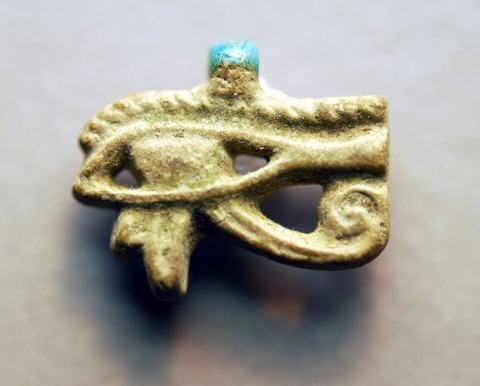
The healed eye of Horus, ancient Egypt's emblem of offering and protection — and the source of a math myth modern scholars have debunked.
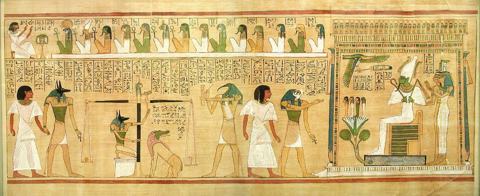
Egypt's judgment of the dead: the heart set on a scale against the feather of Maat, with oblivion waiting for whichever side tips wrong.
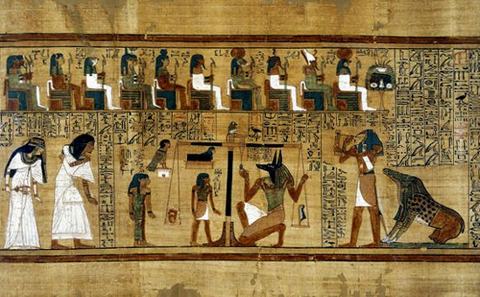
The New Kingdom funerary spells the Egyptians called "Going Forth by Day" — copied for the dead, and renamed the Book of the Dead by Lepsius in 1842.
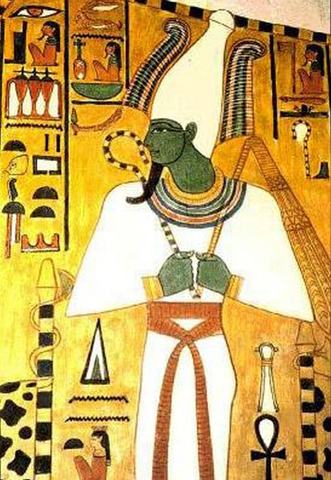
Lord of the afterlife — the murdered king remade as the first mummy, whose resurrection promised every Egyptian a life beyond the grave.
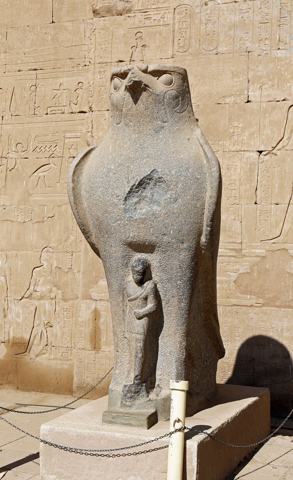
The sky falcon — god of kingship whose torn-out eye became the symbol of healing, and who won Egypt's throne from Set after eighty years of litigation.
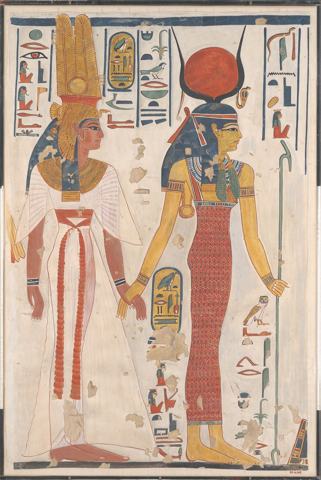
Goddess of magic — the widow whose spells restored Osiris, the mother who hid Horus in the marshes, and the one Egyptian deity Rome adopted whole.
Also mentioned inMa'atNut and Geb (Egyptian Sky and Earth)
Sources & Further Reading
- 1.Pyramid Texts (Old Kingdom, c. 2400–2300 BCE).
- 2.The Egyptian Book of the Dead (Book of Going Forth by Day), especially Spell 125, New Kingdom.
- 3.The Contendings of Horus and Seth (Papyrus Chester Beatty I, 20th Dynasty).
- 4.Plutarch, On Isis and Osiris (Moralia V), c. 100 CE.
- 5.Wilkinson, Richard H. The Complete Gods and Goddesses of Ancient Egypt. Thames & Hudson, 2003.
- 6.Stadler, Martin A. "Thoth." UCLA Encyclopedia of Egyptology, 2012.
- 7.Hornung, Erik. Conceptions of God in Ancient Egypt: The One and the Many. Trans. John Baines. Cornell University Press, 1982.
Spot an error or have a source to suggest? Write to info@viseterna.com. We cite primary sources and modern scholarship, and we correct fast.