
Ankh (Egyptian Symbol of Life)
The looped cross Egyptian gods hand to kings on every temple wall, the hieroglyph for life itself, worn as an amulet for three thousand years.
Horus offering the ankh to Ramesses II, painted limestone relief (Musee du Louvre) · Public domain · source
A Sign Older Than Its Explanations
The ankh — the looped cross that is Egyptian writing's most familiar symbol — is first of all a word: the ordinary hieroglyphic sign for life, used to write "to live," "living," and "life" itself from the Early Dynastic Period onward, roughly three thousand years before anyone outside Egypt had reason to draw it 5,7. What the shape itself represents is unsettled. Proposals on record include a sandal strap seen from above, a ritual knot or girdle, and a stylised union of male and female generative signs, and Egyptologists have not converged on any one of them; the safest statement is that the Egyptians themselves left no text explaining the design, only three thousand years of confident use 5,7.
Life Given by the Gods' Hands
Its commonest setting is not an amulet case but a temple wall. In relief after relief a god extends an ankh to the nose or lips of the reigning king, delivering "life" the way a physical object might be handed over, much as the healed Eye of Horus stood for a restored offering — though the ankh's message is more general, life given outright rather than a wound made good 1,7. Akhenaten's Amarna theology pushed the image to its logical extreme: the god Aten, worshipped as the visible sun disc alone, is shown with rays ending in small human hands, several of which hold out ankh signs to the king, his queen Nefertiti, and their daughters, an idea spelled out in the Great Hymn inscribed in the tomb of the courtier Ay 1,3. The same gesture appears wherever a falcon-headed Horus or Ra faces a pharaoh in New Kingdom temple decoration, making the ankh less a static symbol than a small recurring drama of transfer, repeated on nearly every wall built to celebrate a living king 1,7.
Amulet, Mirror, and Grave Good
Outside temple relief the ankh was worn. Faience and gold ankh amulets are common finds in burials and among the jewellery of the living, threaded singly or worked into pectorals and collars as one more claim on continued life, and Book of the Dead spells that list the amulets to be bound into a mummy's wrappings include it among the protective set laid on the body 2,4. The connection ran deeper than decoration: Wilkinson notes that the everyday Egyptian word for a hand mirror was itself ankh, and that mirrors were sometimes cast or mounted with ankh-shaped handles, so that a woman's reflection and a symbolic gift of life were, in the language, the same object 5.
Life, Stability, and Dominion
The ankh rarely appears alone in formal decoration. It is one of a standard trio with the djed pillar, Osiris's emblem of stability, and the was sceptre, a symbol of dominion, and the three together — life, stability, dominion — recur as a set on temple friezes, furniture legs, and royal regalia throughout pharaonic art 5,7. As a group they read almost like a wish spoken over the king each time they are carved: that his reign continue, stand firm, and command.
An Afterlife Outside Egypt
Egyptian Christians of the Roman and early Byzantine periods knew the sign too. At some Egyptian Christian sites the ankh's outline was taken up as a form of cross, the crux ansata, read by at least some communities as an old word for life absorbed into a new one, though how widespread or deliberate that borrowing was remains debated rather than settled fact 6. Its most recent revival is entirely secular: Egyptian Revival jewellery after the nineteenth-century opening of the country to European travel, and again after the 1922 discovery of Tutankhamun's tomb, carried the ankh into mainstream Western ornament, from which it passed into twentieth-century counterculture and gothic fashion as a generic emblem of "ancient Egypt" largely detached from the offering scenes that had carried its original meaning 7.
Continue Exploring
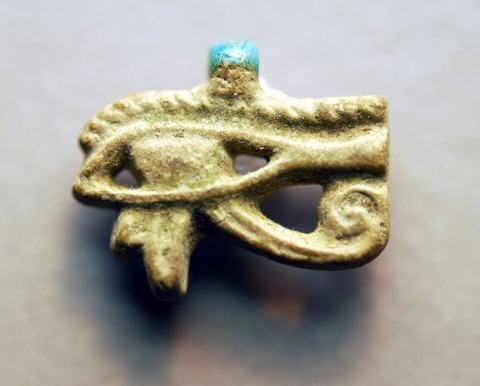
The healed eye of Horus, ancient Egypt's emblem of offering and protection — and the source of a math myth modern scholars have debunked.
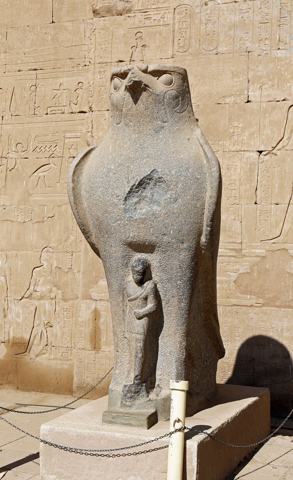
The sky falcon — god of kingship whose torn-out eye became the symbol of healing, and who won Egypt's throne from Set after eighty years of litigation.
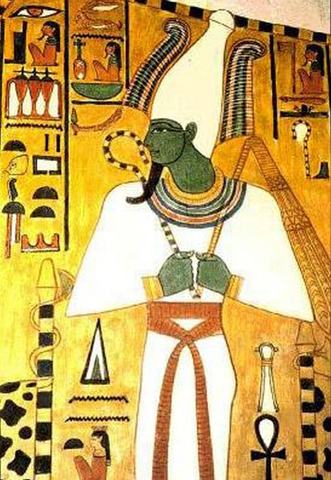
Lord of the afterlife — the murdered king remade as the first mummy, whose resurrection promised every Egyptian a life beyond the grave.
The sun itself as a god — Ra sails the sky by day, fights the serpent of chaos by night, and is reborn on the horizon every dawn.
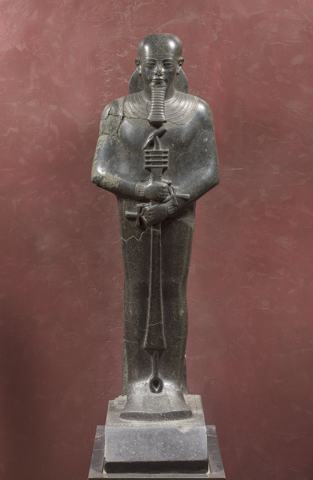
The creator who made the world by thinking it and speaking it — Ptah of Memphis, patron of sculptors and architects, and lord of the Apis bull.
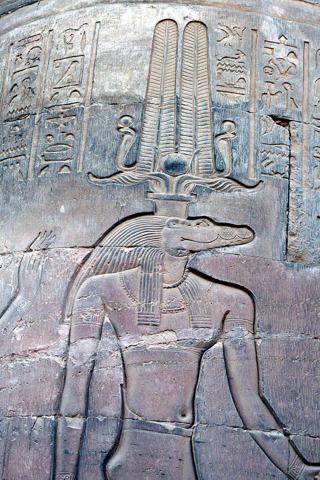
Crocodile god of the Nile, the marshes and raw pharaonic power — Sobek is the danger in the water turned into a protector, worshipped with living crocodiles.
Also mentioned inSekhmet
Sources & Further Reading
- 1.Pyramid Texts (Old Kingdom, c. 2400–2300 BCE).
- 2.The Egyptian Book of the Dead (Book of Going Forth by Day), New Kingdom.
- 3.The Great Hymn to the Aten, tomb of Ay at Amarna (18th Dynasty, c. 1350 BCE).
- 4.Andrews, Carol. Amulets of Ancient Egypt. British Museum Press, 1994.
- 5.Wilkinson, Richard H. Symbol & Magic in Egyptian Art. Thames & Hudson, 1994.
- 6.Assmann, Jan. Death and Salvation in Ancient Egypt. Cornell University Press, 2005.
- 7.Pinch, Geraldine. Egyptian Mythology: A Guide to the Gods, Goddesses, and Traditions of Ancient Egypt. Oxford University Press, 2002.
Spot an error or have a source to suggest? Write to info@viseterna.com. We cite primary sources and modern scholarship, and we correct fast.