
The Pyramid Texts
The oldest surviving body of religious literature on Earth — spells carved inside Old Kingdom pyramids to launch the king into the sky as a god.
Pyramid Texts (utterances 302–312), antechamber, Pyramid of Unas, Saqqara, c. 2350 BC · Public domain · source
The Oldest Religious Texts on Earth
The Pyramid Texts are the earliest surviving body of connected religious writing anywhere in the world: several hundred distinct spells, which Egyptologists call "utterances," carved in finely cut hieroglyphs on the walls of pyramid corridors and burial chambers at the end of the Old Kingdom 1,5. No single pyramid preserves them all — Egyptologists count roughly 760 utterances across every known source combined, and each pyramid carries only a selection, arranged differently from the next 5. They begin, so far as anyone has found, with the pyramid of King Unas at the very end of the Fifth Dynasty, and continue through the Sixth Dynasty kings Teti, Pepi I, Merenre and Pepi II, several Sixth Dynasty queens consort to Pepi I and Pepi II, and the minor Eighth Dynasty king Ibi 1,5.
Found at Saqqara, 1881
The French Egyptologist Gaston Maspero broke into the burial chamber of Unas's pyramid at Saqqara in 1881 and found its walls, floor to ceiling, covered in vertical columns of hieroglyphs still filled with their original blue-green pigment 1,2. It was the first time anyone in the modern era had seen writing of this kind inside a pyramid, since earlier explorers had assumed the Old Kingdom pyramids were undecorated, and Maspero began publishing the texts within the year, followed over the next several seasons by the similarly inscribed pyramids of Teti, Pepi I, Merenre and Pepi II at the same site 2.
What the Spells Actually Do
The Pyramid Texts are not narrative myth but ritual utterance, written to be spoken over the dead king and to act on his behalf: offering formulas that supply him with food and drink forever, spells protecting his body from snakes and decay, and above all spells that get him into the sky among the imperishable, never-setting stars 1,5. Utterance 273–274, nicknamed by modern scholars the "Cannibal Hymn," has the king hunting down and devouring the gods themselves to absorb their powers before his ascent — one of the most startling passages in Egyptian literature, and a reminder that Old Kingdom funerary religion could be considerably less decorous than later periods preferred 4,5. Elsewhere the king is identified with the rising sun god Ra and with Osiris in the same breath, a doubling of divine models that later funerary literature keeps rather than resolves 5.
Sethe's Numbering, and an Argument About Order
The standard reference numbers for individual spells — "PT §" followed by a paragraph number — come from Kurt Sethe's edition of 1908–1922, the first attempt to lay every known utterance from every pyramid side by side 3. Sethe's numbering remains universal, but the order it implies is not the order carved on any actual wall: each pyramid distributes its chosen utterances across its rooms according to its own logic, and Egyptologists still disagree about how much of that arrangement reflects real ritual sequence, architectural symbolism, or simple decorative convenience 5,6. Hays's study of the corpus argues the texts are best understood not as one continuous composition at all but as a flexible toolkit, assembled anew for each king from a shared stock 6.
From the King's Privilege to Everyone's Coffin
Access to these spells was, at first, a royal monopoly — carving them required a king's resources and, theologically, a king's exclusive claim to an afterlife among the gods 1,5. That monopoly broke down within a few generations of the Old Kingdom's collapse, as provincial officials of the First Intermediate Period adapted a substantial share of the same material, together with new compositions, and had it painted inside their own wooden coffins instead of carved on chamber walls, producing what modern scholars call the Coffin Texts. That tradition, expanded again in the New Kingdom, became the direct ancestor of the Book of the Dead 4,5.
Modern Study and Disagreement
Faulkner's 1969 translation made the whole corpus available in English for the first time, keeping Sethe's numbering; Allen's 2005 translation reorganises the same material by pyramid and by wall, arguing that reading each pyramid's texts in their actual carved sequence recovers meaning that Sethe's paragraph order obscures 3,4. The disagreement is not cosmetic — it is a live argument about whether the Pyramid Texts were composed as a fixed liturgy or assembled, wall by wall, for a specific king's specific tomb, and it shapes how each translation is organised on the page 4,5,6.
Continue Exploring
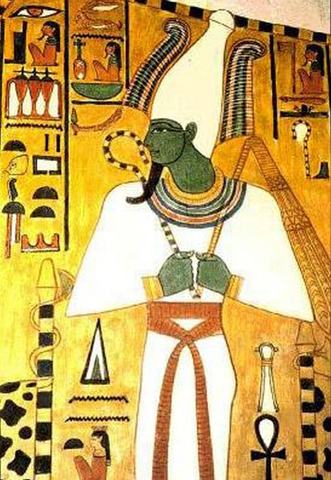
Lord of the afterlife — the murdered king remade as the first mummy, whose resurrection promised every Egyptian a life beyond the grave.
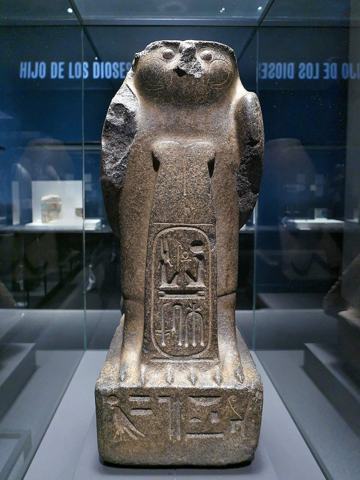
The sun itself as a god — Ra sails the sky by day, fights the serpent of chaos by night, and is reborn on the horizon every dawn.
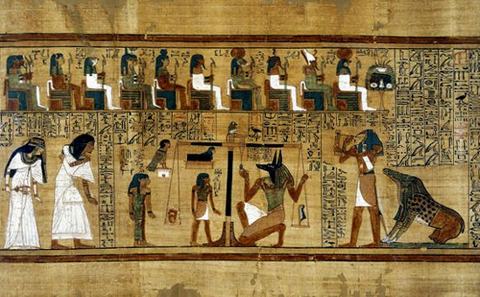
The New Kingdom funerary spells the Egyptians called "Going Forth by Day" — copied for the dead, and renamed the Book of the Dead by Lepsius in 1842.
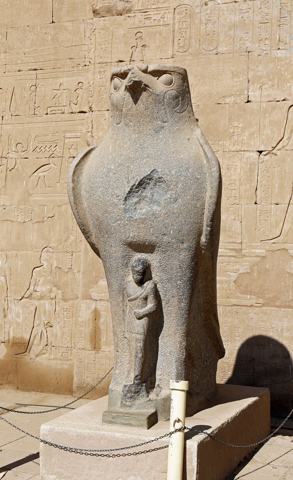
The sky falcon — god of kingship whose torn-out eye became the symbol of healing, and who won Egypt's throne from Set after eighty years of litigation.
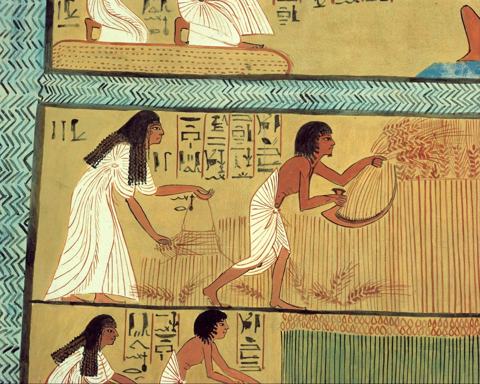
The Egyptian underworld — the night country crossed by the sun in twelve hours and by every dead Egyptian hoping to come out reborn at dawn.
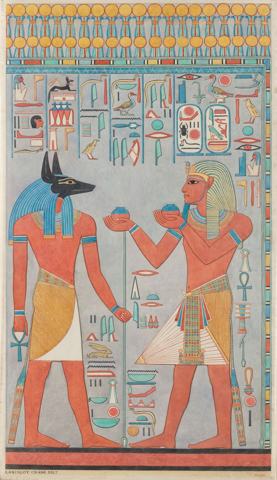
Guardian of the dead — the black jackal god who embalmed Osiris, watched over the necropolis, and weighed the heart against the feather of truth.
Sources & Further Reading
- 1.The Pyramid Texts, Pyramid of Unas, Saqqara (5th Dynasty, c. 2350 BCE).
- 2.Maspero, Gaston. Recueil de travaux relatifs à la philologie et à l'archéologie égyptiennes et assyriennes, vols. 3–5 (1882–1884) — first publication of the Unas texts, discovered 1881.
- 3.Sethe, Kurt. Die altägyptischen Pyramidentexte. 4 vols. Leipzig: J. C. Hinrichs, 1908–1922.
- 4.Faulkner, Raymond O., trans. The Ancient Egyptian Pyramid Texts. Oxford: Clarendon Press, 1969.
- 5.Allen, James P., trans. The Ancient Egyptian Pyramid Texts. Writings from the Ancient World 23. Society of Biblical Literature, 2005.
- 6.Hays, Harold M. The Organization of the Pyramid Texts: Typology and Disposition. Probleme der Ägyptologie 31. Leiden: Brill, 2012.
Spot an error or have a source to suggest? Write to info@viseterna.com. We cite primary sources and modern scholarship, and we correct fast.