
Nut and Geb (Egyptian Sky and Earth)
Sky and earth, once locked together and forced apart at creation — she swallows the sun each night, he lies beneath every field and tomb in Egypt.
Nut, Shu, and Geb, Greenfield Papyrus (Book of the Dead of Nesitanebtashru), c. 950 BC (British Museum) · Public domain · source
A Marriage Pulled Apart
Nut and Geb are sky and earth as a divorced couple, and Egyptian cosmogony is unusually blunt about the separation being forced. In the Heliopolitan creation scheme, the self-created Atum (identified with Ra) produces Shu, god of air, and Tefnut, goddess of moisture; that pair in turn produces Nut and Geb, who are born locked in permanent embrace 1,6. Shu, their own father, forces himself between them, lifting Nut's body into the vault of the sky while Geb's remains stretched out below as the ground — a genealogy that makes the visible world, quite literally, the wreckage of a family argument 5,6. Later texts add a second version, in which the sun god orders the separation because he cannot rise through his grandchildren's tangled bodies, which makes the same physical fact — sky and earth, once touching, now held apart by the height of the air — into an act of cosmic administration rather than domestic cruelty 5.
What They Look Like
Egyptian artists solved sky and earth with one of the most recognisable compositions in their whole repertoire. Nut is a woman arched on her toes and fingertips over the scene, her body the vault of heaven, sometimes covered in stars, sometimes shown as a cow whose belly is the sky and whose legs are held up by supporting gods; Geb lies beneath her, often painted green or black for growing and fertile soil, sometimes ithyphallic, reaching up toward the wife he can no longer touch 3,4. The tableau appears on temple ceilings, sarcophagus lids, and funerary papyri, with Shu standing between them, arms raised, and in later versions flanked by ram-headed Heh gods lending their strength to hold the sky up for eternity 4,6.
The Goddess Who Eats the Sun
Nut's most striking role is astronomical bookkeeping performed as digestion. Each evening she swallows the sun and the stars; each dawn she gives birth to them again, which made her, in Egyptian thinking, both mother and grave of the sun without contradiction 3,6. The Book of the Heavenly Cow, painted in New Kingdom royal burial chambers, develops this into a full myth: an aging Ra, weary of ruling and angered by human rebellion, withdraws from the earth entirely and climbs onto the back of Nut in her cow form, who lifts him into the sky and becomes so dizzy at the height that four gods have to stand at her legs to steady her 3. It is one of the few Egyptian myths that reads as an explanation for why the gods are now remote from human affairs at all — heaven used to be within reach, and this is the story of it moving away 3,6.
The Days Outside the Year
Nut's fertility caused a calendar problem the gods had to solve by cheating. According to the version of the story preserved by Plutarch but rooted in genuinely Egyptian material, the sun god decreed that Nut could not give birth on any day of the 360-day year, since Geb was not meant to have heirs; Thoth, gambling with the moon, won enough extra light to assemble five additional days outside the calendar altogether, and on those five epagomenal days Nut bore Osiris, Horus the Elder, Set, Isis, and Nephthys 6,7. The five days were genuinely marked in the Egyptian civil calendar as the birthdays of these five gods, a rare case of an origin story built to patch an actual administrative gap 6.
Geb and the Throne of Egypt
Geb is more than scenery. As the physical ground, he is the source of everything that grows from it, and Egyptian texts extend that literally to kingship: the throne itself is called "the throne of Geb," and a new pharaoh's coronation could be described as receiving "the inheritance of Geb," since the earth god was reckoned the mythical first king in the line that ran through Osiris, Horus, and every later ruler 6,7. Earthquakes were explained as Geb laughing, a detail that keeps him, alone among the very abstract cosmic pairs, faintly personable 6. He also had a darker administrative role in the afterlife: certain funerary texts place him as a judge alongside the tribunal that assesses the dead, guarding the entrance the deceased must pass through to reach the fields beyond 2,6.
Nut Inside the Tomb
Nowhere was Nut more important than on the object closest to an Egyptian's actual body after death. Coffin lids and sarcophagus interiors from the Middle Kingdom onward were routinely painted or carved with her image stretched across the inside, so that the dead lay literally inside the sky goddess, awaiting the same daily rebirth she gave the sun 2,6. The Pyramid Texts already promise the king this embrace directly, addressing Nut and asking her to spread herself over him so that he might be placed among the imperishable stars, safe from death a second time 1,6. The Greenfield Papyrus scene of Nut arched over Geb, copied for the funeral of the priestess Nesitanebtashru around 950 BCE, is one of the clearest surviving versions of this image, painted specifically to reassure a dead woman that the sky would still open for her, every single morning, the way it always had 4,7.
Continue Exploring
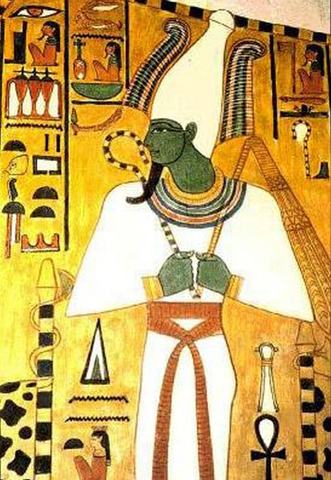
Lord of the afterlife — the murdered king remade as the first mummy, whose resurrection promised every Egyptian a life beyond the grave.
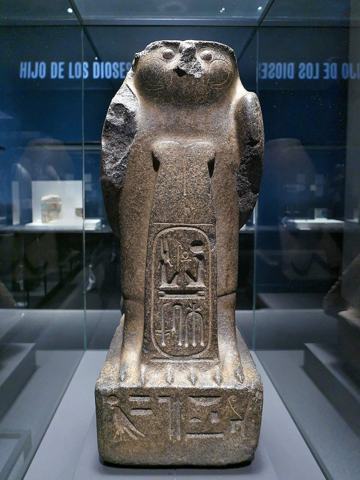
The sun itself as a god — Ra sails the sky by day, fights the serpent of chaos by night, and is reborn on the horizon every dawn.
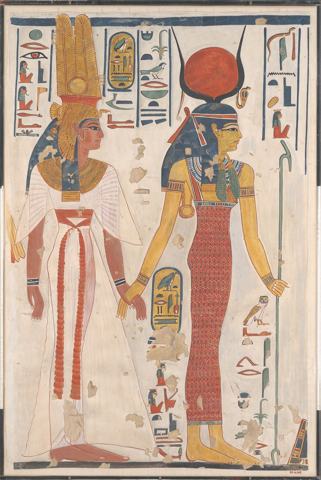
Goddess of magic — the widow whose spells restored Osiris, the mother who hid Horus in the marshes, and the one Egyptian deity Rome adopted whole.
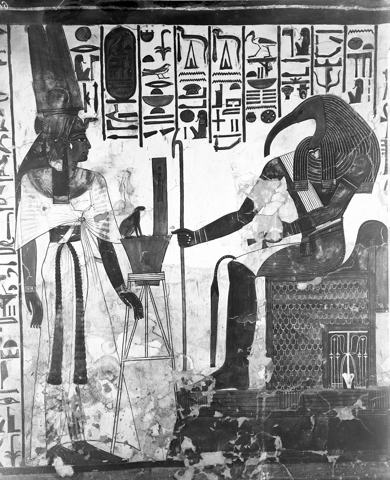
Ibis-headed lord of writing, reckoning and the moon — Thoth keeps the record at the judgment of the dead and settles the quarrels of the gods.
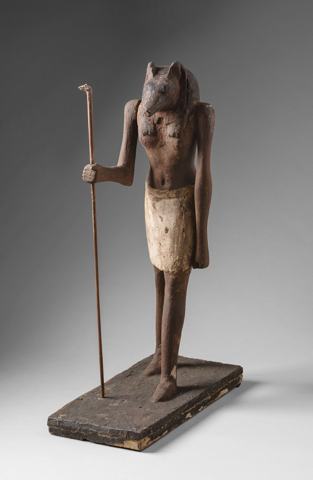
God of chaos — the red god of storm and desert who murdered Osiris, yet stood in the sun's boat each night to spear the serpent of nonexistence.
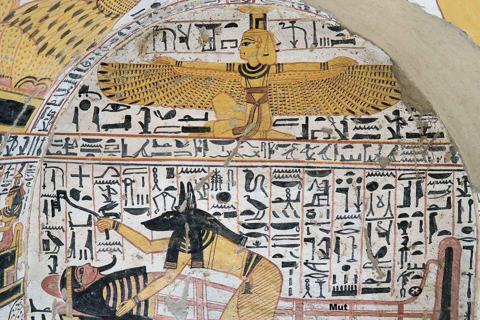
Isis's quieter sister — the mourner who helped restore Osiris, was seduced or seducer in Anubis's birth, and stood at the head of every Egyptian coffin.
Sources & Further Reading
- 1.Pyramid Texts (Old Kingdom, c. 2400-2300 BCE).
- 2.Coffin Texts (Middle Kingdom, c. 2100-1800 BCE).
- 3.The Book of the Heavenly Cow, New Kingdom royal tombs.
- 4.The Greenfield Papyrus (Book of the Dead of Nesitanebtashru), c. 950 BCE (British Museum).
- 5.Rundle Clark, R. T. Myth and Symbol in Ancient Egypt. Thames & Hudson, 1959.
- 6.Wilkinson, Richard H. The Complete Gods and Goddesses of Ancient Egypt. Thames & Hudson, 2003.
- 7.Pinch, Geraldine. Egyptian Mythology: A Guide to the Gods, Goddesses, and Traditions of Ancient Egypt. Oxford University Press, 2002.
Spot an error or have a source to suggest? Write to info@viseterna.com. We cite primary sources and modern scholarship, and we correct fast.