
Anubis
Guardian of the dead — the black jackal god who embalmed Osiris, watched over the necropolis, and weighed the heart against the feather of truth.
The King with Anubis, Tomb of Haremhab, c. 1323-1295 BC; facsimile by Lancelot Crane (Metropolitan Museum of Art), CC0 · CC0 · source
Who Anubis Was
Anubis is the Greek form of the Egyptian name Inpw (conventionally Anpu), the canine god who presided over embalming, over the desert cemeteries, and over the dead person's passage into judgment 5. He is one of the oldest deities attested in Egyptian records: he appears already in First Dynasty inscriptions and dominates the funerary spells of the Old Kingdom, where the king's protection and the offerings made at his tomb are repeatedly placed in Anubis's charge 1,5.
He was not a god of death in the sense of a killer or a devourer. Egyptian religion drew that distinction sharply. Anubis was the technician and the guardian of death — the one who made the corpse into something that could survive, and the one who saw the survivor safely to the tribunal 6.
The Black Canid and His Titles
The animal behind Anubis is usually called a jackal, though the long-eared, bushy-tailed creature of Egyptian art is better matched to the African wolf or a generalised desert canid; wild dogs genuinely haunted the cemeteries at the desert edge, and scholars have long read the god as an appropriation of that threat into a protective office 5. His pitch-black coat is not naturalistic. Black was the colour of embalmed, resin-darkened flesh and of the fertile Nile silt — in Egyptian symbolic terms, the colour of regeneration rather than of extinction 5,6.
His epithets are a job description. He is Khenty-imentiu, "Foremost of the Westerners" (the westerners being the dead) — a title later absorbed by Osiris as Osiris's cult rose 1,5. He is Neb-ta-djeser, "Lord of the Sacred Land," meaning the necropolis; Tepy-dju-ef, "He who is upon his mountain," the jackal couchant on the cliff above the tombs; and Imy-ut, "He who is in the place of embalming" 5. The imiut fetish — a headless animal skin tied to a pole set in a pot — stood in embalming chapels as his emblem 5,6.
Parentage and the Embalming of Osiris
Anubis's family shifts with the sources, which is normal for Egyptian theology rather than a contradiction to be resolved. Old and Middle Kingdom texts can make him a son of Ra 1,2. By the time Plutarch wrote up the Osiris cycle for a Greek readership, the current story made Anubis the son of Nephthys — conceived with Osiris, who mistook her for Isis — and afterwards found and raised by Isis herself 4.
The role that defined him in every period is his part in the death of Osiris. When Set killed Osiris, it was Anubis who wrapped and treated the body, producing the first mummy and so establishing the rite that every later Egyptian burial repeated 4,6. This is why the embalmer's workshop was his temple in miniature. The chief embalming priest bore the title sem and, in at least some rituals, wore a jackal-headed mask so that the god himself was understood to be performing the work; a surviving example of such a mask, in painted cartonnage, is known from the Roman-period cemeteries 6.
The Weighing of the Heart
The scene most people picture when they hear his name comes from Spell 125 of the Book of the Dead. The deceased is led into the Hall of the Two Truths, where the heart — the seat of character and memory — is set on a balance against the feather of Maat, truth and cosmic order 3. Anubis steadies the scales and reports the result; Thoth writes it down; the hybrid monster Ammit crouches beside the balance to swallow the heart of anyone who fails 3,6. Vindicated, the dead person is presented to Osiris and admitted to the afterlife in the Duat 3.
Papyri of the New Kingdom also show Anubis leading the deceased by the hand toward the balance, and kneeling at the mummy on its lion-shaped bier — the "opening of the mouth" and the final adjustments before burial 3,6. He is, throughout, the god of the procedure: correct, unbribable, and utterly non-negotiable.
Cult Centres and Worship
Anubis had no vast state temple on the scale of Karnak, because his sphere was the cemetery rather than the city. His principal cult centre was Hardai in the seventeenth Upper Egyptian nome, which the Greeks accordingly named Cynopolis, "Dog City" 5. The enormous necropolis at Saqqara held the Anubieion, a temple complex attached to galleries containing hundreds of thousands of mummified dogs and jackals offered by pilgrims in the Late and Ptolemaic periods 5,6. Similar animal catacombs elsewhere show the same practice: a mummified canid bought and deposited as a petition to the god 6.
In the Greco-Roman World
Under Greek and Roman rule Anubis travelled. He merged with Hermes, the Greek conductor of souls, into the composite Hermanubis, shown as a young man with a jackal's head or with a herald's staff, and he appears in the Greek Magical Papyri as a summoner of spirits 5. Roman worshippers of Isis carried his image in procession, and satirists mocked the barking god of the Egyptians — evidence, in its way, of how widely he had spread.
His modern afterlife in film, games, and fiction usually casts him as a lord of the dead or a villain. The Egyptian record supports neither. Anubis stands closer to a mortuary priest and a sworn officer of the court: the god you wanted on your side, because the outcome he oversaw was decided by the truth of your own heart 3,5.
Continue Exploring
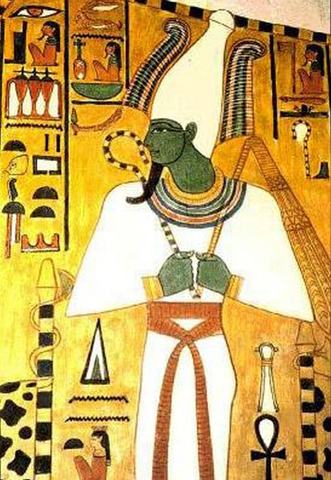
Lord of the afterlife — the murdered king remade as the first mummy, whose resurrection promised every Egyptian a life beyond the grave.
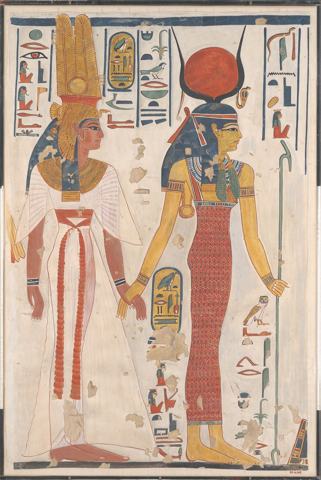
Goddess of magic — the widow whose spells restored Osiris, the mother who hid Horus in the marshes, and the one Egyptian deity Rome adopted whole.
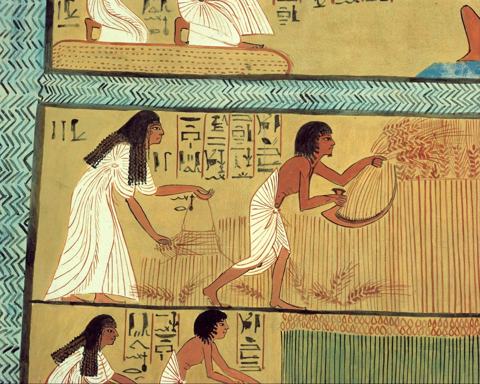
The Egyptian underworld — the night country crossed by the sun in twelve hours and by every dead Egyptian hoping to come out reborn at dawn.
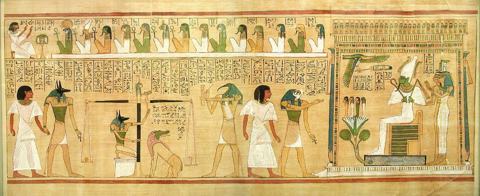
Egypt's judgment of the dead: the heart set on a scale against the feather of Maat, with oblivion waiting for whichever side tips wrong.
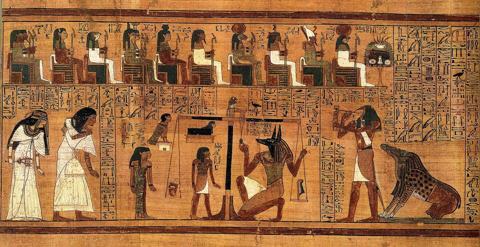
Devourer of the dead — the crocodile-lion-hippopotamus hybrid who crouched beside the scales and swallowed the hearts that failed the weighing.
The New Kingdom funerary spells the Egyptians called "Going Forth by Day" — copied for the dead, and renamed the Book of the Dead by Lepsius in 1842.
Sources & Further Reading
- 1.Pyramid Texts (Old Kingdom, c. 2400–2300 BCE).
- 2.Coffin Texts (Middle Kingdom, c. 2100–1800 BCE).
- 3.The Egyptian Book of the Dead (Book of Going Forth by Day), New Kingdom — esp. Spell 125.
- 4.Plutarch, On Isis and Osiris (Moralia, 1st–2nd century CE).
- 5.Wilkinson, Richard H. The Complete Gods and Goddesses of Ancient Egypt. Thames & Hudson, 2003.
- 6.Taylor, John H. Death and the Afterlife in Ancient Egypt. British Museum Press, 2001.
Spot an error or have a source to suggest? Write to info@viseterna.com. We cite primary sources and modern scholarship, and we correct fast.