
The Opening of the Mouth Ceremony
The Egyptian rite that restored a mummy's or statue's senses — touching sacred tools to its face so it could eat, see, and speak again.
Ay performing the Opening of the Mouth on Tutankhamun, tomb painting, Valley of the Kings (KV62), c. 1323 BC · Public domain · source
Waking a Mummy's Senses
The Opening of the Mouth Ceremony is the ritual Egyptian funerary religion treated as the actual moment of resurrection: performed on a mummy, on a substitute statue, or on a carved image, it was believed to restore the senses a dead person needed to function in the Duat — to eat, drink, breathe, speak, see and move as a transfigured Osiris 1,6. Without it, the offerings, the Book of the Dead spells recited at the tomb, and the whole apparatus prepared for the dead were considered useless, because the deceased would have no working mouth or eyes with which to use any of it 1,6.
Origins in the Birth Room
Elements of the rite already appear in the Old Kingdom Pyramid Texts, and Ann Macy Roth's study of its core instrument, the fishtail-shaped pss-kf blade, argues the whole ceremony began as a re-enactment of birth rather than of death 1,4. The pss-kf, she shows, was originally the blade used to cut a newborn's umbilical cord, and the sequence of objects presented to the mummy — clearing the mouth with the fingers, a touch of the breast, tools associated with infancy — mimics the stages by which an Egyptian infant was fed and matured, so that the dead could be symbolically reborn and grown up enough, again, to eat solid food 4,5.
Tools and Choreography
By the New Kingdom the ceremony had accumulated dozens of implements and gestures: an adze for the symbolic first touch, the two finger-shaped ntrwj blades, incense and natron for purification, and the foreleg of a freshly slaughtered bull, cut off while the animal still struggled, touched to the mummy's mouth and eyes as a final offering of vital force 2,3. The whole sequence was performed before a statue or mummy propped upright, with the officiant moving through each tool in order while reciting the accompanying spell.
An Heir's Public Claim
The rite was traditionally performed by the dead person's heir, most often an eldest son, which made it as much a political statement as a religious one: to open the mouth of a king's mummy was to be seen performing the office of his legitimate successor 2,6. The clearest surviving image of the ceremony shows exactly this — Tutankhamun's successor Ay, dressed in the leopard skin of a sem-priest, touching an adze to the mouth of Tutankhamun's upright mummiform figure on the north wall of the young king's tomb, a scene that doubled as Ay's visual claim to the throne 2.
Beyond the Tomb
The ceremony was not confined to human burials. Temples performed a version of it daily on the cult statues of the gods, to "activate" the image so the god could genuinely inhabit it and receive the morning offering, and the same rite could be applied to a relief or painted figure on a tomb or temple wall to make that image function for its owner 3,6. In every case the logic was the same: an image, however carefully made, was inert until this ritual gave it working senses.
Not a Single Gesture
Eberhard Otto's critical edition of the developed New Kingdom liturgy divides it into around seventy-five separate episodes of purification, censing, sacrifice and instrument-touching, a scale that makes clear the ceremony popular film and fiction usually compress into one wand-like flourish was, in practice, a long formal service conducted by trained priests reciting fixed wording 3. Later burials, especially those of more modest means, sometimes abbreviated the sequence or relied on its recitation alone rather than the full set of tools, but the underlying belief — that a dead face left unopened cannot eat, see, or answer to its own name — proved durable across the whole of pharaonic history 1,3,6.
Continue Exploring
The Egyptian underworld — the night country crossed by the sun in twelve hours and by every dead Egyptian hoping to come out reborn at dawn.
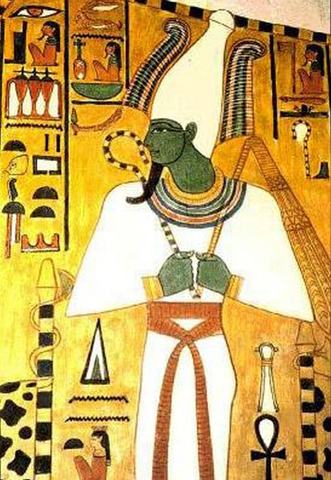
Lord of the afterlife — the murdered king remade as the first mummy, whose resurrection promised every Egyptian a life beyond the grave.
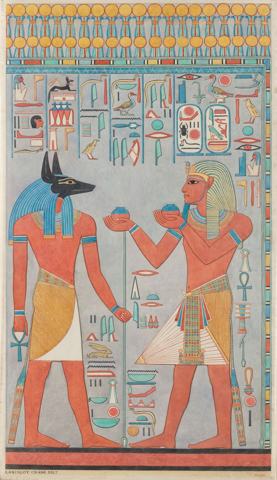
Guardian of the dead — the black jackal god who embalmed Osiris, watched over the necropolis, and weighed the heart against the feather of truth.
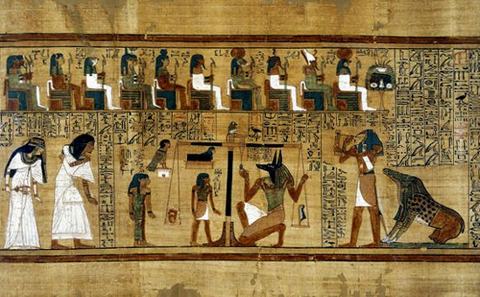
The New Kingdom funerary spells the Egyptians called "Going Forth by Day" — copied for the dead, and renamed the Book of the Dead by Lepsius in 1842.
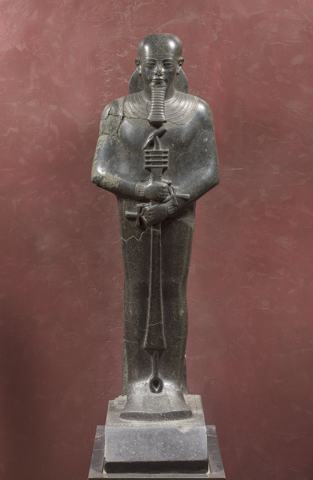
The creator who made the world by thinking it and speaking it — Ptah of Memphis, patron of sculptors and architects, and lord of the Apis bull.
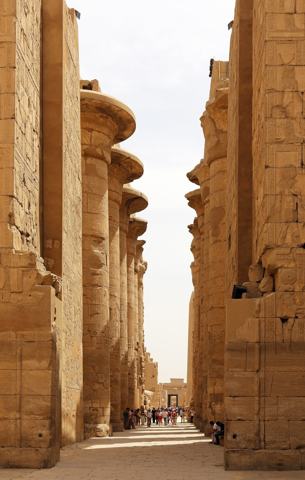
The largest religious complex ever built — fifteen hundred years of continuous construction at Thebes, centred on the state cult of Amun-Re.
Sources & Further Reading
- 1.The Pyramid Texts (Old Kingdom, c. 2400–2300 BCE) — earliest attested elements of the rite.
- 2.Tomb of Tutankhamun (KV62), Valley of the Kings, north wall scene, c. 1323 BCE.
- 3.Otto, Eberhard. Das ägyptische Mundöffnungsritual. 2 vols. Ägyptologische Abhandlungen 3. Wiesbaden: Harrassowitz, 1960.
- 4.Roth, Ann Macy. "The pss-kf and the 'Opening of the Mouth' Ceremony: A Ritual of Birth and Rebirth." Journal of Egyptian Archaeology 78 (1992): 113–147.
- 5.Roth, Ann Macy. "Fingers, Stars, and the 'Opening of the Mouth': The Nature and Function of the ntrwj-Blades." Journal of Egyptian Archaeology 79 (1993): 57–79.
- 6.Taylor, John H. Death and the Afterlife in Ancient Egypt. British Museum Press, 2001.
Spot an error or have a source to suggest? Write to info@viseterna.com. We cite primary sources and modern scholarship, and we correct fast.