
Freyr (Frey)
Vanir god of harvest, peace and kingship. Owner of the golden boar Gullinbursti, he traded away his sword for love and pays for it at Ragnarok.
Freyr, engraved by Eduard Ade after Johannes Gehrts, 1901 · Public domain · source
Name, Family and Domain
Freyr's name is not really a name: Old Norse Freyr means "lord", the masculine counterpart to Freyja, "lady". Both look like cult titles that hardened into personal names, which is one reason the pair are so hard to pin to a single original function 6,7. He is the son of Njord and, according to Snorri, of Njord's unnamed sister; his own sister is Freyja, and the three of them came to the Aesir as hostages after the war with the Vanir 2,4.
Snorri's summary is uncharacteristically warm. Freyr governs rain and sunshine and the produce of the earth, and it is right to call on him for good seasons and for peace; he also disposes of the prosperity of men 2. Where the Aesir gods offer victory or protection, Freyr offers the year turning out well — til árs ok friðar, "for a good season and peace", the formula that recurs in Old Norse accounts of sacrifice 7,8.
Alfheim, the Boar and the Ship
Grimnismal says the gods gave Freyr the realm of Alfheim in the earliest days as a tannfé, a tooth-gift — the present customarily made to an infant when its first tooth appeared 1. It is a strange and memorable detail: an entire world of elves handed over as a baby present. What the association between Freyr and the elves originally meant is not settled, though scholars have noted that both are tied to fertility and to the dead in the mound 6,7.
Two of his possessions come from the dwarf-smiths' contest recounted in Skaldskaparmal. Skidbladnir is a ship built by the sons of Ivaldi, big enough to carry all the gods with their gear, always finding a fair wind the moment its sail is raised, and foldable like cloth into a pouch 3. Gullinbursti — "golden-bristled", also called Slidrugtanni — is the boar forged by the dwarf Eitri while his brother Brokkr worked the bellows, in the same wager that produced Draupnir and Mjolnir; it runs over air and water faster than any horse and lights the dark with its bristles 3. Boars are Freyr's animal generally: Freyja's Hildisvini is its counterpart, and the sonargöltr, the boar over which oaths were sworn at Yule, belongs to the same complex 6,7.
Skirnismal: The Sword Given Away
The one full narrative about Freyr is the eddic poem Skirnismal. He sits in Odin's high seat Hlidskjalf, from which all worlds are visible, and sees the giantess Gerd, daughter of Gymir, in her father's courtyard; the light from her arms fills sky and sea, and he goes home sick with longing 1. He sends his servant Skirnir to woo her, lending him a horse that will carry him through the flickering flame and a sword that fights of itself against the race of giants 1.
Gerd refuses gifts — eleven golden apples, and the ring Draupnir — and refuses threats of beheading, until Skirnir turns to runic cursing: he will carve her a life of madness, monstrous lust and unbearable loneliness among the frost-giants. She yields and names the meeting-place, the grove Barri, nine nights hence 1. The poem closes on Freyr's famous complaint that one night is long, two are longer, and how shall he endure three.
Interpretations vary widely. An older school read the poem as a fertility rite, the sun-god's courtship of the frozen earth; more recent work treats it as a study of coercion, of the abuse of magic, and of the political price of a marriage across the god-giant line 6,8. What is not in dispute is the consequence: the sword is gone.
Uppsala, the Ynglings and the Wagon
Freyr's cult was substantial and specifically Swedish in its centre of gravity. Adam of Bremen, writing around 1075, describes the temple at Uppsala with three idols, of which the one he calls Fricco was shown "with an enormous phallus" and invoked at weddings 5. The small eleventh-century bronze figurine from Rällinge in Södermanland, a seated ithyphallic man with a pointed cap, is conventionally identified with him on that basis, though the identification is an inference rather than a certainty 7.
Ynglinga saga makes Freyr — as Yngvi-Freyr — a king at Uppsala and the founder of the Yngling dynasty from whom the kings of Sweden and Norway claimed descent. When he died his men kept it secret, laid him in a mound with a door and windows, and poured tribute in for three years, and the good seasons continued 4. A later Icelandic tale, Ogmundar thattr dytts, describes a Swedish wagon-procession in which Freyr's image toured the countryside with a priestess, a practice that echoes Tacitus's account of Nerthus centuries earlier 6,7.
Ragnarok
Voluspa and Snorri agree on the ending. When the fire-giant Surtr comes from the south with his burning blade, Freyr meets him and falls, and Snorri says plainly that he will miss the sword he gave to Skirnir 1,2. Snorri also has him kill the giant Beli with an antler when caught unarmed, a feat that is offered as proof he could have done without a sword had he kept one 2.
It is a tidy piece of mythic bookkeeping: the god of peace and plenty disarms himself for love, and the world's last fire finds him with nothing in his hands 6.
Continue Exploring
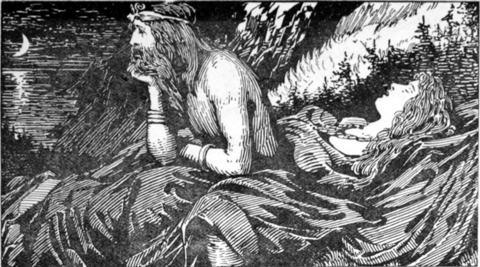
Vanir god of harbours, wind and wealth. Sent to the Aesir as a hostage; father of Freyr and Freyja; husband of a mountain giantess, briefly.
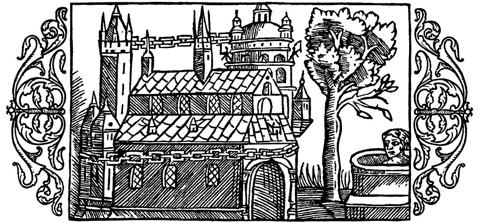
A golden temple with statues of Thor, Odin and Freyr, described by Adam of Bremen c. 1075 — a real cult site, but archaeology and legend disagree on its form.
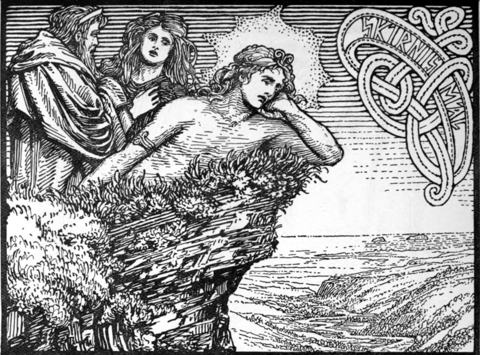
The realm of the light-elves, given to Freyr as a baby present — one of the least described places in the Norse cosmos.
The alfar of Old Norse belief: sacrificed to at the alfablot, ranked beside the gods in poetry, and never quite pinned down by Snorri's own tidy scheme.
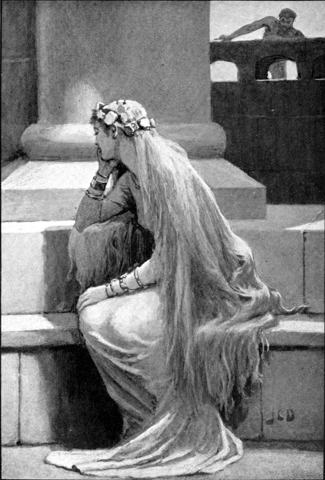
Thor's golden-haired wife, whose shorn hair forced Loki to commission the dwarf-made treasures of the gods, Mjolnir among them.
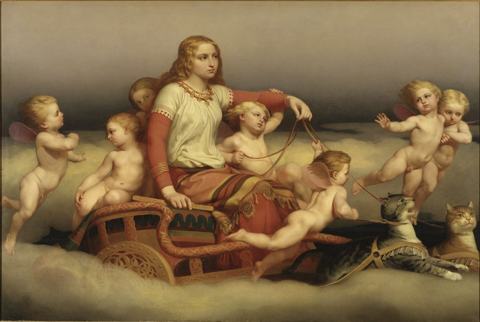
Lady of the Vanir. Goddess of love, war, gold and seidr magic — often spelled Freya — who claims half of the battle-slain for her own hall.
Also mentioned inBlot (Norse Sacrifice)MimirThe Poetic EddaVanaheimVidar
Sources & Further Reading
- 1.Poetic Edda — Skirnismal, Grimnismal, Voluspa and Lokasenna (Codex Regius, 13th century).
- 2.Snorri Sturluson, Prose Edda — Gylfaginning (c. 1220).
- 3.Snorri Sturluson, Prose Edda — Skaldskaparmal (c. 1220).
- 4.Snorri Sturluson, Ynglinga saga, in Heimskringla (c. 1230).
- 5.Adam of Bremen, Gesta Hammaburgensis Ecclesiae Pontificum, Book IV — the temple at Uppsala (c. 1075).
- 6.Lindow, John. Norse Mythology — A Guide to the Gods, Heroes, Rituals, and Beliefs. Oxford University Press, 2001.
- 7.Simek, Rudolf. Dictionary of Northern Mythology. Trans. Angela Hall. D.S. Brewer, 1993.
- 8.Turville-Petre, E.O.G. Myth and Religion of the North. Weidenfeld & Nicolson, 1964.
Spot an error or have a source to suggest? Write to info@viseterna.com. We cite primary sources and modern scholarship, and we correct fast.