
Niflheim
The primordial realm of frost and mist in the north — and, in Snorri's telling, confused ever after with the realm of Hel.
Ymir Suckled by the Cow Audhumbla, Nicolai Abildgaard, 1777 (Statens Museum for Kunst, Copenhagen) · Public domain · source
Mist Before Anything Else
Niflheimr means, transparently, "mist-world" or "dark world" — the element nifl- is the same root behind German Nebel and English nebulous, a word for concealment and murk rather than for cold specifically 5,6. It names one of the two regions Snorri Sturluson places at the outer edges of Ginnungagap before the world existed: freezing, ancient, and — like its opposite number Muspelheim — older than the earth it eventually helps to build 3.
That primordial sense is what the name meant first. The realm most people now picture when they hear "Niflheim" — a cold land of the dead — is a later layer, and untangling the two is most of what this entry is about 3,4,5.
The Spring, the Rivers, and the Meeting of Fire and Frost
Snorri's Gylfaginning gives Niflheim a specific geography. At its centre is the boiling spring Hvergelmir, source of eleven rivers collectively called the Elivagar, which flow out and freeze into layered ice the further they get from their source 3. Where that ice-front meets the sparks and heat drifting out of Muspelheim across the void, the rime thaws into drops that quicken into life — first the giant Ymir, then the cow Audhumbla, whose milk feeds him and whose licking at the salty ice frees the first of the gods 3. Niflheim, on this account, is not a wasteland at the margin of the story; it is half the raw material the world is made of 3,5.
Voluspa's own creation stanzas are far sparser than Snorri's, naming Ginnungagap and the yawning gap of nothing before the earth but not walking through the fire-and-frost mechanics in any detail — which is a reminder that the vivid step-by-step cosmogony most people know is substantially Snorri's own synthesis of scattered material 1,5,7.
Niflheim vs. Niflhel — Two Different Words
Here the sources genuinely disagree with each other, and the disagreement matters. Vafthrudnismal and Baldrs draumar both use a distinct term, Niflhel, "misty Hel," for the lowest and darkest tier of the underworld, the place below the ordinary dead where the wise giant Vafthrudnir claims to have travelled 1,2. Nothing in either poem equates that underworld directly with the primordial Niflheim of the creation account — they read as two different regions that happen to share a root word for mist 1,2,5.
Snorri is the one who blurs them. In Gylfaginning he has Odin cast Hel down into "Niflheim" and give her power over nine worlds, using the name of the primordial ice-realm for what is functionally the underworld of the dead — the same conflation noted in the entry on Helheim, where Snorri "tries to place Niflhel, Niflheim and Hel in relation to one another and does not entirely succeed" 3. Simek and Lindow both treat this as an authorial seam rather than an error to smooth over: Snorri inherited at least two mist-named cold places from his sources and never fully reconciled them into one 4,5.
Roots, Rivers, and What Lives There
Niflheim reappears at the base of Yggdrasil, where the boiling spring Hvergelmir seethes beneath a root of the world tree and Nidhoggr gnaws at it from below 3. This is the primordial Niflheim rather than a place of human dead — a fixed, physical location under the cosmos rather than a moral destination — and it is one of the few Eddic locations imagined as continuously present, doing the same thing, from before creation through to the poems' own telling 3,5.
Beyond the spring and its rivers, the sources give almost nothing else: no hall, no named ruler in the primordial sense, no inhabitants beyond Nidhoggr and the serpents that share the root with him. It is geography and process — cold, mist, meltwater — rather than a populated kingdom, which sets it apart from realms like Jotunheim that come with courts, kings and stories of visitors 3,6.
A Cosmology, Not a Punishment
It is worth being plain about what Niflheim is not. It is not, in the primordial sense, a hell in the moral or Christian meaning of the word — nothing in Voluspa or Vafthrudnismal punishes anyone there, and the frost that begins the world carries no verdict on anyone's conduct 1,2,6. The punitive, serpent-woven hall of Nastrond belongs to the separate Niflhel/underworld tradition discussed at Helheim, and later retellings that fuse "Niflheim" wholesale with a realm of torment are compounding exactly the confusion Snorri started 3,4.
What the primordial Niflheim actually offers is colder and stranger than a hell: an old, mechanical cosmology in which mist and fire simply meet, without intention, and something is born from it 3,5.
Continue Exploring
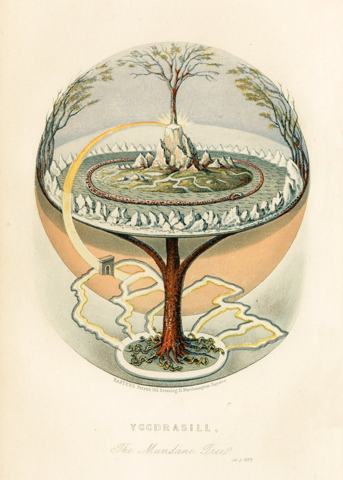
The World Tree. The great ash whose roots reach three wells and nine worlds, tended by the norns, eaten from every side, and still standing when the sky burns.
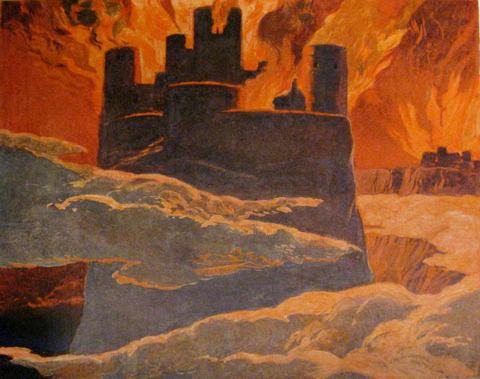
The primordial fire-region of the south, older than the earth — home of Surtr and the sons of Muspell, present at the world's making and its burning.
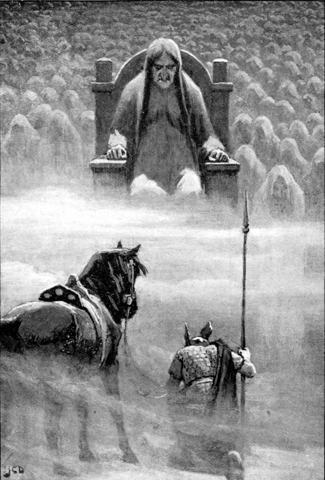
Queen of the Dead. Half living woman and half corpse, Loki's daughter rules the cold realm where those who die of sickness and age must go.
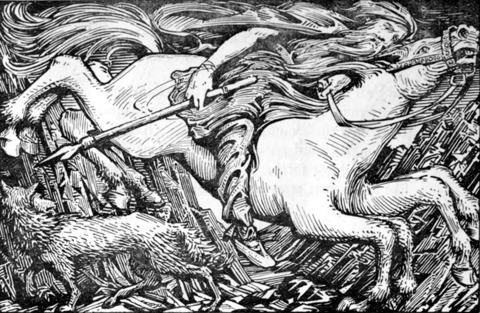
The cold underworld. Down and to the north, past a gold-roofed bridge and a gate that does not open twice, the hall where most of the Norse dead actually go.
Gnawer of roots. The dragon chewing the world tree from below, feeding on oath-breakers, and flying up out of the dark in the last stanza of Voluspa.
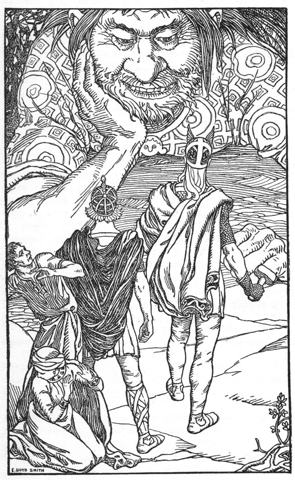
Land of the giants. The wild country east of the fence, older than the gods, holding the wisdom and the brides the AEsir keep going out to take.
Sources & Further Reading
- 1.Poetic Edda — Voluspa and Vafthrudnismal (Codex Regius, 13th century).
- 2.Poetic Edda — Baldrs draumar (Codex Regius and AM 748 I 4to, 13th-14th century).
- 3.Snorri Sturluson, Prose Edda — Gylfaginning (c. 1220).
- 4.Lindow, John. Norse Mythology — A Guide to the Gods, Heroes, Rituals, and Beliefs. Oxford University Press, 2001.
- 5.Simek, Rudolf. Dictionary of Northern Mythology. Trans. Angela Hall. D.S. Brewer, 1993.
- 6.Turville-Petre, E.O.G. Myth and Religion of the North — The Religion of Ancient Scandinavia. Weidenfeld & Nicolson, 1964.
- 7.Larrington, Carolyne (trans.). The Poetic Edda. Rev. ed., Oxford World's Classics, 2014.
Spot an error or have a source to suggest? Write to info@viseterna.com. We cite primary sources and modern scholarship, and we correct fast.