
Shiva
The destroyer and transformer — ascetic on the cremation ground, lord of the cosmic dance, and for millions of Shaivas the supreme reality itself.
Nataraja, Shiva as the Lord of Dance, Chola period, Tamil Nadu, c. 11th century (Cleveland Museum of Art) · CC0 · source
Who Shiva Is
Shiva (Sanskrit Śiva, "the auspicious one") is one of the most widely worshipped deities in Hinduism, and for the Shaiva traditions he is not one god among many but the supreme reality from which everything proceeds 8. He is worshipped today by hundreds of millions of people; the material below describes texts and traditions of a living religion, not a closed mythology 8.
The popular shorthand — Brahma creates, Vishnu preserves, Shiva destroys — comes from the trimurti, a later systematising scheme that gives each god one function 8. Shaiva theology rejects the demotion. In its own terms Shiva performs five acts: creation, maintenance, dissolution, concealment, and the bestowal of grace 7,8. "Destruction" here means dissolution back into the source at the end of a cosmic cycle, the necessary condition of the next beginning — not annihilation 7.
From Rudra to Shiva
His oldest identifiable ancestor is Rudra, the fierce archer of the Rigveda: a god of the wild places and of disease who is asked, urgently, not to harm the worshipper's people or cattle 1. Petitioners flatter him by calling him śiva, "auspicious," and that propitiatory epithet eventually becomes the name 1,8. The Shatarudriya, the great litany of the Yajurveda, already addresses Rudra in a hundred aspects and remains in daily liturgical use 2.
The Svetasvatara Upanishad takes the decisive step of identifying Rudra with the single transcendent ground of being, the earliest clearly theistic elevation of the god in the surviving texts 3,8. Scholars have also long argued for pre-Vedic and non-Vedic contributions to his character — including a much-debated Indus Valley seal of a seated horned figure — but the evidence there is thin, and Flood treats the Indus identification as unproven 8.
The Erotic Ascetic
The paradox at Shiva's centre, and the theme of Doniger's classic study, is that he is simultaneously the supreme renouncer and the supreme householder 6. He sits in motionless meditation on Mount Kailasa, smeared with cremation ash, matted-haired, indifferent to the world — and he is also the passionate husband of Parvati, whose marriage the Puranas describe at loving length, and the father of Ganesha and Kartikeya 4,6.
The myths refuse to resolve this. When Kama, god of desire, fires an arrow at Shiva to draw him toward Parvati, Shiva opens his third eye and burns him to ash — and then marries her anyway 4,6. The Ardhanarishvara form makes the union structural rather than narrative: one body, male on the right and female on the left, god and goddess inseparable 7.
Forms and Symbols
Shiva's iconography is a compressed theology 7. The crescent moon and the river Ganga are caught in his matted hair — he broke the falling river's force with his head so it would not shatter the earth 4. His throat is blue (Nilakantha) because at the churning of the ocean he swallowed the halahala poison that would have destroyed creation, and held it in his throat 4,5. He wears serpents as ornaments, ash as clothing of a kind, and a tiger skin; his weapon is the trident, his drum the damaru whose beat is the pulse of time, and his mount the bull Nandi 4,7.
As Nataraja, Lord of the Dance, he performs the ananda-tandava within a ring of fire: drum in one hand sounding creation, flame in another for dissolution, one hand raised in reassurance, one foot crushing the demon of ignorance and one lifted in release 7. As Bhairava he haunts cremation grounds, terrifying and ash-covered, a form central to tantric Shaivism and closely linked to fierce goddesses including Kali 6,8.
The Great Myths
Three episodes recur everywhere. Daksha's sacrifice: Shiva's father-in-law holds a great rite and pointedly excludes him; Sati, Shiva's wife, dies of the insult, and Shiva's grief and rage produce Virabhadra, who wrecks the sacrifice — after which Shiva carries Sati's body across the world until it is dismembered, and each place where a piece fell becomes a shakti pitha, a goddess shrine 4. Sati is reborn as Parvati and wins him back through austerities of her own 4.
Tripurantaka: three flying fortresses of the demons can be destroyed only by a single arrow at a single instant of alignment; Shiva takes the earth as his chariot, the Vedas as horses, and Mount Meru as his bow, and burns all three with one shot 4,5.
The pillar of light: Brahma and Vishnu argue over which of them is supreme, and an infinite column of fire appears between them. Neither can find its top or bottom. It is Shiva, and the story is the mythic charter of the linga 4,7.
The Linga and Worship
The linga — an upright form, usually set in a circular yoni base — is Shiva's principal object of worship, and it is understood in devotional practice as a sign of the formless absolute rather than as an anatomical image; Kramrisch reads it as the mark of the god's presence and infinity 7. Twelve jyotirlinga sites, from Somnath to Kashi Vishvanath in Varanasi, are major pilgrimage centres 8. Common observances include the mantra Om Namah Shivaya, the offering of water, milk, and bilva leaves, and the night-long vigil of Mahashivaratri 8.
Living Traditions
Shaivism is not a single church. Kashmir Shaivism developed a sophisticated nondual philosophy; Shaiva Siddhanta, strong in Tamil Nadu, works from a dualist frame and a rich body of Tamil devotional poetry; the Lingayats of Karnataka reject temple-centred ritual in favour of a personal linga; the Nath yogis and earlier Pashupata ascetics carried the renunciant line 8. What the traditions share is the conviction that the ash-covered outsider of the old myths is, in fact, the centre 7,8.
Continue Exploring
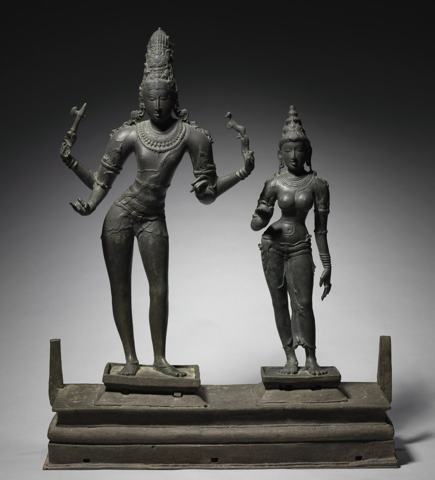
The Goddess who wins Shiva through fierce austerity, mother of Ganesha and Kartikeya, and one revealed face of the same Devi worshipped as Durga and Kali.
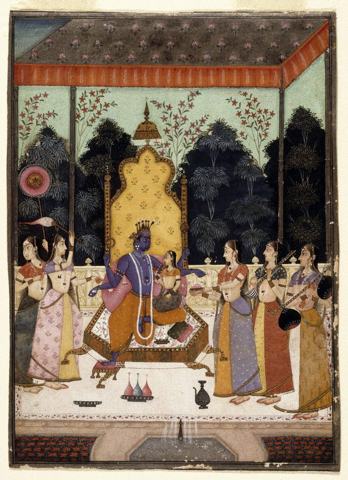
The preserver of cosmic order — the god who descends age after age, as Rama, as Krishna, and in other forms, to set dharma right when it fails.
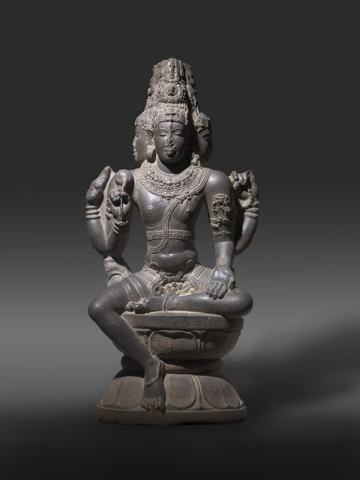
The four-faced creator from whom the worlds issue at the dawn of each cosmic day — immensely powerful in myth, and almost never worshipped in temples.
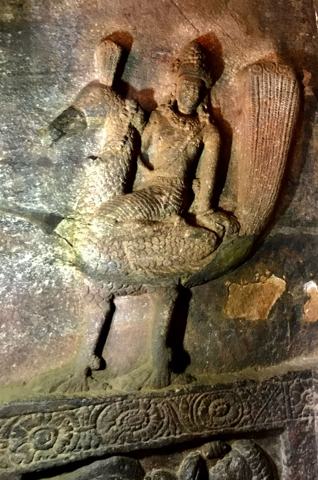
The six-headed god of war, spear in hand and peacock beneath him — Skanda to Sanskrit tradition, and Tamil Nadu's most fervently worshipped deity as Murugan.
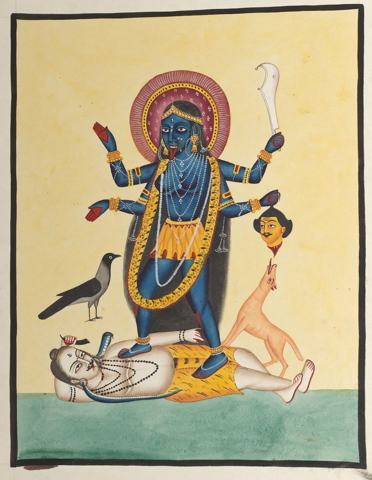
The black goddess of time and dissolution — annihilator of demons and of the ego, and to millions of Bengali devotees simply the Mother.
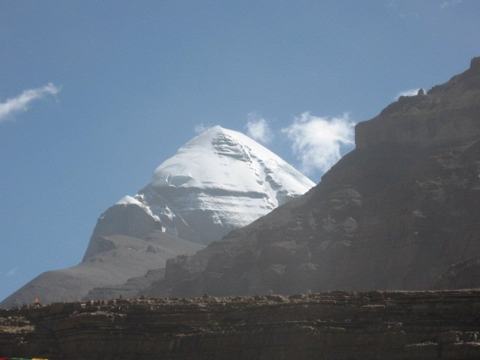
A remote, unclimbed Himalayan peak in western Tibet sacred to Hindus, Buddhists, Jains, and Bon — Shiva's meditation seat and the source of four great rivers.
Also mentioned inAgni (Hindu Fire God)DurgaGanesha (Ganesh)HanumanKrishnaMount MeruNagaRakshasaRamaRavanaSaraswati (Sarasvati)The Churning of the Ocean (Samudra Manthan)TrishulaVaranasi (Kashi)
Sources & Further Reading
- 1.The Rigveda (c. 1500–1200 BCE), hymns to Rudra.
- 2.Shatarudriya (the Rudram), Krishna Yajurveda.
- 3.Svetasvatara Upanishad (c. 400–200 BCE).
- 4.The Shiva Purana and the Linga Purana.
- 5.The Mahabharata.
- 6.O'Flaherty, Wendy Doniger. Asceticism and Eroticism in the Mythology of Siva. Oxford University Press, 1973.
- 7.Kramrisch, Stella. The Presence of Siva. Princeton University Press, 1981.
- 8.Flood, Gavin. An Introduction to Hinduism. Cambridge University Press, 1996.
Spot an error or have a source to suggest? Write to info@viseterna.com. We cite primary sources and modern scholarship, and we correct fast.