
Ganesha (Ganesh)
The elephant-headed son of Shiva and Parvati, lord of beginnings and remover (and placer) of obstacles, invoked before every undertaking.
Ganesha Holds Court, unknown Indian artist (Walters Art Museum, Baltimore, W.900) · Public domain · source
Who Ganesha Is
Ganesha — also written Ganesh, Ganapati, Vinayaka or Gajanana — is the elephant-headed god who stands at the threshold of things. He is invoked at the start of journeys, weddings, examinations, business ventures and manuscripts, and the standard formula Shri Ganeshaya namah opens texts across sectarian lines. His name means "lord of the ganas", the troop of attendants who serve his father 4,5. Ganapatya devotees, a small but historically distinct sect, worship him as the supreme reality rather than as a doorkeeper to other gods 2,6.
His most-cited title, Vighnesha or Vighnaharta, is usually translated "remover of obstacles", but scholars point out that the older sense runs both ways: he is Vighnaraja, lord of obstacles, the one who sets them in the path as readily as he clears them. Propitiation, not petition, is the older logic — the obstacle-god is placated so the obstacle never comes 4,5. That ambivalence survives in the ritual etiquette of offering him modaka sweets before anything else is asked of him.
Origins and the Elephant Head
The most widely told birth story comes from the Puranic strand best known through the Shiva Purana: Parvati, wanting a guardian of her own while she bathed, formed a boy from the paste or unguent of her body and gave him life. When Shiva returned and the boy refused him entry, Shiva struck off his head. Confronted with Parvati's grief, he sent his ganas to bring back the head of the first creature they found lying with its head to the north — an elephant — and fixed it on the body 1,4.
Other Puranas give quite different accounts: some have Shiva father the child directly, some have the gods' gaze or the glance of Shani, the planet Saturn, burn the head away, some have the boy born already elephant-headed. The variation is itself the evidence — the myth was assembled late, around a figure whose origins the texts no longer remembered 2,4,5.
The historical picture is thinner and more interesting. The earliest secure images of an elephant-headed deity in India date to roughly the fourth and fifth centuries CE, and the god's rise into the mainstream pantheon appears to belong to the Gupta period and after 5,6,7. Before that, Vedic and early Dharmashastra literature knows plural Vinayakas — malignant spirits who seize and obstruct, requiring a specific propitiation ritual; the Yajnavalkya Smriti prescribes exactly such a rite 3,5. Many scholars read the singular, benevolent Ganesha as a consolidation of those troublesome powers into one manageable, brahmanized deity, though the details are debated and no single derivation commands consensus 4,5,6.
Iconography
Ganesha is portrayed with a heavy elephant head, one broken tusk, a wide belly, and typically four arms holding some combination of a noose (pasha), an elephant goad (ankusha), a broken tusk and a bowl of sweets. The noose pulls the devotee close, the goad drives him forward; the pot-belly is glossed as containing the whole universe, or simply as prosperity 4,5. His mount is a mouse or rat, the mushika — an incongruity that commentators have read as the great and the small joined, or as the god mastering the archetypal ruiner of grain stores, itself an obstacle in agrarian life 4,6.
His epithet Ekadanta, "one-tusked", is explained variously: he broke the tusk fighting Parashurama, or snapped it off himself to use as a pen. That second story attaches to the tradition — found in some manuscript recensions and generally treated as a late accretion rather than part of the epic's core — that Ganesha served as the scribe of the Mahabharata while Vyasa dictated it, on condition that the dictation never pause 2,4.
Worship and Reach
Ganesha's festival, Ganesh Chaturthi, falls in the lunar month of Bhadrapada (August-September). Clay images are installed, worshipped for one to eleven days, and then immersed in water. The public, street-scale form of the festival is largely a modern development: it was expanded in late nineteenth-century Maharashtra, notably under the nationalist Bal Gangadhar Tilak, as a way of gathering crowds that colonial assembly restrictions otherwise discouraged 5,6,7.
He travelled unusually well. Elephant-headed figures appear in Buddhist and Jain contexts, in Nepal and Tibet, in Southeast Asian temple sculpture from Java to Cambodia, and in Japan as the paired tantric figure Kangiten — evidence of a deity portable enough to be adopted rather than merely translated 5,6.
A Sibling Story Worth Knowing
One of the most repeated Ganesha tales is the race for the fruit of wisdom, contested with his brother Skanda (Karttikeya, Murugan). The prize goes to whoever circles the world first; Skanda sets off on his peacock, while Ganesha walks a circle around his parents and declares that they are the world. He wins 2,4. Like much of the Ganesha corpus the story is not attested early, but it captures the shape devotees give him: not the fastest or the strongest god in the pantheon, but the one who reframes the problem.
Related entries: Shiva, Kali, Vishnu, Brahma, Saraswati, Lakshmi.
Continue Exploring
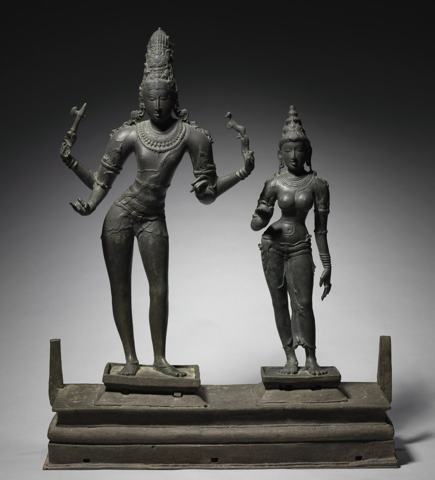
The Goddess who wins Shiva through fierce austerity, mother of Ganesha and Kartikeya, and one revealed face of the same Devi worshipped as Durga and Kali.
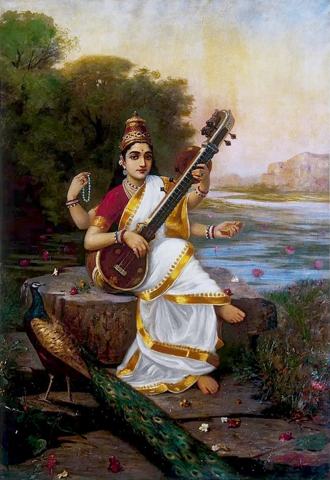
Goddess of speech, learning, music and the arts — a Vedic river who became the patron of every word written or sung.
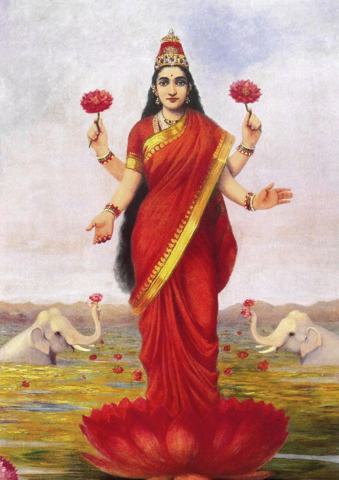
Goddess of wealth, beauty and good fortune, born from the churning of the ocean and inseparable consort of Vishnu.
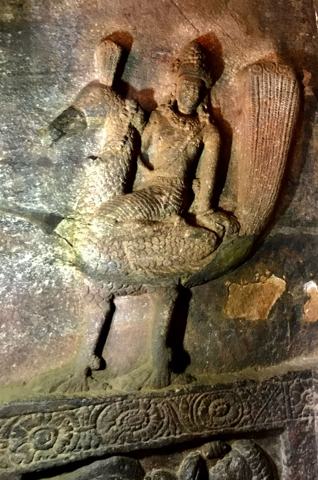
The six-headed god of war, spear in hand and peacock beneath him — Skanda to Sanskrit tradition, and Tamil Nadu's most fervently worshipped deity as Murugan.
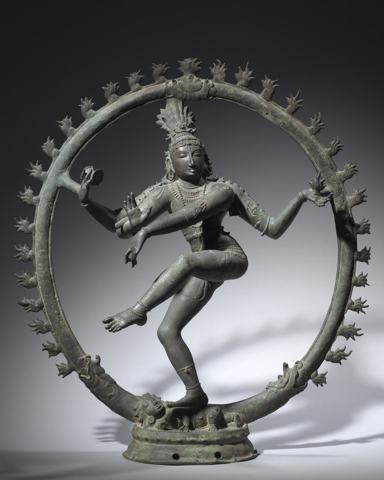
The destroyer and transformer — ascetic on the cremation ground, lord of the cosmic dance, and for millions of Shaivas the supreme reality itself.
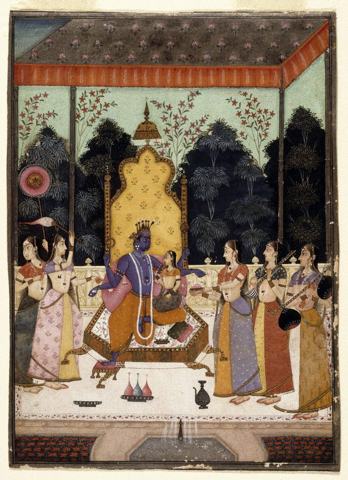
The preserver of cosmic order — the god who descends age after age, as Rama, as Krishna, and in other forms, to set dharma right when it fails.
Also mentioned inDurga
Sources & Further Reading
- 1.Shiva Purana — Rudrasamhita, Kumarakhanda (birth and beheading of Ganesha; Puranic, date uncertain).
- 2.Ganesha Purana and Mudgala Purana — the two sectarian Ganapatya Puranas (c. 12th-16th centuries).
- 3.Yajnavalkya Smriti — Acharadhyaya, the Vinayaka propitiation rite (c. 3rd-5th century CE).
- 4.Courtright, Paul B. Ganesa — Lord of Obstacles, Lord of Beginnings. Oxford University Press, 1985.
- 5.Brown, Robert L. (ed.). Ganesh — Studies of an Asian God. State University of New York Press, 1991.
- 6.Thapan, Anita Raina. Understanding Ganapati — Insights into the Dynamics of a Cult. Manohar, 1997.
- 7.Flood, Gavin. An Introduction to Hinduism. Cambridge University Press, 1996.
Spot an error or have a source to suggest? Write to info@viseterna.com. We cite primary sources and modern scholarship, and we correct fast.