
Saraswati (Sarasvati)
Goddess of speech, learning, music and the arts — a Vedic river who became the patron of every word written or sung.
Goddess Saraswati, Raja Ravi Varma, 1896 · Public domain · source
The River First
Saraswati is unusual among major Hindu deities in that she begins as a place. In the Rig Veda she is a river — sarasvati, "she who possesses pools" — and the hymns addressed to her are among the most physically specific in the collection: she is torrential, she breaks mountain ridges, she is naditama, "best of rivers", and the Vedic peoples settled along her banks and performed sacrifice there 1,7. Only three rivers get their own hymns in the Rig Veda, and hers are the fullest.
Which river is a long-running and unresolved argument. One position identifies her with the seasonal Ghaggar-Hakra system in northwest India, which dried out in antiquity; another with the Helmand (Old Iranian Haraxvaiti) in Afghanistan; a third holds that the Vedic poets were describing more than one watercourse under one name, or a partly mythologised one 6,7. The debate carries modern political freight in India and readers should treat confident answers on any side with caution. What the texts themselves record is that the river later vanished into the desert sands at Vinashana, and the tradition made that disappearance meaningful: she flows on underground, and joins the Ganga and Yamuna invisibly at Prayaga 2,5,6.
From River to Speech
The transformation from water to knowledge happens through an identification with Vac, the goddess of Speech, which is already under way in the Brahmana literature and complete by the epic period 2,5,6. The logic is not arbitrary: the river was where the sacrifice was performed and the hymns were spoken, and the qualities credited to her — purification, flow, inexhaustibility, the carrying-away of what is foul — transfer to language with almost no strain 5,6.
By the Puranic period Saraswati is the goddess of vidya in the widest sense: the Vedas, grammar, poetry, rhetoric, mathematics, music, dance and the crafts. She is credited in various traditions with inventing Sanskrit and the Devanagari script, though these are late attributions rather than early textual claims 3,5. Catherine Ludvik's study traces the further mutation into her Buddhist and East Asian forms, where the vina-playing goddess of learning also acquires weapons and a protective, martial role 6.
Consort and Company
Saraswati is generally paired with Brahma, the creator, and one strand of Puranic myth makes her his daughter-turned-consort, born from his own body — a story the texts themselves treat as troubling and which is sometimes given as the reason Brahma lost his claim to worship 3,5. Other traditions, particularly older and eastern ones, associate her with Vishnu; the Brahma Vaivarta Purana has all three great goddesses originally his, with a quarrel between Saraswati and Lakshmi leading to the redistribution that leaves Saraswati with Brahma 3,5. The variation reflects sectarian bargaining rather than a single lost original.
She completes the Tridevi alongside Lakshmi and Durga/Parvati — knowledge, wealth and power. Popular sayings that Lakshmi and Saraswati do not dwell in the same house (that the learned are poor, and the rich unlearned) are folk commentary, not doctrine, and are contradicted by the many temples and Bengali Durga Puja tableaux in which the two sisters stand side by side 5,7.
How She Is Shown
Her iconography is calm and fixed. She sits or stands in white, on a white lotus, four-armed: one pair plays the vina, a long-necked stringed instrument; the others hold a manuscript of palm leaves and a japamala, a rosary. There are no weapons in the standard Indian form and no ornament to speak of — the white is deliberate, marking sattva, purity untinged by passion 5,6. Her vehicle is a hamsa, a goose or swan, said in the commentaries to separate milk from water and so to stand for discrimination; in some regional forms she rides or is accompanied by a peacock, which the same commentaries read as the vanity that learning must set aside 5,6.
Worship
Her festival is Vasant Panchami, the fifth day of the bright half of Magha (late January or February), which opens the spring season. Devotees wear yellow, temples and homes offer yellow flowers and sweets, and instruments, tools and account books are placed before her image 5,7. Two customs are near-universal in India: vidyarambham, the ritual first writing of a child's first letters, often in rice or sand, and the placing of books before the goddess on Vasant Panchami and on Ayudha Puja during Navaratri, on the understanding that they are not to be read that day 5,7. The etiquette of the tradition — that touching a book with the foot is an offence — belongs to the same goddess.
She travelled with Buddhism. As Benzaiten in Japan, Biàncáitiān in China and Thurathadi in Myanmar, she remains a goddess of eloquence and music, though her attributes shift considerably and in Japan she picks up an independent association with water that arguably returns her to the river she started as 6.
Related entries: Brahma, Vishnu, Lakshmi, Durga, Ganesha, Shiva.
Continue Exploring
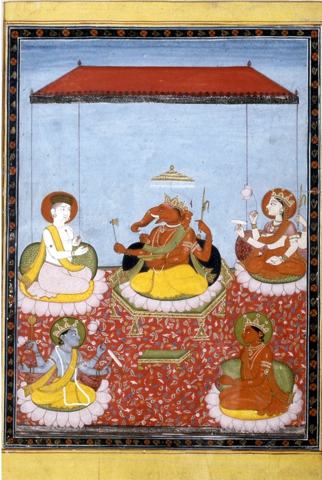
The elephant-headed son of Shiva and Parvati, lord of beginnings and remover (and placer) of obstacles, invoked before every undertaking.
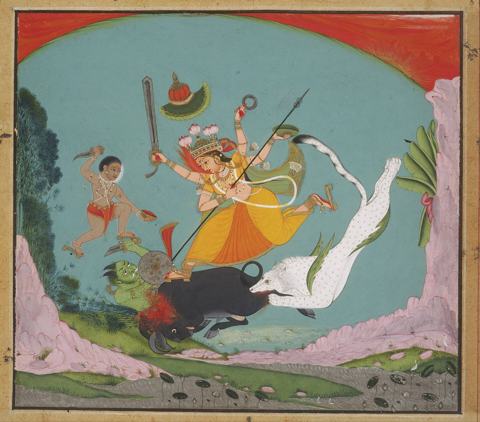
The warrior goddess assembled from the massed light of all the gods, lion-mounted slayer of the buffalo demon Mahishasura.
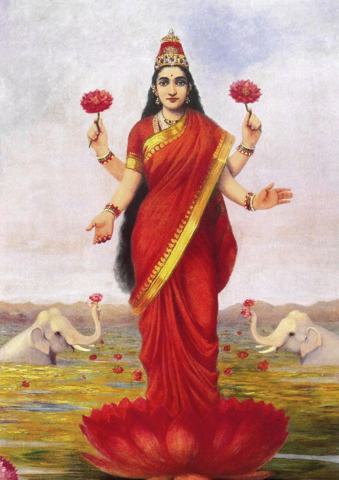
Goddess of wealth, beauty and good fortune, born from the churning of the ocean and inseparable consort of Vishnu.
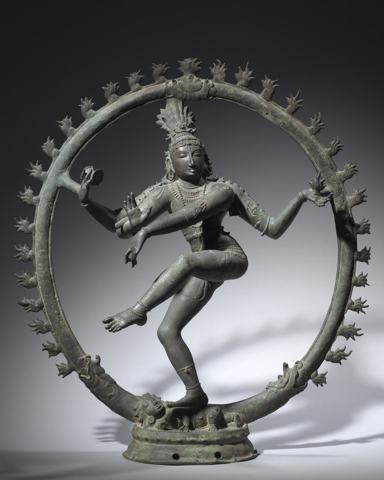
The destroyer and transformer — ascetic on the cremation ground, lord of the cosmic dance, and for millions of Shaivas the supreme reality itself.
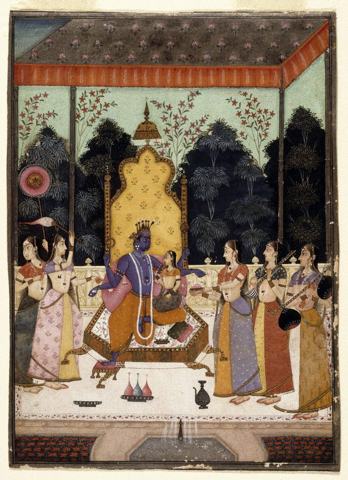
The preserver of cosmic order — the god who descends age after age, as Rama, as Krishna, and in other forms, to set dharma right when it fails.
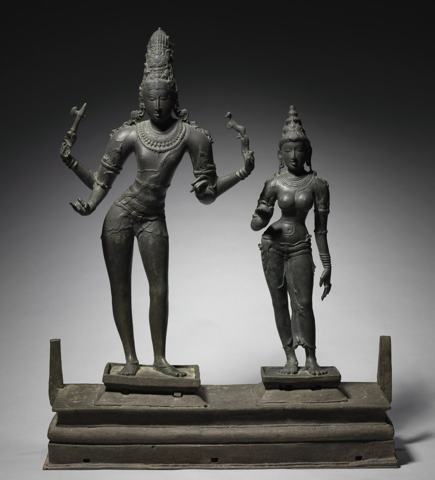
The Goddess who wins Shiva through fierce austerity, mother of Ganesha and Kartikeya, and one revealed face of the same Devi worshipped as Durga and Kali.
Sources & Further Reading
- 1.Rig Veda — hymns to Sarasvati the river and goddess (notably 2.41, 6.61, 7.95-96); c. 1500-1200 BCE.
- 2.Brahmanas and the Mahabharata — Sarasvati identified with Vac (Speech) and the river's disappearance in the sands.
- 3.Devi Bhagavata Purana and Brahma Vaivarta Purana — Saraswati as consort of Brahma and one of the three great goddesses.
- 4.Saraswati Rahasya Upanishad and the Sarasvati stotra tradition (later devotional texts).
- 5.Kinsley, David. Hindu Goddesses — Visions of the Divine Feminine in the Hindu Religious Tradition. University of California Press, 1986.
- 6.Ludvik, Catherine. Sarasvati, Riverine Goddess of Knowledge — From the Manuscript-carrying Vina-player to the Weapon-wielding Defender of the Dharma. Brill, 2007.
- 7.Jamison, Stephanie W., and Joel P. Brereton (trans.). The Rigveda — The Earliest Religious Poetry of India. Oxford University Press, 2014.
Spot an error or have a source to suggest? Write to info@viseterna.com. We cite primary sources and modern scholarship, and we correct fast.