
Brahma
The four-faced creator from whom the worlds issue at the dawn of each cosmic day — immensely powerful in myth, and almost never worshipped in temples.
Brahma, Chola dynasty, Tamil Nadu, late 10th - early 11th century (Cleveland Museum of Art) · CC0 · source
Who Brahma Is, and Is Not
Brahma (ब्रह्मा, Brahmā) is the creator god of classical Hinduism: four-faced, four-armed, seated on a lotus, reciting the Vedas, emitting the worlds at the start of each cosmic day 4,8.
Three similar words need separating before anything else, because English writing confuses them constantly. Brahman (neuter) is the impersonal absolute of the Upanishads, the ground of all being. Brahmin is a member of the priestly class. Brahma (masculine) is this god — a personal deity, powerful but limited, and subject to time like everything else 8. Only the first of the three is what Vedanta means by ultimate reality, and Brahma is not it 8.
From Prajapati to Brahma
Brahma's Vedic ancestry is clear. The Rigveda's late cosmogonic hymns already reach for a first principle that is also an agent: Hiranyagarbha, the golden germ that arose at the beginning and became the one lord of creation; and Purusha, the cosmic person whose sacrificial dismemberment produces the sun, the moon, the elements, and the social orders 1.
By the Brahmana texts this has consolidated into Prajapati, "lord of creatures," who creates through tapas — heat, or ascetic effort — and through desire, and who exhausts himself in the act, falling apart and needing to be reassembled by ritual 2. The classical Brahma is the direct continuation of this figure, and Bailey's study treats the transition as the central fact of his mythology: an abstract Vedic creator inherited into a Puranic world that no longer had a leading role for him 6.
The Vaishnava framing places him one step further down. Brahma is born from a lotus growing from the navel of Vishnu as he sleeps on the cosmic ocean between world-cycles, and creates on his behalf 4,7.
The Four Faces
Brahma is shown with four bearded faces looking to the four directions, each reciting one of the four Vedas, and four arms carrying the Vedas, a rosary for counting time, a water pot, and a sacrificial ladle. His mount is the hamsa, the goose or swan, and his consort is Sarasvati, goddess of speech, learning, and music 4,8.
He originally had five heads. The reason he does not is one of the most-told stories about him: Shiva, in his terrifying Bhairava form, tore off the fifth, and the Puranas assign the offence variously to arrogance, to a lie, or to Brahma's pursuit of his own daughter, contradicting each other in cause while agreeing on the outcome 5,7.
The daughter myth is older than Brahma himself, appearing in Vedic literature as Prajapati pursuing his daughter, and it is generally read not as a moral tale but as a cosmogonic one: creation requires a first union, and at the beginning there is nobody but the creator and what he has made 1,2,7.
How Brahma Creates
The Puranas describe creation as emanation rather than manufacture. Brahma brings forth the manasaputras, the "mind-born sons" — the great sages Marichi, Atri, Angiras, Pulastya, and others — from his thought, and from them descend the gods, demons, ancestors, and all living kinds 4,7. Other accounts have beings issue from parts of his body, or from a division of himself into male and female halves 4,7.
He also creates in stages and rejects his own drafts, producing beings who will not multiply, or who are too dark, or too fierce, before arriving at a workable world 7. There is no omnipotence here: Brahma is the being whose job creation is, and the job goes imperfectly.
Bailey identifies a second, structural role that runs through epic and Puranic narrative: Brahma is the granter of boons 6. Demons perform enormous austerities, Brahma is obliged to appear and reward them, and the boons he gives — invulnerability with one loophole, sovereignty over the three worlds — are what generate the crises the other gods then have to solve 3,6,7. He is, in narrative terms, the mechanism that starts the plot.
Why Almost No One Worships Him
Brahma has virtually no temple cult. Against the tens of thousands of temples to Vishnu and Shiva, dedicated Brahma temples number in the handful, of which the best known is at Pushkar in Rajasthan 8.
The Puranas supply etiologies, best read as explanations offered after the fact rather than as causes. In the Shaiva version, Brahma and Vishnu quarrel over supremacy, an infinite pillar of light appears between them, and neither can find its end; Vishnu admits failure, while Brahma lies and produces a false witness — for which Shiva curses him to receive no worship. In another the curse comes from his own wife, or from a sage he slighted 5,7.
Historians of religion put it the other way round. Brahma is a philosophical and cosmological figure who never acquired a devotional community, in a religious culture where salvation came to be sought through personal attachment to a chosen deity; the curse stories explain a gap that already existed 6,8. Flood notes that both Vaishnava and Shaiva theologies had every incentive to write the creator down, and both did 8.
The Day of Brahma
Brahma's real presence in Hindu thought is in the reckoning of time, where the scale is staggering. One day of Brahma is a kalpa, conventionally 4.32 billion years, during which the worlds exist; his night, of equal length, is their dissolution. His day contains fourteen manvantaras, each with its own Manu and its own cycle of four yugas 4,8.
Brahma lives a hundred such years, after which even he ends and another follows in the next cycle 4,8. The creator, in Hindu cosmology, is not eternal — which is the theological point of the whole scheme.
Brahma Beyond Hinduism
The god travelled. In Buddhist tradition Brahmā Sahampati is the deity who appeals to the newly enlightened Buddha to teach rather than remain silent — appearing as a being of high but conditioned status, subject to rebirth, which is exactly the Buddhist critique of a creator god 8.
He also travelled east. The Erawan Shrine in Bangkok, dedicated to Phra Phrom, the Thai four-faced Brahma, is among the busiest devotional sites in Southeast Asia, drawing worshippers of several faiths with flowers, incense, and commissioned dance; in Bali, Brahma keeps his place in an active trimurti alongside Vishnu and Shiva 8.
The god who is barely worshipped in India has, in other words, one of the most crowded shrines in Asia.
Continue Exploring
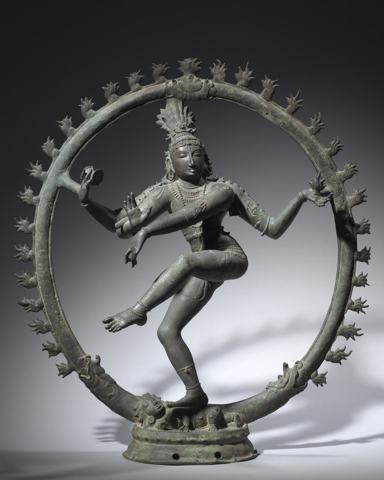
The destroyer and transformer — ascetic on the cremation ground, lord of the cosmic dance, and for millions of Shaivas the supreme reality itself.
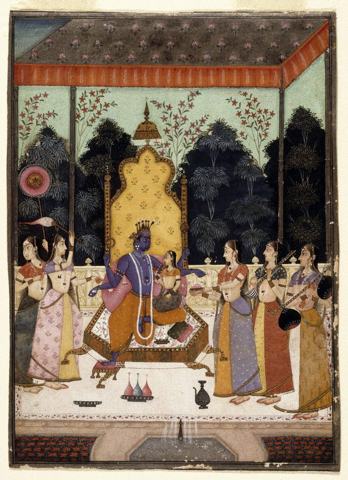
The preserver of cosmic order — the god who descends age after age, as Rama, as Krishna, and in other forms, to set dharma right when it fails.
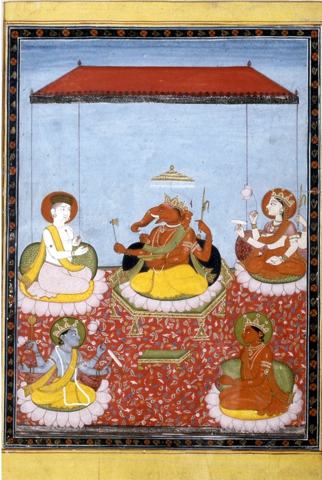
The elephant-headed son of Shiva and Parvati, lord of beginnings and remover (and placer) of obstacles, invoked before every undertaking.
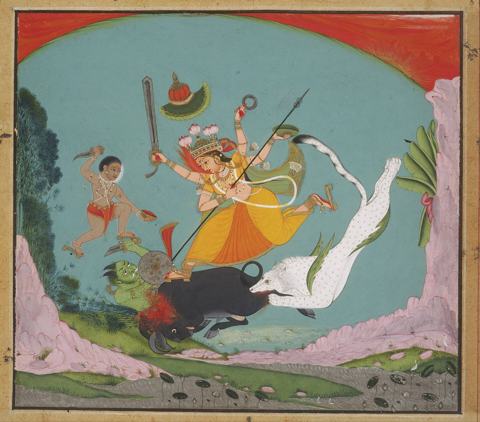
The warrior goddess assembled from the massed light of all the gods, lion-mounted slayer of the buffalo demon Mahishasura.
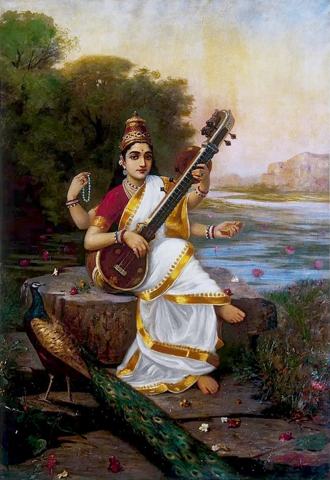
Goddess of speech, learning, music and the arts — a Vedic river who became the patron of every word written or sung.
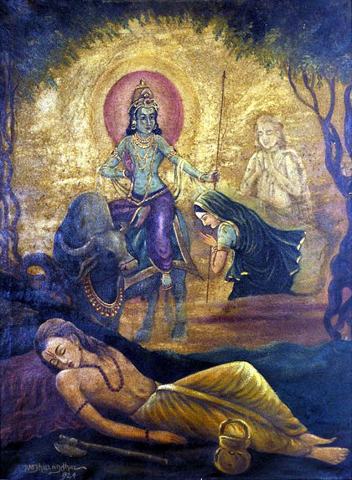
The Rigveda's first mortal to find the path of death, later Lord of the Dead — met by the boy Nachiketas in the Katha Upanishad and once outwitted by Savitri.
Sources & Further Reading
- 1.The Rigveda (c. 1500–1200 BCE), including the Hiranyagarbha and Purusha hymns; trans. Stephanie W. Jamison & Joel P. Brereton. Oxford University Press, 2014.
- 2.The Shatapatha Brahmana.
- 3.The Mahabharata.
- 4.The Vishnu Purana.
- 5.The Shiva Purana.
- 6.Bailey, Greg. The Mythology of Brahma. Oxford University Press, 1983.
- 7.O'Flaherty, Wendy Doniger. Hindu Myths: A Sourcebook Translated from the Sanskrit. Penguin Classics, 1975.
- 8.Flood, Gavin. An Introduction to Hinduism. Cambridge University Press, 1996.
Spot an error or have a source to suggest? Write to info@viseterna.com. We cite primary sources and modern scholarship, and we correct fast.