
Agni (Hindu Fire God)
The fire god who opens the Rigveda — household priest among men and messenger among the gods, carrying every offering from the altar to the deities themselves.
Agni, God of Fire, Riding a Ram, gouache painting, Tiruchirapalli, Tamil Nadu, c. 1830 (British Museum) · Public domain · source
The God Who Opens the Rigveda
The very first hymn of the Rigveda, out of roughly a thousand, is addressed to Agni: "I praise Agni, the household priest, the god who administers the sacrifice, the invoker who bestows the most treasure" 1. That placement is not incidental. Agni is purohita, the priest placed at the front of every rite, and among the gods he holds the specific office of hotr, the one who calls the other deities to the offering — which makes him, in Vedic religious logic, the god through whom every other act of worship has to pass 1. Jamison and Brereton's introduction to their translation treats his opening position as a structural statement about the entire collection: whatever else the Rigveda's hymns ask for, they begin by securing the attention of the fire that will carry the request 1.
Fire With Three Births
Vedic poets describe Agni as born three times over, a single power distributed across the visible cosmos rather than confined to one place: in the sky as the sun, in the atmosphere as lightning, and on earth as the sacrificial and domestic flame 1,4. This threefold birth underlies the epithet Vaishvanara, "belonging to all men," and lets the hymns address the modest fire kindled in a household hearth and the fire of lightning or of the sun in the same breath, as manifestations of one another rather than as separate gods loosely grouped together 1,5. Flood reads this distributed, multiform quality as characteristic of Vedic theology more broadly, in which a single divine power routinely appears under several names and in several elements without any sense of contradiction 5.
Messenger Between Two Worlds
Agni's defining function is transit. Oblations poured or placed into the fire do not simply vanish — the smoke rising from the altar is understood as Agni's own body carrying the offering upward, and hymns address him directly as duta, messenger, the intermediary through whom the other gods receive what humans have prepared for them 1,3. He is, in this sense, the hinge of the entire sacrificial system: without Agni to carry it, an offering is only food and fuel. The same logic extends past the individual rite. Agni is present at birth rituals, at weddings — where the couple circles the fire and takes their vows before it as witness, a custom still called Agni Sakshi — and at cremation, where the funeral fire is his particular domain, carrying the dead into whatever comes next much as he carries the smoke of any other offering 3,5.
Agni's Character and Myths
The Brahmana literature is fond of a more reluctant Agni than the hymns' confident invocations suggest. One well-known myth has Agni flee his sacrificial duties altogether, hiding from the gods — variously in the waters or inside a fig tree — because he is tired of being invoked at every single rite performed anywhere; the gods eventually find him and coax him back only by granting him a share of every offering as fixed compensation, an origin story for why fire is due its portion before any other god receives one 2,3. He is also repeatedly described as many-mouthed and many-tongued, a physical way of explaining how one fire can simultaneously consume the separate offerings of countless different rites without confusion 1,3.
Agni's mythology intersects with several other major stories rather than standing entirely apart from them. Puranic accounts of the birth of Parvati's son Kartikeya have Agni carry Shiva's seed onward toward the river Ganga before the child is born and raised, casting the fire god as an intermediary even in myths that are not primarily about him 3. In the Rigveda itself he is paired constantly with Indra as one of the two most frequently invoked gods in the whole collection, sacrifice and storm standing together at the center of the earliest Vedic pantheon 1.
The Fire Altar and Its Scholars
Vedic fire ritual did not stay confined to the hymns that describe it. The Agnicayana, the elaborate construction of a brick fire altar built in the shape of a giant bird, is among the most complex rites described in the Brahmana texts, and Frits Staal's landmark study documents an actual performance of it, conducted by Nambudiri brahmins in Kerala in 1975, treating the ceremony as a living continuation of a ritual tradition already ancient when the Brahmanas were composed rather than as an antiquarian reconstruction 4. That continuity is, in the end, Agni's most distinctive feature among Vedic gods: the household flame the hymns describe is not a metaphor safely confined to old poetry, but a rite still kindled, by name, in Hindu homes and temples today 4,5.
Continue Exploring
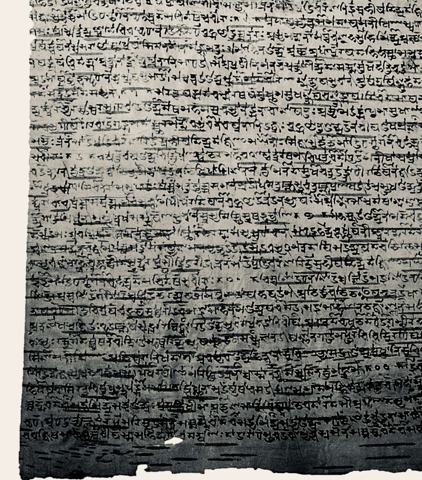
Ten books of hymns to Agni, Indra and Soma — the oldest surviving Sanskrit text, kept by memory alone for two millennia before it was ever written down.
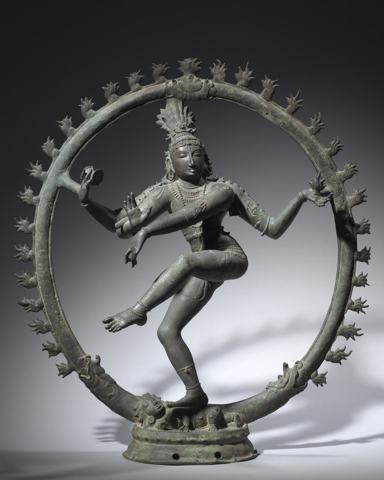
The destroyer and transformer — ascetic on the cremation ground, lord of the cosmic dance, and for millions of Shaivas the supreme reality itself.
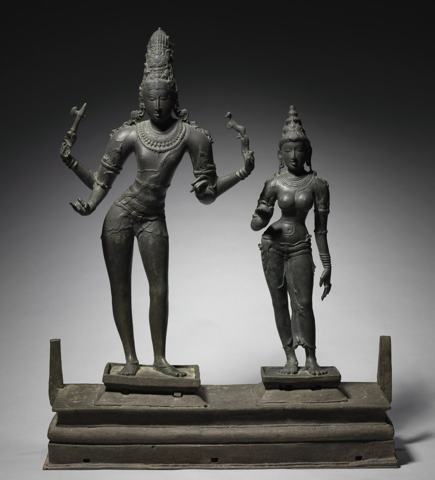
The Goddess who wins Shiva through fierce austerity, mother of Ganesha and Kartikeya, and one revealed face of the same Devi worshipped as Durga and Kali.
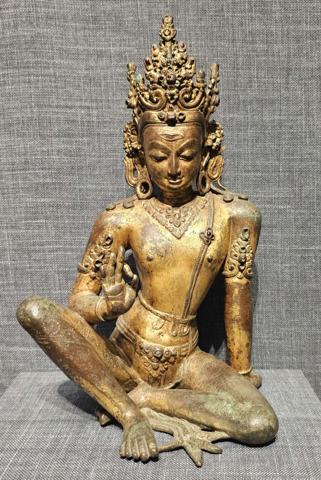
King of the gods and lord of storm and war — wielder of the thunderbolt, slayer of the serpent Vritra, and the deity Hinduism gradually demoted.
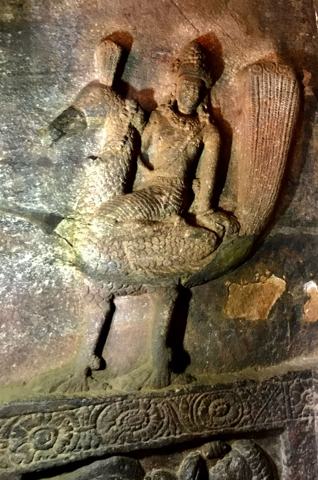
The six-headed god of war, spear in hand and peacock beneath him — Skanda to Sanskrit tradition, and Tamil Nadu's most fervently worshipped deity as Murugan.
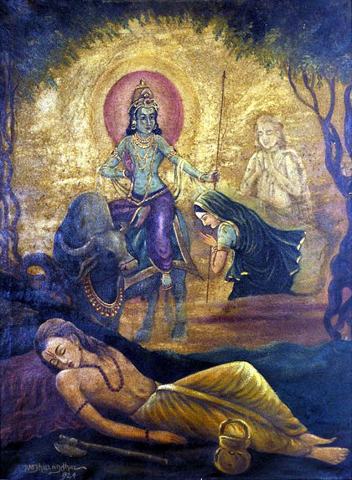
The Rigveda's first mortal to find the path of death, later Lord of the Dead — met by the boy Nachiketas in the Katha Upanishad and once outwitted by Savitri.
Also mentioned inArjuna
Sources & Further Reading
- 1.The Rigveda, translated by Stephanie W. Jamison and Joel P. Brereton as The Rigveda — The Earliest Religious Poetry of India. Oxford University Press, 2014.
- 2.Satapatha Brahmana, translated by Julius Eggeling, in Sacred Books of the East, vols. 12, 26, 41, 43-44. Clarendon Press, 1882-1900.
- 3.O'Flaherty, Wendy Doniger, trans. Hindu Myths — A Sourcebook Translated from the Sanskrit. Penguin Classics, 1975.
- 4.Staal, Frits, with C. V. Somayajipad and M. Itti Ravi Nambudiri. Agni — The Vedic Ritual of the Fire Altar. 2 vols. Asian Humanities Press, 1983.
- 5.Flood, Gavin. An Introduction to Hinduism. Cambridge University Press, 1996.
Spot an error or have a source to suggest? Write to info@viseterna.com. We cite primary sources and modern scholarship, and we correct fast.