
Kali
The black goddess of time and dissolution — annihilator of demons and of the ego, and to millions of Bengali devotees simply the Mother.
Kali, Kalighat painting, Calcutta, 19th century (Cleveland Museum of Art) · CC0 · source
Who Kali Is
Kali (काली) is the fierce goddess of time, destruction, and liberation — the most immediately shocking image in Hindu iconography and, for a very large devotional community, the most tender 5,6. Her name is the feminine of kala, which means both "black" and "time," and both readings are used: she is the Black One, and she is Time, which consumes everything it produces 5.
She is worshipped now, daily, by millions of people, most intensively in Bengal, Assam, and Odisha and across the Hindu diaspora 6. Nothing in what follows is a dead mythology, and the gap between the terrifying image and the affectionate relationship her devotees describe is the central thing to understand about her 5,6.
Born from Durga's Brow
Kali's classic origin is in the Devi Mahatmya, the sixth-century text that is the foundational scripture of goddess worship in India 1. The goddess Durga is besieged by the demon generals Chanda and Munda. Her face darkens with fury, and from her furrowed brow springs Kali — gaunt, black, sunken-eyed, carrying a sword and a noose, wearing a garland of skulls and a tiger skin, her tongue lolling, filling the sky with her roar 1,5.
She tears through the demon army, crushing soldiers in her jaws, and beheads Chanda and Munda, presenting the heads to Durga — who names her Chamunda for the feat 1. Coburn emphasises that the Devi Mahatmya does something structurally new: the Goddess is not a consort assisting a god but the supreme power, and Kali is an aspect of her wrath given independent body 1.
Older traces exist. A goddess named Kali appears in the Mundaka Upanishad's list of the flickering tongues of the sacrificial fire, and dark battlefield goddesses of death haunt the Mahabharata, but neither gives the developed figure of the Puranas 2,3,5.
Raktabija
Her most famous feat solves an impossible problem. The demon Raktabija has a boon: every drop of his blood that touches the ground becomes another demon exactly like him 1. Every wound the goddess inflicts multiplies her enemy until the battlefield is filled with copies.
Kali's answer is to stop the blood reaching the earth. She spreads her tongue across the field and drinks each drop as it falls, swallowing the duplicates as they emerge, until the original is drained and killed 1,5. It is a grotesque image and a precise one: the only thing that can defeat endless proliferation is something that consumes without limit 5.
The Body and What It Means
Kali's iconography is a compressed argument, and Kinsley's reading of it is the standard one 5. She is black or deep blue, naked or barely clothed, with wild unbound hair. She has four arms: two hold a bloodied sword and a freshly severed head, and two are raised in the gestures of "do not fear" and "receive this boon" — terror and reassurance offered by the same body at once 5.
Around her neck hangs the mundamala, a garland of fifty or fifty-one severed heads, conventionally identified with the letters of the Sanskrit alphabet — language itself, worn as trophies 5. Her skirt is made of severed arms, the organs of action, and her setting is the cremation ground, where the distinctions people spend their lives defending are reduced to ash 5,6.
The famous protruding red tongue is usually explained in popular Bengali tradition as embarrassment. Kinsley notes that this reading is a later, domesticating one: in Tantric interpretation the extended tongue signals appetite and consumption, and the shame narrative arrives with the goddess's gradual softening into a mother figure 5.
Standing on Shiva
The most reproduced Kali image shows her standing or dancing on the prone white body of Shiva. Two explanations circulate, and both are current 5.
In the narrative version, her dance after Raktabija cannot be halted, so Shiva lies down in her path; she treads on her own husband, realises what she has done, and stops — the tongue coming out in shock 4,5. In the Tantric version the image is not a story at all but a diagram: Shiva is pure consciousness, inert without power, and Kali is shakti, the active energy that makes anything happen. Without her he is a corpse, and the Sanskrit pun between shiva and shava, "corpse," is deliberate 5,7.
The Mother of Bengal
The transformation that made Kali beloved happened chiefly in Bengal, from about the eighteenth century, and it was accomplished largely in song 5,6. The poet Ramprasad Sen addressed her not as a terror to be appeased but as Ma — a mother he could scold, tease, complain to, and refuse to let go of. His Shakta lyrics, still sung, argue with her, accuse her of neglect, and insist on the relationship anyway 5,6.
The nineteenth-century mystic Ramakrishna, priest at the Dakshineswar temple outside Calcutta, made the same devotion internationally visible: his ecstatic relationship with the Mother, and his insistence that the terrifying and the tender were one being, shaped modern Hindu thought through his disciple Vivekananda 5,6.
McDaniel's fieldwork in West Bengal documents how varied the resulting practice is — a folk strand centred on possession and healing, a Tantric strand centred on ritual and visualisation, and a devotional strand of pure love — coexisting, and not always on friendly terms 6.
Worship, Then and Now
Kali Puja, on the new-moon night of Kartik coinciding with Diwali, is one of the great festivals of Bengal: neighbourhood images, night-long worship, immersion the next day. Her major temples include Kalighat and Dakshineswar in Kolkata, Tarapith in Birbhum, and the shakti pitha of Kamakhya in Assam 6.
Offerings vary by lineage and temple: flowers, hibiscus, sweets, and — at some temples, within a specific ritual frame — animal sacrifice, a practice that continues and is debated within Hinduism itself 6. Kali also heads the Dasha Mahavidya, the ten wisdom goddesses of Tantric tradition, and appears in a benign household form, Dakshina Kali, beside her cremation-ground form 5,7.
One last note is owed. Kali was badly served by colonial writing, which used her image to characterise Indian religion as bloodthirsty, and she continues to be borrowed as a decorative shorthand for feminine rage 5,6. Both distort a figure whose worshippers, in the poems that define her cult, mostly address her as their mother and ask her to come home 6.
Continue Exploring
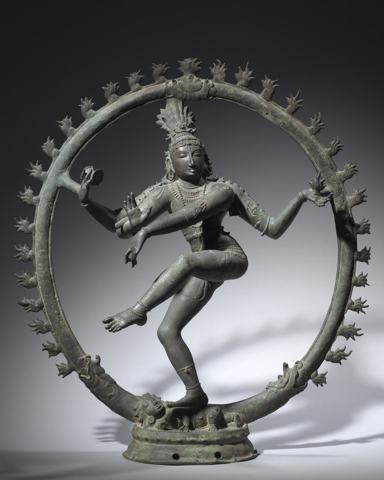
The destroyer and transformer — ascetic on the cremation ground, lord of the cosmic dance, and for millions of Shaivas the supreme reality itself.
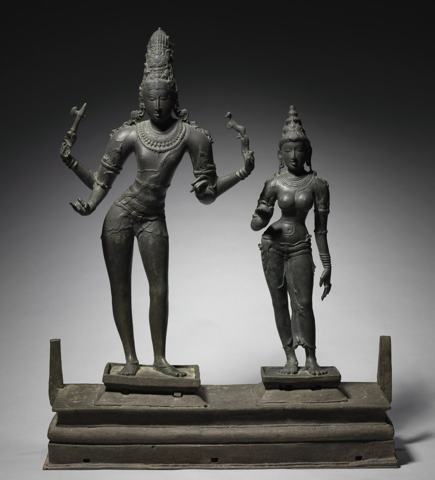
The Goddess who wins Shiva through fierce austerity, mother of Ganesha and Kartikeya, and one revealed face of the same Devi worshipped as Durga and Kali.
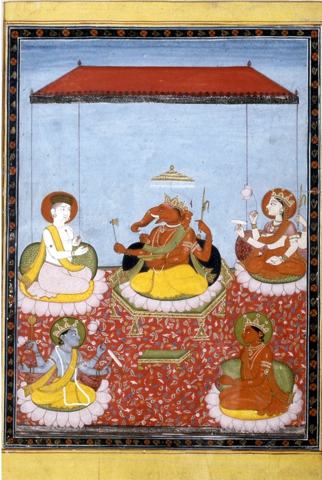
The elephant-headed son of Shiva and Parvati, lord of beginnings and remover (and placer) of obstacles, invoked before every undertaking.
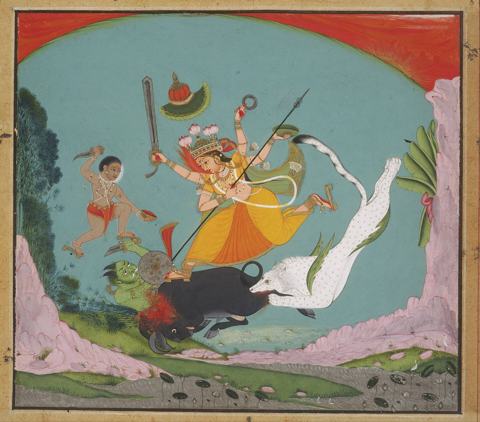
The warrior goddess assembled from the massed light of all the gods, lion-mounted slayer of the buffalo demon Mahishasura.
The festival of lights lit around the new moon of Kartika — explained across regions and faiths by at least four different founding stories.
Shiva's three-pronged weapon — planted on temple roofs, carried by wandering ascetics, and read as a compressed statement of his whole theology.
Sources & Further Reading
- 1.Devi Mahatmya (in the Markandeya Purana, c. 5th–6th c. CE); trans. Thomas B. Coburn, Encountering the Goddess. SUNY Press, 1991.
- 2.The Mahabharata.
- 3.The Mundaka Upanishad.
- 4.The Kalika Purana (c. 10th–11th c. CE).
- 5.Kinsley, David. Hindu Goddesses: Visions of the Divine Feminine in the Hindu Religious Tradition. University of California Press, 1986.
- 6.McDaniel, June. Offering Flowers, Feeding Skulls: Popular Goddess Worship in West Bengal. Oxford University Press, 2004.
- 7.Flood, Gavin. An Introduction to Hinduism. Cambridge University Press, 1996.
Spot an error or have a source to suggest? Write to info@viseterna.com. We cite primary sources and modern scholarship, and we correct fast.