
Ravana
Lanka's rakshasa king, ten-headed abductor of Sita in the Ramayana and a devoted worshipper of Shiva — a villain regional traditions read very differently.
Shri Ram Shooting an Arrow at Ravana, the Ten-Headed Demon, Indian roundel painting, 19th century (Wellcome Collection) · CC BY 4.0 · source
The Rakshasa King of Lanka
Ravana is the ten-headed, twenty-armed king of the rakshasas and the principal antagonist of the Ramayana, but Valmiki's text gives him a pedigree far grander than "demon." He is the son of the sage Vishravas and the rakshasi Kaikasi, grandson of the great rishi Pulastya, and half-brother of Kubera, god of wealth, whose kingdom of Lanka he seizes for himself along with the flying palace Pushpaka 1. Extreme austerities directed at Brahma earn him a boon of near-invulnerability — safe from gods, demons, and serpents — with mortal men left out of the terms only because Ravana, in his pride, considered humans too weak to be worth fearing 1. The epic tradition never fully settles how literally to take his ten heads; some tellings treat them as heads in fact, others as a count of his mastery of the four Vedas and six systems of learning made visible 1,6.
By the time the Ramayana opens, Ravana has already conquered gods, sages, and rival kings, and rules Lanka as a scholar as much as a warrior — accomplished in statecraft, music, and the Vedas, which makes his downfall a fall from real greatness rather than the collapse of an ordinary monster 1,7.
Shiva's Devotee
Ravana's devotion to Shiva runs through the tradition as a genuine counterweight to his villainy. The best-known story has him try to uproot Mount Kailasa itself to carry it, and Shiva, to Lanka, only for Shiva to press the mountain down with a toe, trapping Ravana's arm beneath it for a thousand years. Rather than curse his tormentor, Ravana is said to have composed the Shiva Tandava Stotra on the spot, a hymn of praise so accomplished that Shiva freed him and gave him the sword Chandrahasa in reward 4. The hymn is still recited by Shaiva devotees today, one of the few places where Ravana is remembered without any of the moral weight of the epic he ruins 4.
The Abduction of Sita
The central crime of the Ramayana follows a chain of slights and schemes. Ravana's sister Shurpanakha, spurned and mutilated by Rama's brother Lakshmana after propositioning Rama in the forest, begs Ravana for revenge; Ravana enlists the rakshasa Maricha to become a golden deer that lures Rama away from the hermitage, then arrives disguised as a wandering ascetic to carry Sita off in Pushpaka while she is alone 1. The vulture king Jatayu intercepts the flight and is mortally wounded for the attempt, living just long enough to tell Rama what happened 1. Valmiki is careful to note a curse constraining Ravana even in captivity: he cannot force himself on a woman without her consent, so Sita is held in the Ashoka grove under guard and threat rather than assaulted outright, and the year of her imprisonment becomes a war of attrition against his patience as much as hers 1.
War and Death
Rama's alliance with the vanara king Sugriva and his general Hanuman produces the bridge to Lanka and the war that follows, ending with Rama killing Ravana in single combat after his own brother Vibhishana defects to Rama's side and discloses the secret of his invulnerability. The death of so accomplished and devoted a king, rather than a simple monster, is part of why the Ramayana has never been read as a story with an uncomplicated villain 1,7.
Regional Counter-Traditions
Outside Valmiki's frame, Ravana looks considerably different. Kamban's twelfth-century Tamil Kamba Ramayanam, one of the most beloved Ramayana tellings in South India, gives him a tragic, almost overwhelming stature, and Tamil literary tradition has long read his death scene with a poignancy that Valmiki's more straightforwardly righteous telling does not aim for 2,6. A. K. Ramanujan's influential essay on the plurality of Ramayana traditions treats these divergences in tone and sympathy as evidence against any single "correct" version of the story 6.
Jain retellings go further. Vimalasuri's Paumacariya, one of the oldest surviving Jain versions, presents Ravana not as a rakshasa demon but as an accomplished vidyadhara — a member of a semi-divine human lineage — and rationalizes his "ten heads" and superhuman feats as exaggerations of an unusually gifted king rather than literal monstrosity 3,5. In several Jain tellings it is Lakshmana, not Rama, who kills him, and Jain cosmology holds that his accumulated learning and devotion still earn him a future path toward liberation despite his crimes — a genuinely different moral verdict from the Brahmanical epic 5.
A newer counter-tradition has emerged in Sri Lanka, where twentieth- and twenty-first-century Sinhala Buddhist writers have reclaimed Ravana as an indigenous king and symbol of the island's pre-colonial sovereignty, a reading Justin Henry's recent history traces to figures like the early-twentieth-century nationalist Kumaratunga Munidasa and situates against Tamil Hindu traditions that had already cast Ravana as a Dravidian hero for nearly a century 7. Henry treats this "Sinhala Ravana" phenomenon as a modern reconstruction responding to modern politics, not as a survival of ancient Sri Lankan belief, and stresses that it now runs in parallel with, and in tension against, the older Tamil claim on the same figure 7.
Continue Exploring
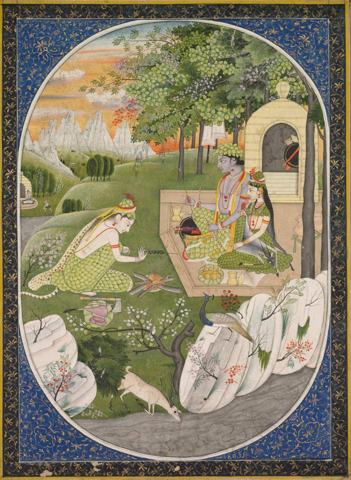
Prince of Ayodhya and seventh avatar of Vishnu — exiled hero of the Ramayana, slayer of Ravana, and the ideal of dharma.
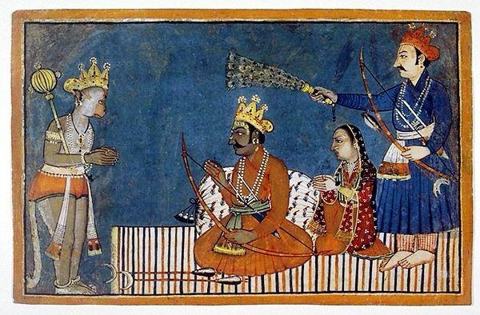
Son of the wind, greatest of the vanaras, and Rama's perfect servant — the leaper of oceans who became one of India's most worshipped gods.
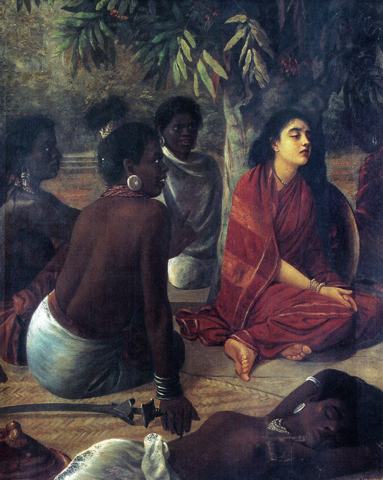
Wife of Rama and heroine of the Ramayana — found in a furrow, abducted by Ravana, tested by fire, and read differently across the tradition's many tellings.
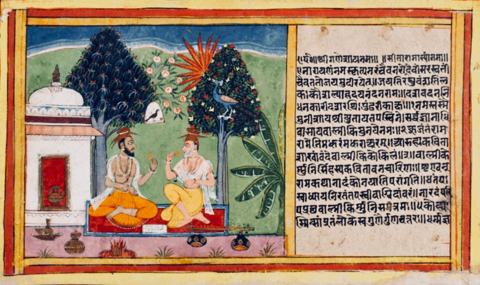
Valmiki's Sanskrit epic of Rama's exile and Sita's rescue — one telling among dozens across Asia, critically re-edited only in the twentieth century.
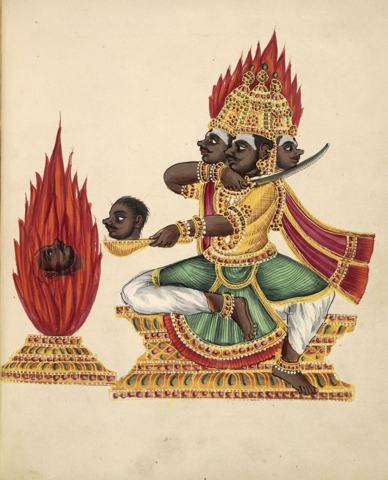
Hindu myth's shape-shifting night-demons, from Vedic sacrifice-wreckers to the villains of Lanka — a class capable of both monstrous cruelty and real nobility.
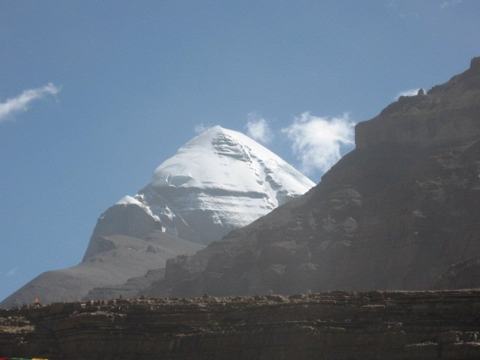
A remote, unclimbed Himalayan peak in western Tibet sacred to Hindus, Buddhists, Jains, and Bon — Shiva's meditation seat and the source of four great rivers.
Also mentioned inDiwali (Deepavali)Surya (Hindu Sun God)
Sources & Further Reading
- 1.Valmiki. Ramayana, translated by Robert P. Goldman et al. as The Ramayana of Valmiki — An Epic of Ancient India. Princeton University Press, 1984-2017.
- 2.Kamban. Kamba Ramayanam, translated by P. S. Sundaram as The Kamba Ramayana. Penguin Classics, 2002.
- 3.Vimalasuri. Paumacariya (Prakrit Jain Ramayana, c. 3rd-5th century CE).
- 4.Shiva Tandava Stotra (traditionally attributed to Ravana).
- 5.Jaini, Padmanabh S. "Jaina Puranas — A Puranic Counter Tradition." In Purana Perennis — Reciprocity and Transformation in Hindu and Jaina Texts, edited by Wendy Doniger. State University of New York Press, 1993.
- 6.Ramanujan, A. K. "Three Hundred Ramayanas — Five Examples and Three Thoughts on Translation." In Many Ramayanas — The Diversity of a Narrative Tradition in South Asia, edited by Paula Richman. University of California Press, 1991.
- 7.Henry, Justin W. Ravana's Kingdom — The Ramayana and Sri Lankan History from Below. Oxford University Press, 2022.
Spot an error or have a source to suggest? Write to info@viseterna.com. We cite primary sources and modern scholarship, and we correct fast.