
Rama
Prince of Ayodhya and seventh avatar of Vishnu — exiled hero of the Ramayana, slayer of Ravana, and the ideal of dharma.
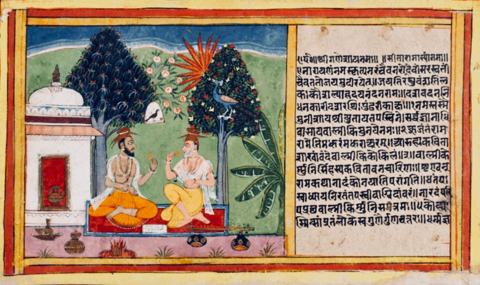
Rama, Sita and Lakshmana in the Forest, page from the Ramayana, Kangra school, Pahari Hills, 19th century (Cleveland Museum of Art, 1989.332) · CC0 · source
Prince of Ayodhya
Rama is the eldest son of King Dasharatha of Ayodhya and Queen Kaushalya, and the central figure of the Ramayana, one of the two great Sanskrit epics. He has three half-brothers — Bharata, Lakshmana and Shatrughna — and wins his wife Sita, daughter of King Janaka of Mithila, by stringing and breaking the bow of Shiva at her svayamvara 1,5.
In the epic's own frame he is presented first as a man: Valmiki's poem opens with the sage asking who in the world is truly virtuous, and receiving Rama as the answer. The identification of Rama with Vishnu is present in the text as it survives, but scholars have long argued that it is concentrated in the first and last books, which most philologists regard as later additions to a core of Books II through VI. The consequence is that the oldest recoverable Rama is a heroic prince, and the avatar is a theological layer laid over him 5,6,7.
The Exile
The story turns on a promise. Dasharatha's junior queen Kaikeyi, prompted by her maidservant Manthara and holding two old boons, demands that her son Bharata be crowned and Rama exiled to the forest for fourteen years. Dasharatha is destroyed by the demand but cannot break his word; Rama accepts without argument, and it is this acceptance — not any feat of arms — that the tradition treats as the source of his authority 1,5. Sita insists on coming, as does Lakshmana. Dasharatha dies of grief, and Bharata, refusing the throne, rules as regent with Rama's sandals placed on it.
In the forest the exiles fall foul of the rakshasi Shurpanakha, whose brother is Ravana, the ten-headed king of Lanka. Lakshmana disfigures her; Ravana retaliates by luring Rama away with a golden deer and abducting Sita. The old vulture Jatayu dies trying to stop him 1,5.
The War
The search brings Rama into alliance with the vanaras. He kills the monkey king Vali to install his brother Sugriva — an episode the epic itself treats as morally difficult, since Rama shoots from concealment, and which commentators have argued over for a thousand years 1,5,6. Sugriva's minister Hanuman leaps the ocean, finds Sita in the ashoka grove and burns Lanka. An army of monkeys and bears builds a causeway to the island, and the war books describe the siege in detail: the giant Kumbhakarna, the sorcerer-prince Indrajit, the defection of Ravana's brother Vibhishana, and the final duel in which Rama kills Ravana with a divine weapon 1,5.
What follows is the epic's hardest passage. Rama's first words to the recovered Sita are cold — he says he fought for his honour, not for her — and she enters fire to prove her purity, the agni pariksha, and is delivered unburnt. The seventh book, generally considered later, takes it further: back in Ayodhya, public gossip about the queen's years in another man's house leads Rama to banish the pregnant Sita to Valmiki's hermitage, where she bears the twins Lava and Kusha. Years later, asked again to prove herself, she calls on the earth to take her back, and it does 1,5,6.
Rama Rajya
Rama's reign, Rama rajya, became the tradition's shorthand for perfect government: no famine, no premature death, no injustice. It is a political ideal as much as a religious one, invoked by Gandhi as a vision of just rule and, in other hands, put to sharply different uses in modern Indian politics — a history that Sheldon Pollock and others have examined directly and that has made the epic contested public property rather than settled scripture 6,7.
Many Ramayanas
There is no single Ramayana. Valmiki's Sanskrit poem is the fountainhead, but Kamban's Tamil Iramavataram, Tulsidas's Awadhi Ramcharitmanas, Krittibas's Bengali version, Jain retellings in which Lakshmana rather than Rama kills Ravana, Buddhist Jataka versions, and the Thai Ramakien, Javanese Kakawin Ramayana and Cambodian Reamker are all full traditions in their own right, not derivatives 5,6. Some tellings, particularly in folk and women's song traditions, are markedly more sympathetic to Sita and considerably harder on Rama 6.
Tulsidas's version is the one most North Indians actually know. Written in the vernacular in 1574, sung and staged annually as the Ramlila cycle, it recentres the story on devotion — Rama as accessible God rather than exemplary king — and it is largely responsible for the shape of modern Rama bhakti 2,8.
Worship
Rama is worshipped alongside Sita, Lakshmana and Hanuman, and his temples are among the most visited in India. Rama Navami, in the spring month of Chaitra, marks his birth; Vijaya Dashami marks his victory over Ravana, celebrated with effigy-burnings across North India; and Diwali is explained in much of the country as the lamps lit for his return to Ayodhya 2,5. The greeting Ram Ram and the name itself as a mantra — repeated at deaths, on pilgrimage, in daily practice — arguably do more devotional work than the temples.
Related entries: Hanuman, Vishnu, Krishna, Shiva, Lakshmi, Garuda, Indra.
Continue Exploring
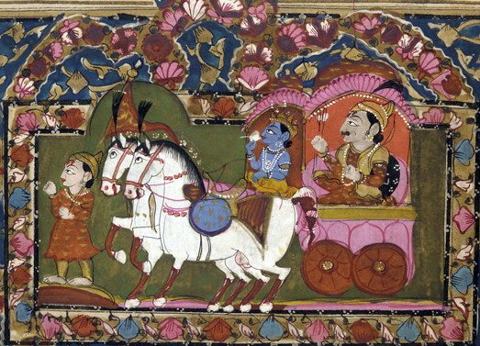
Cowherd, lover, statesman and charioteer — the avatar of Vishnu who speaks the Bhagavad Gita and anchors India's largest devotional tradition.
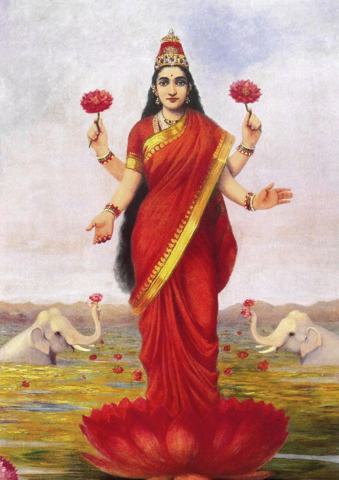
Goddess of wealth, beauty and good fortune, born from the churning of the ocean and inseparable consort of Vishnu.
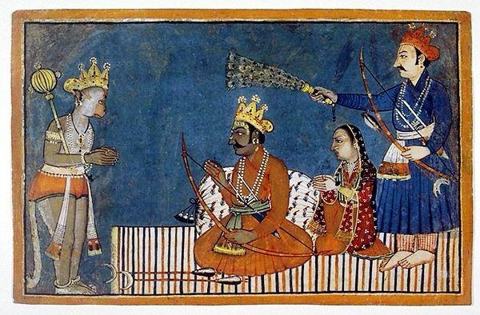
Son of the wind, greatest of the vanaras, and Rama's perfect servant — the leaper of oceans who became one of India's most worshipped gods.
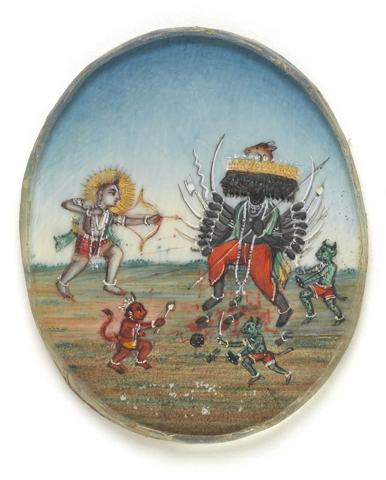
Lanka's rakshasa king, ten-headed abductor of Sita in the Ramayana and a devoted worshipper of Shiva — a villain regional traditions read very differently.
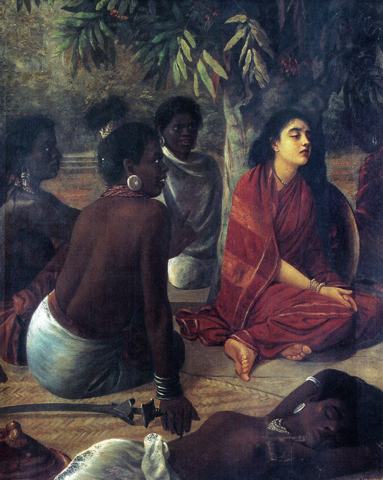
Wife of Rama and heroine of the Ramayana — found in a furrow, abducted by Ravana, tested by fire, and read differently across the tradition's many tellings.
Valmiki's Sanskrit epic of Rama's exile and Sita's rescue — one telling among dozens across Asia, critically re-edited only in the twentieth century.
Also mentioned inDashavataraSurya (Hindu Sun God)
Sources & Further Reading
- 1.Valmiki, Ramayana — the Sanskrit epic in seven books (kandas); core layers c. 3rd century BCE - 3rd century CE.
- 2.Tulsidas, Ramcharitmanas (Awadhi, 1574) — the definitive North Indian retelling.
- 3.Kamban, Iramavataram (Tamil, c. 12th century) — the major South Indian retelling.
- 4.Adhyatma Ramayana and the Rama sections of the Vishnu and Bhagavata Puranas.
- 5.Goldman, Robert P., et al. (trans.). The Ramayana of Valmiki — An Epic of Ancient India. 7 vols. Princeton University Press, 1984-2017.
- 6.Richman, Paula (ed.). Many Ramayanas — The Diversity of a Narrative Tradition in South Asia. University of California Press, 1991.
- 7.Pollock, Sheldon. "Ramayana and Political Imagination in India." Journal of Asian Studies 52, no. 2 (1993).
- 8.Lutgendorf, Philip. The Life of a Text — Performing the Ramcaritmanas of Tulsidas. University of California Press, 1991.
Spot an error or have a source to suggest? Write to info@viseterna.com. We cite primary sources and modern scholarship, and we correct fast.