
Naga
Semi-divine serpent beings of the waters and the underworld — hooded and jewel-crowned guardians of treasure, of rain, and of hidden knowledge.
Nagakanya (serpent being), Indian stone sculpture, Vidisha, Madhya Pradesh · CC0 · source
What a Naga Is
Nagas (नाग; feminine nagini) are the serpent beings of Indian religion: semi-divine, powerful, long-lived, and neither gods nor demons 5,7. In art they appear as great hooded cobras, as serpents with human heads and torsos, or as men and women with a fan of snake hoods rising behind them and a jewel at the brow 5.
They belong to water and to what is beneath. Their kingdom is Patala, the subterranean world, with its capital Bhogavati — described as a place of enormous wealth, lit by the gems in the serpents' hoods 4,5. On the surface they inhabit rivers, lakes, wells, springs, and the pools at the foot of waterfalls, and they hold the local rains, the local fertility, and often the local treasure 5,7.
Vogel's classic study makes the essential point about their character: nagas are not evil. They are proud, easily offended, and dangerous when wronged, but they reward respect, and much of Indian serpent practice is about maintaining good relations rather than driving them off 5. The Atharvaveda already preserves charms against snake venom that address serpents directly, negotiating as much as warding 1,5.
Kadru's Thousand Sons
The Mahabharata gives them a genealogy. Kadru, wife of the sage Kashyapa, asks for a thousand serpent sons and receives them; her sister Vinata asks for two sons of surpassing strength and gets Garuda and the dawn-charioteer Aruna 2,5.
When the sisters bet on the colour of the celestial horse's tail, Kadru orders her sons to darken it by winding themselves through the hairs. Some obey and some refuse; she wins the wager and enslaves her sister — and curses the sons who would not cheat for her 2,5. Garuda's raid on heaven to buy his mother's freedom ends with the nagas cheated out of the nectar of immortality, licking the sharp kusha grass where the vessel had rested, and splitting their tongues 2,5. The episode fixes two permanent facts of Indian myth: serpents have forked tongues, and eagles and serpents are enemies without end.
The Great Nagas
Several nagas are major figures in their own right 3,4,5:
Shesha, also called Ananta, "the endless," bears the earth on his hoods and serves as the couch on which Vishnu sleeps upon the cosmic ocean between world-cycles. When he shifts, the earth quakes 4.
Vasuki is used as the churning rope in the churning of the ocean of milk, wound around Mount Mandara while gods and demons haul on either end — an ordeal that leaves him scorched and vomiting the halahala poison that Shiva then swallows 3,4.
Takshaka kills King Parikshit with a bite, setting in motion the events described below 2.
Kaliya poisons a bend of the Yamuna until the child Krishna leaps in, is coiled and nearly crushed, then rises and dances on the serpent's hoods until he submits — a scene shown in temple sculpture and dance across India 3.
Manasa, the snake goddess of Bengal, has her own scriptural cycle and a bitter struggle for recognition; Kinsley treats her as a striking case of a folk goddess forcing her way into the established pantheon 6.
The Snake Sacrifice
The nagas sit at the structural heart of the Mahabharata. King Parikshit, cursed to die within seven days, is killed by Takshaka despite every precaution. His son Janamejaya responds with a sarpasatra, a serpent sacrifice, a rite that drags snakes from every corner of the world into the fire by mantra 2,5.
The slaughter is stopped by the young sage Astika, whose mother is a naga and whose father a brahmin, and who is granted a boon at exactly the moment Takshaka hangs in the air above the flames 2. And it is at that sacrifice, in the frame story, that the Mahabharata itself is recited — meaning the entire epic is told in the pause of a serpent massacre 2,5. Serpent marriages run through it too: Arjuna marries the naga princess Ulupi, who later restores him to life 2.
Nagas in Buddhism and Jainism
The nagas crossed into every Indian religion. In Buddhist tradition the naga king Mucalinda rises from his pool during a seven-day storm and shelters the newly enlightened Buddha with his coils and spread hood — one of the most reproduced images in all Buddhist art, especially in Southeast Asia 5,7.
Nagas guard the teaching as well: a well-known tradition holds that the Perfection of Wisdom scriptures were kept in the naga realm until the philosopher Nagarjuna retrieved them, and in Theravada ordination the candidate is formally called a naga, preserving an old story about a serpent that took human form to join the order 7. Jain iconography likewise crowns the twenty-third tirthankara, Parshvanatha, with a canopy of serpent hoods 7.
Living Serpent Worship
Naga veneration is ordinary, continuing religious practice across South Asia. Nag Panchami, in the bright half of the month of Shravana, is a widely observed festival on which snakes and their images receive milk, flowers, and turmeric 5,7.
Carved naga stones, nagakal, stand under trees and at temple margins throughout South India, often installed by women praying for children — fertility being the nagas' most consistently invoked gift 5,7. In Kerala, families have maintained sarpa kavu, small uncleared serpent groves on domestic land, and the Mannarasala temple, whose rites are led by a priestess, remains a major centre of naga worship 7.
Belief also runs the other way: nagas are held responsible for certain afflictions, particularly skin diseases and childlessness, understood as the consequence of a serpent offended — by a felled grove, a filled well, or a killed snake 5,7. The remedy is propitiation rather than exorcism, which is the whole logic of the tradition in one sentence 5.
Nagas Across Asia
Where Indian religion went, the nagas followed. Khmer, Thai, and Lao traditions treat the naga as the guardian of waters and of temples: multi-headed naga balustrades line the causeways at Angkor, naga finials curl from Thai temple roofs, and the founding legend of Funan has the brahmin Kaundinya marry a naga princess whose father drinks the flood water to make the land 5,7.
Along the Mekong, the Phaya Naga of Lao and Thai belief is still credited with the lights that rise from the river each year at the end of the rains — a serpent in the water, doing what nagas have always done, which is to be the reason the river matters 7.
Continue Exploring
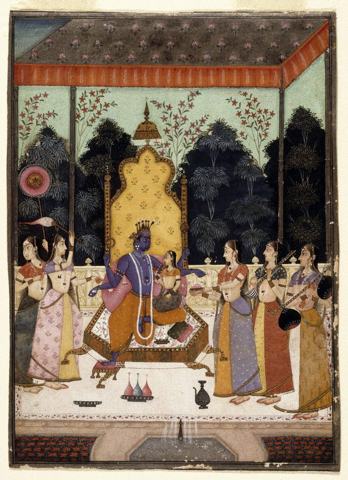
The preserver of cosmic order — the god who descends age after age, as Rama, as Krishna, and in other forms, to set dharma right when it fails.
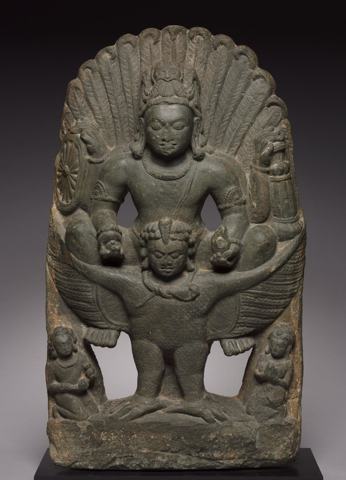
The golden sun-eagle who carries Vishnu — thief of the gods' nectar, liberator of his enslaved mother, and the eternal enemy of the serpents.
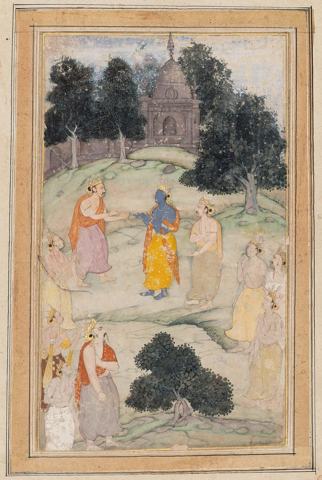
Roughly 100,000 verses attributed to the sage Vyasa — the frame for most of Hindu myth, including the Bhagavad Gita, and still the longest epic poem known.
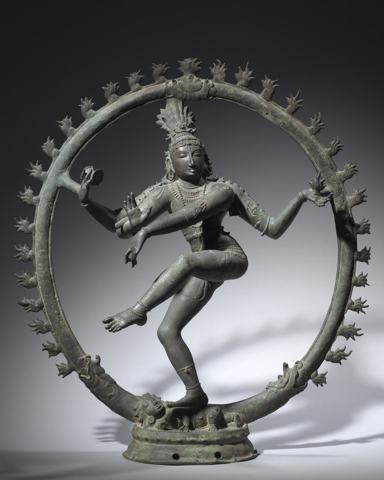
The destroyer and transformer — ascetic on the cremation ground, lord of the cosmic dance, and for millions of Shaivas the supreme reality itself.
The Pandava hero of the Mahabharata, winner of Draupadi's hand and wielder of the bow Gandiva, whose crisis on the battlefield draws out the Bhagavad Gita.
China's dragon — a benevolent, scaled power of rain, river, and sea, emblem of imperial authority and the only mythical beast in the zodiac.
Sources & Further Reading
- 1.The Atharvaveda, charms against serpent venom.
- 2.The Mahabharata, Adi Parva (including the Astika Parva).
- 3.The Bhagavata Purana.
- 4.The Vishnu Purana.
- 5.Vogel, J. Ph. Indian Serpent-Lore, or The Nagas in Hindu Legend and Art. Arthur Probsthain, 1926.
- 6.Kinsley, David. Hindu Goddesses: Visions of the Divine Feminine in the Hindu Religious Tradition. University of California Press, 1986.
- 7.Flood, Gavin. An Introduction to Hinduism. Cambridge University Press, 1996.
Spot an error or have a source to suggest? Write to info@viseterna.com. We cite primary sources and modern scholarship, and we correct fast.