
The Churning of the Ocean (Samudra Manthan)
Gods and demons churn the cosmic ocean with a mountain and a serpent for the nectar of immortality — and very nearly destroy all creation before they get it.
Samudra Manthan, Mandi Kalam of the Pahari School, c. 1820 (State Museum, Lucknow) · CC BY-SA 4.0 · source
Why the Gods Churned
The episode opens with the gods brought low by their own carelessness. In the Puranic framing, the irritable sage Durvasas presents Indra with a garland as a mark of honor; Indra, distracted, drapes it on his elephant, which crushes it underfoot, and the insulted sage curses the gods to lose their strength and glory 2. Weakened, the devas are driven from heaven by the asuras, and Vishnu advises an uneasy truce: gods and demons together will churn the cosmic ocean of milk for amrita, the nectar of immortality, and split what it yields 1,2. Neither side entirely trusts the other, and the Mahabharata's telling makes clear from the outset that the alliance is a convenience, not a peace 1.
Mandara, Vasuki, and Kurma
The gods need a churning rod and a rope. Mount Mandara is uprooted to serve as the rod, and the serpent king Vasuki agrees to be wound around it as the rope, with the devas taking hold of his tail and the asuras his many-hooded head — or, in some retellings, the reverse, the demons objecting to holding the less honorable end 1,2. The mountain, set loose in the ocean, has nothing beneath it and begins to sink; Vishnu takes the form of Kurma, a colossal tortoise, and settles on the ocean floor to bear Mandara's full weight on his shell while the churning begins in earnest 1,2. The turtle avatar became, in later tradition, one of Vishnu's most consistently listed incarnations, remembered specifically for this single act of unglamorous, load-bearing support 6.
Halahala and Nilakantha
The ocean does not yield treasure first. As the churning accelerates, a deadly poison called halahala — in some texts kalakuta — rises to the surface, its fumes threatening to kill gods, demons, and the world itself before the churning has produced anything worth having 2,4. Shiva is the one who intervenes, gathering and swallowing the poison to spare creation, then holding it deliberately in his throat rather than letting it descend further into his body. The poison stains his throat permanently blue, which is why he is called Nilakantha, "the blue-throated one" — an epithet used in worship as often as any other name of his 2,4.
Treasures from the Deep
With the immediate catastrophe past, the churning produces a sequence of marvels, and the sources do not fully agree on their order or number. Among the most consistently named are Kamadhenu, the wish-granting cow; Uchchaihshravas, a brilliant white horse; Airavata, the elephant later given to Indra; the gem Kaustubha, which Vishnu takes for his own breast; Varuni, goddess of wine; the moon, gathered up by Shiva; and Lakshmi herself, rising fully formed from the foam to become Vishnu's consort 1,2,5. Kinsley reads Lakshmi's emergence from the churned ocean as one of Hindu mythology's clearest statements that abundance and good fortune are, structurally, something produced rather than simply given — the reward of shared, dangerous labor rather than an unearned gift 5. Last of all comes Dhanvantari, physician to the gods, bearing the pot of amrita itself 1,2.
Mohini and the Division of the Nectar
The nectar's appearance breaks the truce immediately. Asuras seize the pot and a scramble breaks out, at which point Vishnu takes the form of Mohini, an enchantress of overwhelming beauty, and offers to divide the amrita fairly between both sides if all present agree to abide by her distribution. Both sides agree; Mohini seats the gods and demons in separate rows and serves the nectar only to the gods 2,3,4. The Bhagavata Purana's eighth book gives Mohini's episode its fullest telling, lingering on the demons' infatuation with her as the reason none of them notice the trick until it is finished 3. One asura, Rahu, disguises himself among the devas and manages to swallow a portion before the sun and moon gods recognize him and alert Vishnu, who beheads him instantly with his discus. Because the nectar had already reached his throat, the severed head and body both survive as separate immortal beings, Rahu and Ketu, ever after blamed in Hindu astronomy for swallowing the sun and moon during eclipses 2,4. The demons, denied their share, resume open war against the now-restored gods — the truce having always been, as it was understood from the start, only as durable as the nectar itself 1.
Continue Exploring
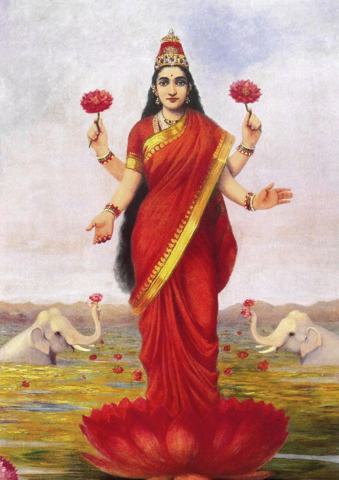
Goddess of wealth, beauty and good fortune, born from the churning of the ocean and inseparable consort of Vishnu.
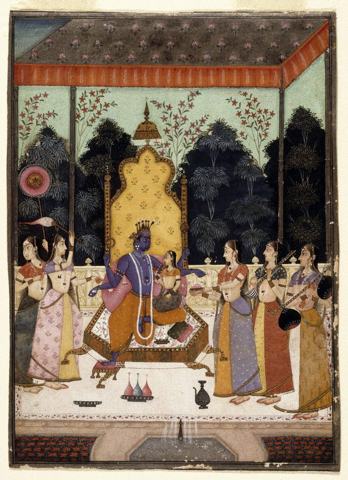
The preserver of cosmic order — the god who descends age after age, as Rama, as Krishna, and in other forms, to set dharma right when it fails.
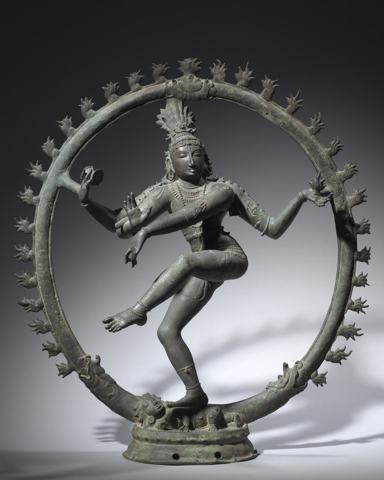
The destroyer and transformer — ascetic on the cremation ground, lord of the cosmic dance, and for millions of Shaivas the supreme reality itself.
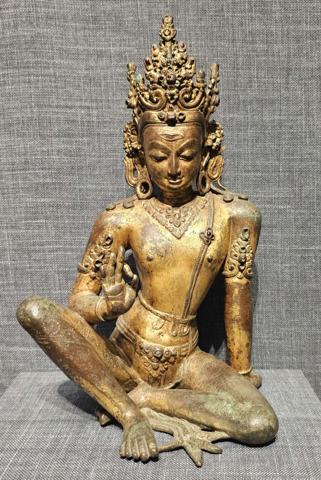
King of the gods and lord of storm and war — wielder of the thunderbolt, slayer of the serpent Vritra, and the deity Hinduism gradually demoted.
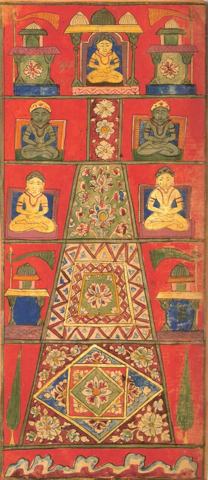
The golden mountain at the exact center of the universe, home of the gods and the fixed point Puranic cosmology measures every continent and ocean from.
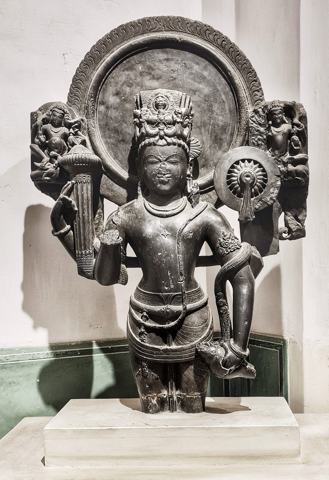
Vishnu's flaming, spinning discus — a weapon of last resort that beheads at a thought, and the emblem that marks him as the upholder of cosmic order.
Also mentioned inDashavatara
Sources & Further Reading
- 1.Mahabharata, Adi Parva, translated by J. A. B. van Buitenen as The Mahabharata, Volume 1 — Book 1, The Book of the Beginning. University of Chicago Press, 1973.
- 2.Vishnu Purana, Book I, chapter 9, translated by Horace Hayman Wilson, 1840.
- 3.Bhagavata Purana, Book 8.
- 4.O'Flaherty, Wendy Doniger, trans. Hindu Myths — A Sourcebook Translated from the Sanskrit. Penguin Classics, 1975.
- 5.Kinsley, David. Hindu Goddesses — Visions of the Divine Feminine in the Hindu Religious Tradition. University of California Press, 1986.
- 6.Flood, Gavin. An Introduction to Hinduism. Cambridge University Press, 1996.
Spot an error or have a source to suggest? Write to info@viseterna.com. We cite primary sources and modern scholarship, and we correct fast.