
Mount Kailash
A remote, unclimbed Himalayan peak in western Tibet sacred to Hindus, Buddhists, Jains, and Bon — Shiva's meditation seat and the source of four great rivers.
Mount Kailash, western Tibet (photograph) · Public domain · source
A Mountain Nobody Has Climbed
Mount Kailash rises 6,638 metres in the Transhimalaya of western Tibet, in a range so remote that no permanent settlement sits within sight of it. It is not a difficult technical climb by Himalayan standards, and mountaineers have asked permission to attempt it more than once — the climber Reinhold Messner reportedly turned down an invitation in the 1980s rather than take it, and Chinese authorities have since closed the mountain to climbing outright 3. Kailash is almost certainly the most revered mountain on earth that has never had a recorded summit, and every tradition that reveres it treats that fact as part of the point rather than an oversight to correct 3.
Geographically it is a genuine landmark independent of any myth: four of Asia's major rivers — the Indus, the Sutlej, the Brahmaputra, and the Karnali (a principal tributary of the Ganges) — all rise within roughly a hundred kilometres of the mountain, a hydrological coincidence striking enough that it alone would have made Kailash a place of significance 4. Its near-perfect pyramidal shape, capped in snow and cut by a distinctive horizontal striation on its south face that pilgrims read as a giant staircase, sets it apart visually from the jagged Himalayan giants further south 3,4.
Shiva's Seat
For Hindus, Kailash is where Shiva sits in unmoving meditation, ash-smeared and indifferent to the world — the setting Kalidasa uses to open the Kumarasambhava, where Kama the god of desire is sent to break the ascetic's concentration and is burned to ash for the attempt 1. The mountain is also, in Puranic and popular imagination, the household Shiva shares with Parvati and their sons, a domestic counterweight to the same god's role as world-renouncer 1.
The best-known Kailash myth is an assault on it. Ravana, the rakshasa king, tries to uproot the mountain bodily to carry it to Lanka; Shiva presses it back down with a single toe, trapping Ravana's arm beneath it, and Ravana composes a hymn of praise from underneath the mountain rather than curse his captor — the Shiva Tandava Stotra, still recited by Shaiva devotees today 1,6. Nearby Lake Manasarovar, the highest large freshwater lake on earth, is paired with Kailash in pilgrim geography as the place where Brahma is said to have created the waters by mental act alone, and the two sites are visited together 2,5.
Not Only a Hindu Mountain
Kailash's real distinction is that no single tradition owns it. Tibetan Buddhists identify it with Mount Meru's Buddhist counterpart and call it the seat of Demchok (Chakrasamvara), a tantric meditational deity, and circumambulate it as part of their own, separate practice 3,6. Jain tradition holds that Rishabhanatha, the first Tirthankara, attained liberation on the mountain, which is known in Jain sources by the older name Ashtapada 3,6. For the pre-Buddhist Bon religion of Tibet, Kailash is Yungdrung Gutsek, the "nine-story swastika mountain," and may be the oldest of the four claims on the site, predating the arrival of Buddhism in Tibet entirely 3. Snelling's history of the mountain treats this overlap not as a coincidence to be explained away but as the actual, durable character of the place: four religious systems that agree on almost nothing else have independently converged on the same 6,638-metre point 3.
Walking Around It Instead of Up It
The dominant ritual act at Kailash is the parikrama or kora, a roughly 52-kilometre circumambulation of the mountain's base, usually walked clockwise by Hindus and most Buddhist schools and counter-clockwise by practitioners of Bon, crossing the 5,630-metre Dolma La pass at its highest point 2,3. Pilgrims commonly complete the full circuit in three days on foot; more demanding devotional versions extend to a punishing series of repeated circuits or, for the most committed, a full-body prostration around the entire route 2,3. Pranavananda's firsthand account from his years surveying the region in the 1930s and 1940s remains one of the fullest descriptions of the pilgrimage as it was practiced before the mountain became more accessible to outside travelers 2.
A Contested, Guarded Present
Kailash sits inside the Tibet Autonomous Region of the People's Republic of China, and access for foreign pilgrims has varied for decades with Chinese permit policy and, more recently, with tension between China and India over the route through Nepal and the disputed border areas nearby 4,6. Eck's study of Indian sacred geography places Kailash among a small set of sites whose religious pull operates almost entirely independent of political control — pilgrims keep petitioning for permits and keep making the journey precisely because the mountain's meaning was never something a government could grant or withhold in the first place 5.
Continue Exploring
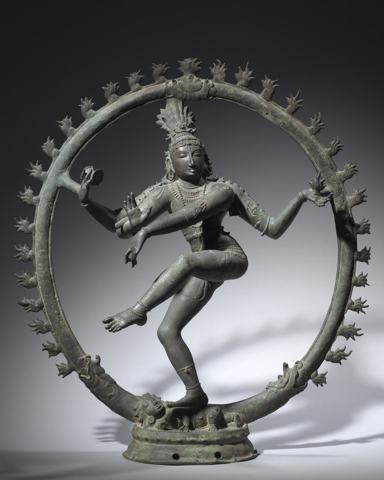
The destroyer and transformer — ascetic on the cremation ground, lord of the cosmic dance, and for millions of Shaivas the supreme reality itself.
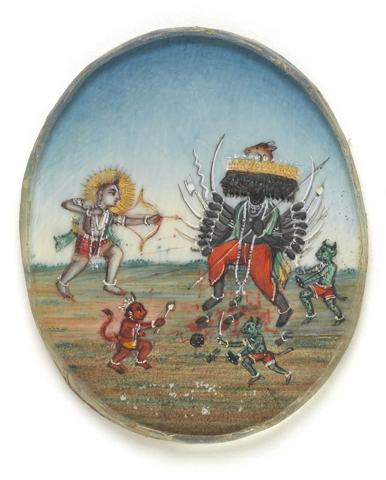
Lanka's rakshasa king, ten-headed abductor of Sita in the Ramayana and a devoted worshipper of Shiva — a villain regional traditions read very differently.
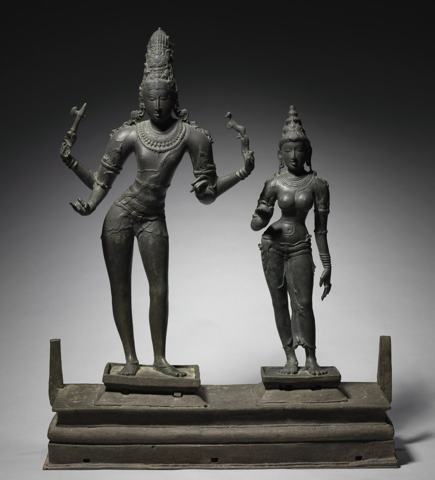
The Goddess who wins Shiva through fierce austerity, mother of Ganesha and Kartikeya, and one revealed face of the same Devi worshipped as Durga and Kali.
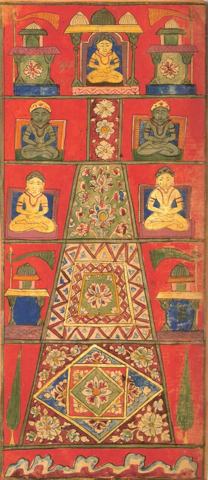
The golden mountain at the exact center of the universe, home of the gods and the fixed point Puranic cosmology measures every continent and ocean from.
Prince of Ayodhya and seventh avatar of Vishnu — exiled hero of the Ramayana, slayer of Ravana, and the ideal of dharma.
The elephant-headed son of Shiva and Parvati, lord of beginnings and remover (and placer) of obstacles, invoked before every undertaking.
Sources & Further Reading
- 1.Kalidasa. Kumarasambhava, translated by Hank Heifetz as The Origin of the Young God - Kalidasa's Kumarasambhava. University of California Press, 1985.
- 2.Pranavananda, Swami. Kailas-Manasarovar. Shri Swami Pranavananda, 1949.
- 3.Snelling, John. The Sacred Mountain: Travellers and Pilgrims at Mount Kailas in Western Tibet, and the Great Universal Symbol of the Sacred Mountain. East-West Publications, 1983.
- 4.Allen, Charles. A Mountain in Tibet: The Search for Mount Kailas and the Sources of the Great Rivers of India. Andre Deutsch, 1982.
- 5.Eck, Diana L. India: A Sacred Geography. Harmony Books, 2012.
- 6.Flood, Gavin. An Introduction to Hinduism. Cambridge University Press, 1996.
Spot an error or have a source to suggest? Write to info@viseterna.com. We cite primary sources and modern scholarship, and we correct fast.