
Kartikeya (Murugan, Skanda)
The six-headed god of war, spear in hand and peacock beneath him — Skanda to Sanskrit tradition, and Tamil Nadu's most fervently worshipped deity as Murugan.
Kartikeya on his peacock, rock-cut relief, Badami Caves, Karnataka, 6th century · CC0 · source
Born to Kill a Demon
Kartikeya, also called Skanda and, above all in South India, Murugan, is the general of the gods' armies, born for a single purpose: to kill the demon Taraka, whom no being except a son of Shiva could defeat, and who could not be conceived in the ordinary way because Shiva's ascetic power was too great for any womb to hold 1,2. The Mahabharata's version of his birth has Shiva's seed passed through Agni, god of fire, and the river Ganga before six of the star-goddesses known as the Krittikas (the Pleiades) nurse the infant, each offering a breast — which is why he is born with six heads, one to feed at each breast at once, and why the name Kartikeya, "son of the Krittikas," sticks to him ever after 2. Parvati is folded into the story as his mother in most later tellings, though the Puranic corpus is genuinely inconsistent about the mechanics, and different texts assign her role differently rather than converging on one account 1.
Six Heads, One Spear
His most distinctive iconographic form is Shanmukha, "six-faced," sometimes shown with twelve arms to match, each face said to preside over a different direction or a different teaching. His weapon, the vel, a sacred spear given to him by his mother in the Tamil tradition, functions less like an ordinary weapon than a portable relic of the god himself: it is installed and worshipped independently at Murugan shrines, and vel processions remain a major feature of his festivals 3,5. His mount is the peacock, Paravani, shown fanning its tail beneath or behind him in sculpture from at least the sixth century, and a rooster banner accompanies him in older iconography as well 1,6.
Slayer of Taraka and Surapadma
The Sanskrit Skanda Purana — the largest of the eighteen Puranas, and named for him specifically — tells of his defeat of Taraka soon after birth, ending the demon's long tyranny over the gods 1. The story is retold and considerably expanded in the Tamil Kanda Puranam, composed by Kachiyappa Sivachariyar around the fifteenth century from Sanskrit sources, which makes the god's central war instead a six-day battle against the demon Surapadma, ending with Surapadma split by Murugan's spear into a peacock, which the god then takes as his mount, and a rooster, which becomes his banner — folding the god's two signature emblems directly into the story of his own victory 3. That siege is commemorated today as Skanda Shashti, a six-day festival observed with particular intensity at Murugan temples in Tamil Nadu.
The Race Around the World
Kartikeya's best-known story outside his own cult is one he loses. Challenged by their parents to see who can circle the world first and win a fruit of wisdom, Kartikeya sets off at once on his peacock, while his brother Ganesha simply walks a circle around Shiva and Parvati and declares that his parents are the world — and wins 1. The tale is not attested early and is best read as a late piece of sectarian byplay between rival cults rather than doctrine, but it is repeated constantly in popular telling, and in some regional versions it is offered as the very reason Kartikeya left the north for Tamil country in wounded pride, never to return 1.
Murugan of the Tamil Hills
In Tamil Nadu, Kartikeya as Murugan is not a secondary son of Shiva but arguably the region's most intensely worshipped deity in his own right, with a documented cult reaching back to the Sangam era of early Tamil poetry, long before most of the Sanskrit Puranic material was composed 3,5,6. Zvelebil's study of that literature identifies Murugan with the still older Ceyon, "the red one," a hill-god of the ancient Tamil tinai landscape classification, worshipped with spear-dance possession rituals (veriyattu) well before his later identification with the Sanskrit Skanda — evidence, in Zvelebil's reading, that the Tamil cult predates and was only later merged with the pan-Indian mythology rather than descending from it 6. Clothey's study of the god's worship across six major hill shrines, the Arupadaiveedu, traces how those local sites (Palani, Tiruchendur, Swamimalai, Tiruttani, Pazhamudircholai and Thiruparankundram among them) were progressively woven into a single pan-Tamil cult centred on the god's two consorts, the celestial Devasena and the hunter-girl Valli, whom he marries by two very different courtships reflecting the god's dual Sanskritic and indigenous character 5.
Worship Today
Murugan's most visible modern festival is Thaipusam, observed with the carrying of kavadi — ornamented physical burdens, sometimes involving pierced skin hooks — as an act of penance and devotion, most spectacularly at the Batu Caves temple in Malaysia, a practice that has spread with the Tamil diaspora well beyond South Asia 5. The Tiruppugazh hymns of the medieval poet-saint Arunagirinathar remain in regular liturgical use at Murugan temples, sung as devotional poetry in a continuous tradition rather than as historical curiosity 4. Sanskritic Skanda worship in the north has receded by comparison to a minor presence, leaving Murugan, in Tamil country, as one of the clearest examples in Hindu practice of a regional cult outliving and eclipsing its pan-Indian counterpart 3,6,7.
Continue Exploring
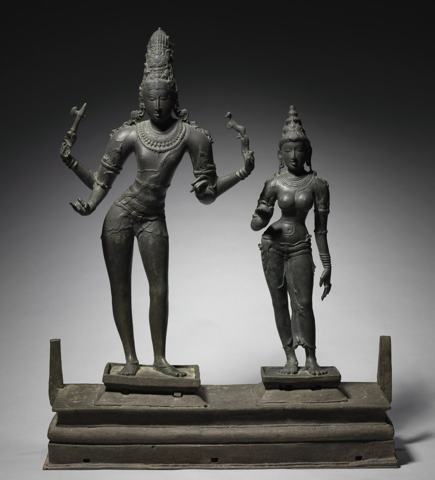
The Goddess who wins Shiva through fierce austerity, mother of Ganesha and Kartikeya, and one revealed face of the same Devi worshipped as Durga and Kali.
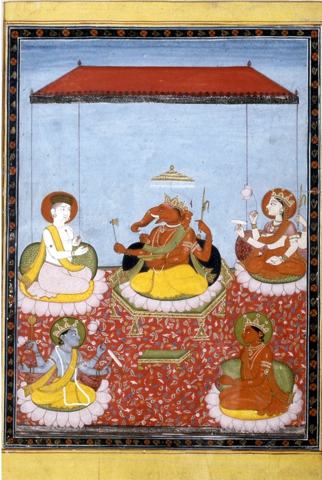
The elephant-headed son of Shiva and Parvati, lord of beginnings and remover (and placer) of obstacles, invoked before every undertaking.
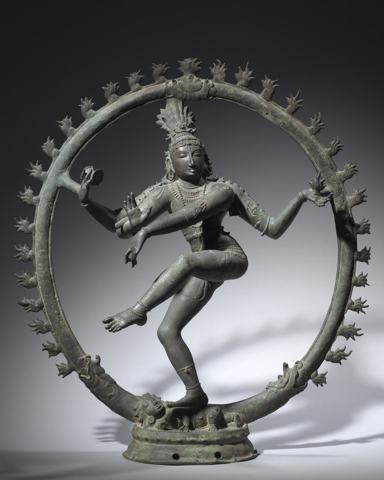
The destroyer and transformer — ascetic on the cremation ground, lord of the cosmic dance, and for millions of Shaivas the supreme reality itself.
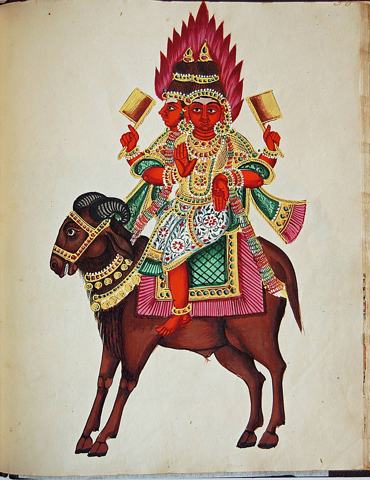
The fire god who opens the Rigveda — household priest among men and messenger among the gods, carrying every offering from the altar to the deities themselves.
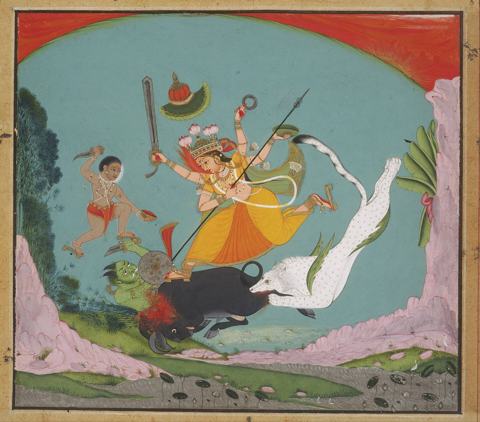
The warrior goddess assembled from the massed light of all the gods, lion-mounted slayer of the buffalo demon Mahishasura.
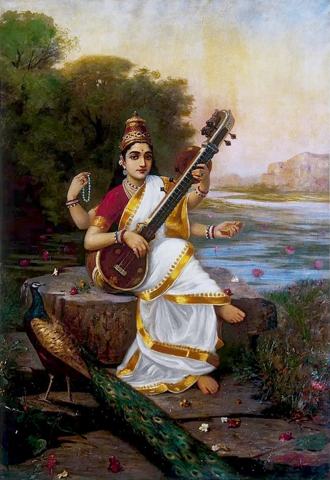
Goddess of speech, learning, music and the arts — a Vedic river who became the patron of every word written or sung.
Sources & Further Reading
- 1.Skanda Purana (Sanskrit; the largest of the eighteen Puranas, centred on his myths).
- 2.The Mahabharata, Vana Parva (the birth of Skanda).
- 3.Kanda Puranam, by Kachiyappa Sivachariyar (Tamil, c. 15th century).
- 4.Tiruppugazh, hymns of Arunagirinathar (Tamil, c. 15th century).
- 5.Clothey, Fred W. The Many Faces of Murukan — The History and Meaning of a South Indian God. Mouton, 1978.
- 6.Zvelebil, Kamil V. The Smile of Murugan — On Tamil Literature of South India. Brill, 1973.
- 7.Flood, Gavin. An Introduction to Hinduism. Cambridge University Press, 1996.
Spot an error or have a source to suggest? Write to info@viseterna.com. We cite primary sources and modern scholarship, and we correct fast.