
Vishnu
The preserver of cosmic order — the god who descends age after age, as Rama, as Krishna, and in other forms, to set dharma right when it fails.
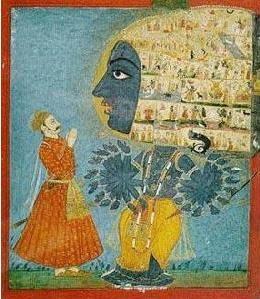
A Vision of Vishnu (Vaikuntha Darshana), Indian miniature painting (Brooklyn Museum) · Public domain · source
Who Vishnu Is
Vishnu (Sanskrit Viṣṇu) is one of the two great theistic centres of Hinduism, and for the Vaishnava traditions he is not a department head in a divine cabinet but the supreme reality itself, from which everything else proceeds 7. He is worshipped today by hundreds of millions of people across India and the global Hindu diaspora, and the traditions described below are current religious practice, not closed mythology 7.
His name is usually derived from a root meaning "to pervade," and pervasion is the idea that runs through his theology: a god who is present in and through the world rather than positioned outside it 6,7. The convenient formula that Brahma creates, Vishnu preserves, and Shiva destroys comes from the trimurti, a later scheme that tidies three enormous traditions into three job titles 7. Vaishnava theology does not accept the reduction; in its own terms Vishnu creates, sustains, and dissolves, and the other gods are within him 4,7.
The Three Strides
In the Rigveda, Vishnu is a real but modest presence — fewer hymns than Indra, and often appearing as Indra's ally rather than as a sovereign 1,6. What he already has is his signature act: he strides across the cosmos in three steps, and the third is set down in a place beyond mortal sight 1.
Those three strides make space itself. The Vedic hymns credit him with measuring out the earthly regions and propping the heavens apart so that beings have somewhere to live, and his highest step is described as a well of honey, the dwelling of the gods and of the devout dead 1,6. Gonda traces how this pervading, space-making deity of a handful of Vedic hymns became the supreme god of an entire branch of Hinduism 6.
Narayana on the Cosmic Ocean
The great Vaishnava cosmological image shows Vishnu as Narayana, asleep on the coils of the thousand-headed serpent Ananta (also Shesha) upon the shoreless ocean between world-cycles, with Lakshmi at his feet 4,5. From his navel grows a lotus, and in the lotus sits Brahma, who then emits the world 4,8.
The picture is theological rather than decorative. Creation is Vishnu's dream, delegated to a subordinate creator; dissolution is his waking. Time here is enormous and cyclical — worlds arise and are withdrawn without end, and the ocean is what remains between them 4,5,7,8.
The Avatars
Vishnu's distinctive doctrine is avatara, "descent." The classic statement is in the Bhagavad Gita, where Krishna tells Arjuna that whenever righteousness declines and unrighteousness rises he brings himself into being, age after age, to protect the good, destroy the wicked, and re-establish dharma 2.
The standard list of ten runs: Matsya the fish, who tows the ark of the flood; Kurma the tortoise, who supports the mountain when gods and demons churn the ocean for the nectar of immortality; Varaha the boar, who lifts the drowned earth on his tusk; Narasimha the man-lion, who kills a demon at a threshold at dusk to satisfy a boon that made him unkillable by man or beast, indoors or out, by day or night; Vamana the dwarf, who asks the demon-king Bali for three paces of ground and then takes the universe in two; Parashurama; Rama; Krishna; the Buddha; and Kalki, still to come, who will end the present degenerate age 4,5,8.
The list is less canonical than it looks: the number varies by text and community, the Bhagavata Purana enumerates far more, Balarama replaces the Buddha in some traditions, and the Buddha's inclusion has been read both as absorption of a rival and as genuine reverence 5,7,8.
Rama and Krishna
Two avatars outgrew the theology that contained them. Rama, prince of Ayodhya, is the subject of the Ramayana, the story of his exile, of Sita's abduction by Ravana, of the alliance with Hanuman and the monkey army, and of the war in Lanka — a narrative recited, performed as Ramlila, and known across South and Southeast Asia in dozens of independent versions 3,7.
Krishna carries even more. He is at once the child who steals butter, the cowherd whose flute calls the gopis out at night, the friend and charioteer of Arjuna who delivers the Bhagavad Gita, and — for the Gaudiya tradition founded in the wake of Chaitanya — not an avatar of Vishnu at all but the supreme godhead in his own right, of whom Vishnu is an expansion 2,5,7. Vaishnavism is genuinely plural on this point, and it matters to the people who hold the positions 7.
Iconography and Household
Vishnu is depicted dark blue or black, in yellow silk, with four arms bearing the conch Panchajanya, the discus Sudarshana, the mace Kaumodaki, and a lotus; the Kaustubha jewel hangs at his neck and the Shrivatsa mark curls on his chest 4,5. His mount is Garuda, the sun-eagle and eternal enemy of the nagas — though Ananta, the serpent he sleeps on, is one 4.
His consort is Lakshmi, or Shri, goddess of fortune and abundance, who accompanies each of his descents in a corresponding form: Sita to Rama, Rukmini to Krishna 5,7. In the Sri Vaishnava theology of Ramanuja she is not an attribute but a mediator, the one who intercedes for the devotee 7.
Living Vaishnavism
Vaishnavism is enormous and internally various. Ramanuja's qualified non-dualism, Madhva's dualism, the Tamil devotional poetry of the Alvars and its 108 sacred sites, the Krishna-centred communities of Bengal and Braj, and the temple traditions of Srirangam, Puri, Badrinath, and Tirupati all sit under the same name 7.
Tirumala Tirupati, where Vishnu is worshipped as Venkateshvara, receives tens of thousands of pilgrims on an ordinary day and is among the most visited religious sites on earth; the Rath Yatra at Puri draws vast crowds to pull Jagannath's chariots through the streets 7. Common practice includes recitation of the thousand names of Vishnu preserved in the Mahabharata, the marking of the forehead with the Vaishnava urdhva pundra, and the observance of Ekadashi fasts 2,7.
What holds it together is the conviction stated in the Gita: that the ground of everything is not indifferent, and that it will come down when it has to 2,7.
Continue Exploring
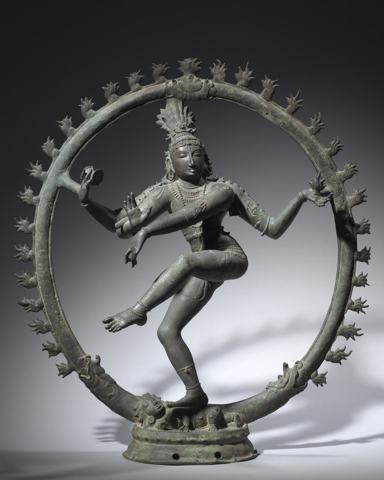
The destroyer and transformer — ascetic on the cremation ground, lord of the cosmic dance, and for millions of Shaivas the supreme reality itself.
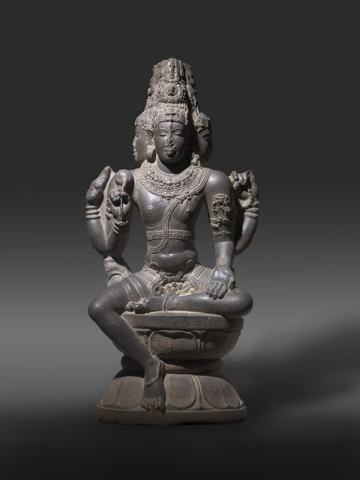
The four-faced creator from whom the worlds issue at the dawn of each cosmic day — immensely powerful in myth, and almost never worshipped in temples.
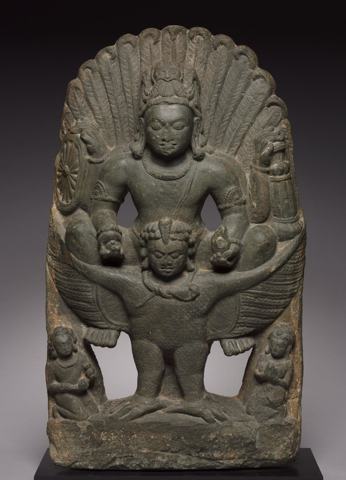
The golden sun-eagle who carries Vishnu — thief of the gods' nectar, liberator of his enslaved mother, and the eternal enemy of the serpents.
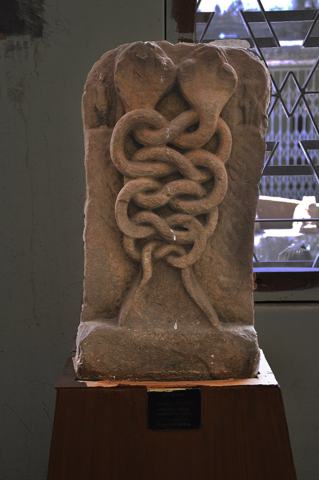
Semi-divine serpent beings of the waters and the underworld — hooded and jewel-crowned guardians of treasure, of rain, and of hidden knowledge.
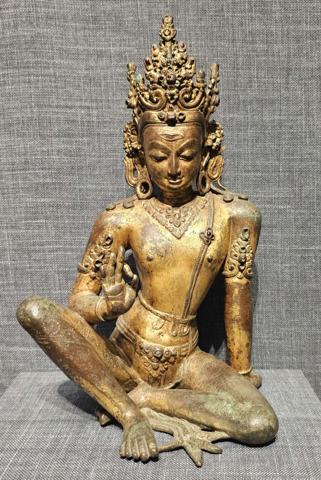
King of the gods and lord of storm and war — wielder of the thunderbolt, slayer of the serpent Vritra, and the deity Hinduism gradually demoted.
Eighteen chapters embedded in the Mahabharata where Krishna counsels Arjuna — read, translated and argued over more than any other Hindu text.
Also mentioned inDashavataraDurgaGanesha (Ganesh)HanumanKrishnaLakshmi (Laxmi)RamaSaraswati (Sarasvati)Sudarshana ChakraThe Churning of the Ocean (Samudra Manthan)The RamayanaThe Rigveda
Sources & Further Reading
- 1.The Rigveda (c. 1500–1200 BCE); trans. Stephanie W. Jamison & Joel P. Brereton. Oxford University Press, 2014.
- 2.The Mahabharata, including the Bhagavad Gita.
- 3.The Ramayana of Valmiki.
- 4.The Vishnu Purana.
- 5.The Bhagavata Purana.
- 6.Gonda, Jan. Aspects of Early Visnuism. N.V. A. Oosthoek's Uitgevers Mij., 1954.
- 7.Flood, Gavin. An Introduction to Hinduism. Cambridge University Press, 1996.
- 8.O'Flaherty, Wendy Doniger. Hindu Myths: A Sourcebook Translated from the Sanskrit. Penguin Classics, 1975.
Spot an error or have a source to suggest? Write to info@viseterna.com. We cite primary sources and modern scholarship, and we correct fast.