
Mount Meru
The golden mountain at the exact center of the universe, home of the gods and the fixed point Puranic cosmology measures every continent and ocean from.
Mount Meru, from a Samghayanarayana manuscript, India, c. 17th century · Public domain · source
The Mountain at the Center
Mount Meru, also called Sumeru, "the good Meru," is not a place a traveler could set out for. It is the fixed point every other place in Puranic cosmology is measured against: a colossal mountain of gold rising from the exact center of the world, wider at the summit than at the base, its foot sunk deep into the earth and its peak lost somewhere above the sky 1,3. The Vishnu Purana gives it a height of 84,000 yojanas above the ground and a further 16,000 below — figures no commentator has ever tried seriously to reconcile with a real mountain, because Meru was never meant to be surveyed the way an actual peak is 1.
Jambudvipa and the Rings of Ocean
Puranic geography sets Meru at the hub of Jambudvipa, "the Rose-Apple Continent," the innermost of seven concentric island-continents that ring outward like the petals of a lotus, each belt of land separated from the next by an ocean of a different substance — salt water, sugarcane juice, wine, clarified butter, curds, milk, and fresh water, given in that order 1,3. Jambudvipa itself is divided into nine regions (varshas) arranged around Meru like spokes around a hub. Bharatavarsha, south of Meru and beyond the Himalayas, is the region where the Puranas locate ordinary human life and its consequences — the one place, the texts say, where karma is actually earned and burned off, which is why being born there is treated as a privilege rather than a geographical accident 1,6.
Meru is usually given four faces, each a different substance turned toward a different direction — crystal to the east, ruby to the south, gold to the west, lapis to the north — an image meant partly to explain why the southern sky looks the particular blue it does when seen from earth 1,3. The river Ganga completes the picture: having already fallen from heaven onto the head of Shiva to break its fall, it is said to circle Meru's summit and split into four great streams that pour down its four faces toward the world below, one to a cardinal direction 1.
Who Lives on Meru
Meru's slopes and summit are inhabited ground, not empty rock. Indra's heaven, Svarga, sits at the top, centered on the city of Amaravati, and the mountain's forests and terraces are home to gandharvas, apsarases, and sages, with the Saptarishi — the seven great seers — given dwellings of their own partway up 2,4. The Matsya Purana's cosmographic chapters catalogue Meru's named groves and lakes in the same patient, list-making style the Puranas use for genealogies, treating the mountain less as a myth to be told than as a geography to be recorded 3.
Not to Be Confused With Mandara
Meru is regularly mixed up with a different, smaller mountain, and the two are worth keeping apart. In the churning of the ocean, the gods and demons need a mountain to use as a churning rod, and they use Mandara — a real, movable peak that has to be uprooted and carried to the shore, and that immediately starts sinking into the sea until Vishnu, as the tortoise Kurma, gets under it 2. Meru, by contrast, is never handled in the myths at all. It is fixed, cosmic, and load-bearing in a different sense: the world's stationary axis rather than a tool the gods pick up and put down 1,2.
Meru does get moved once, and only by Shiva. To destroy the three flying fortresses of the demons in the Tripurantaka myth, Shiva takes the earth as his chariot and Meru itself as his bow, bending the mountain to loose a single arrow that burns all three cities at once — the one occasion the axis of the universe is treated as a weapon rather than a foundation 1,2.
Looking for Meru on Earth
Because Meru anchors a working geography — nine regions, seven oceans, named rivers — readers and scholars have long been tempted to find it on an actual map. The most common identification, Mount Kailash in western Tibet, works less as literal geography than as a devotional shorthand: a real, visible, climbable-in-principle mountain standing in for one that by definition cannot be reached 5. Other proposals have been more openly ideological — the Sanskrit scholar Bal Gangadhar Tilak argued in 1903 that Meru encoded a folk memory of the Arctic and the North Pole, a reading almost no one in Indology has accepted since, but one still repeated outside the field 4,6. Eck's study of Indian sacred geography treats these searches as evidence of a different, more interesting fact: that a purely cosmological mountain kept generating real pilgrimage toward real mountains, century after century, regardless of whether anyone could ever actually stand on the summit being sought 5.
A Shared Axis
Meru did not stay inside a single tradition. Buddhist cosmology adopted the same mountain under the same name as the center of its own world-system, and Jain cosmology places its Meru at the heart of Jambudvipa within the "middle world," where, in Jain art and narrative, Indra is said to carry each newborn Tirthankara to the summit to bathe him in consecrated water — the scene manuscript painters returned to often enough that it became a recognizable genre in its own right, tier upon tier of the mountain shown in cross-section with its inhabitants seated at their appointed heights 4,6. Hindu, Buddhist, and Jain Meru are not the same mountain in the same cosmology, but they are recognizably the same idea, reused by neighboring traditions that never stopped arguing about almost everything else at their center.
Continue Exploring
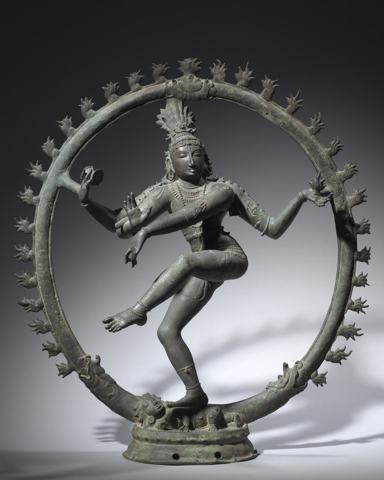
The destroyer and transformer — ascetic on the cremation ground, lord of the cosmic dance, and for millions of Shaivas the supreme reality itself.
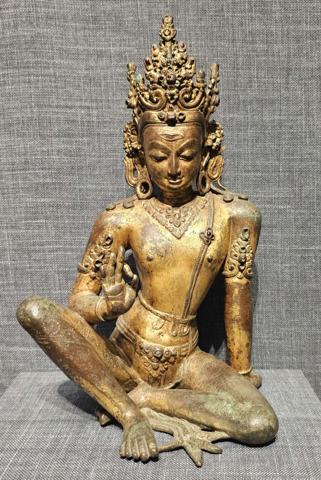
King of the gods and lord of storm and war — wielder of the thunderbolt, slayer of the serpent Vritra, and the deity Hinduism gradually demoted.
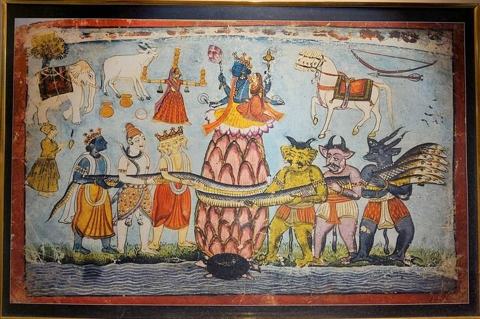
Gods and demons churn the cosmic ocean with a mountain and a serpent for the nectar of immortality — and very nearly destroy all creation before they get it.
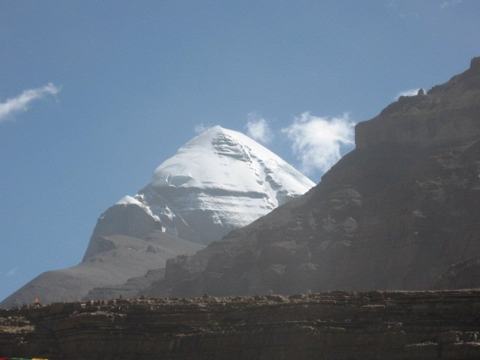
A remote, unclimbed Himalayan peak in western Tibet sacred to Hindus, Buddhists, Jains, and Bon — Shiva's meditation seat and the source of four great rivers.
The preserver of cosmic order — the god who descends age after age, as Rama, as Krishna, and in other forms, to set dharma right when it fails.
Cowherd, lover, statesman and charioteer — the avatar of Vishnu who speaks the Bhagavad Gita and anchors India's largest devotional tradition.
Sources & Further Reading
- 1.Vishnu Purana, Book II, chapters 2-8, translated by Horace Hayman Wilson (1840).
- 2.The Mahabharata, Bhishma Parva (Jambukhandavinirmana Parva).
- 3.The Matsya Purana, chapters on the geography of Jambudvipa.
- 4.Klostermaier, Klaus K. A Survey of Hinduism. State University of New York Press, 1994.
- 5.Eck, Diana L. India: A Sacred Geography. Harmony Books, 2012.
- 6.Flood, Gavin. An Introduction to Hinduism. Cambridge University Press, 1996.
Spot an error or have a source to suggest? Write to info@viseterna.com. We cite primary sources and modern scholarship, and we correct fast.