
Krishna
Cowherd, lover, statesman and charioteer — the avatar of Vishnu who speaks the Bhagavad Gita and anchors India's largest devotional tradition.
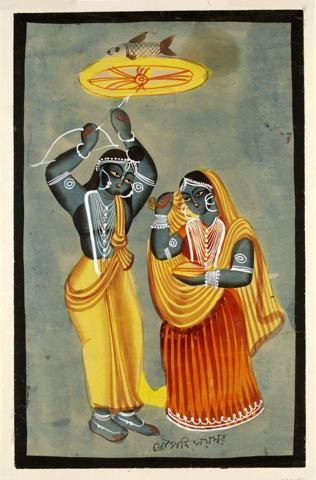
Krishna and Arjuna on the chariot, Mahabharata, India, 18th-19th century (unknown artist) · Public domain · source
Who Krishna Is
Krishna — the name means "dark" or "black" — is counted the eighth avatar of Vishnu, though many traditions, Gaudiya Vaishnavism above all, invert that and hold Krishna to be the source of whom Vishnu is an expression 6,7. He is the most narratively complete deity in the Hindu corpus: infant, thief, cowherd, flute-player, lover, king-maker, philosopher and, at the end, an old man killed by accident.
The scholarly consensus is that this fullness is a fusion. At least three figures appear to have merged: Vasudeva-Krishna, a hero-god of the Vrishni clan around Mathura, attested epigraphically very early; Krishna Gopala, a pastoral deity of the Abhira cowherds; and the Krishna of the Mahabharata, the Yadava statesman and Arjuna's ally 6,7. The Heliodorus pillar at Besnagar, erected around 113 BCE by a Greek ambassador who calls himself a bhagavata of Vasudeva, is the standard evidence that devotion to at least one of these strands was established and prestigious well before the common era 6. A "Krishna, son of Devaki" is named in passing in the Chandogya Upanishad, though whether that is the same figure is debated 6.
Mathura and the Childhood
The birth story is fixed by the Harivamsa and told at length in Book X of the Bhagavata Purana. The tyrant Kamsa, warned that his sister Devaki's eighth child will kill him, imprisons her and kills her infants. Krishna, the eighth, is carried across the flooding Yamuna on the night of his birth by his father Vasudeva and exchanged for a cowherd's daughter in Gokul, where he is raised by Nanda and Yashoda 2,3.
The Vrindavan childhood is the heart of the devotional tradition. He steals butter, is bound to a mortar by an exasperated Yashoda, opens his mouth in denial of eating dirt and shows her the entire universe inside it, subdues the serpent Kaliya by dancing on its hoods, and lifts Mount Govardhan on one finger for seven days to shelter the cowherds from Indra's punitive storm — an episode usually read as a pastoral cult displacing an older Vedic one 2,3,5. John Stratton Hawley's study of the butter-thief cycle argues that the naughtiness is theologically load-bearing rather than decorative: the god who can be scolded is a god who can be loved without fear 5.
The rasa lila — the circle dance with the gopis on the autumn full-moon night, in which Krishna multiplies himself so that each cowherd woman believes she dances with him alone — is treated as allegory of the soul and God by the commentators, and as straightforwardly erotic poetry by many of the poets 3,6,7. Radha, now inseparable from Krishna in popular imagination, is not named in the Bhagavata Purana; she becomes central through Prakrit poetry and above all Jayadeva's twelfth-century Gita Govinda 4,6,8.
The Mahabharata
The adult Krishna is a different register. He kills Kamsa, moves the Yadavas to the sea-fortress of Dvaraka, and enters the Mahabharata as cousin and counsellor to the Pandavas. Offered a choice between Krishna's armies and Krishna himself unarmed, Arjuna takes Krishna, who serves as his charioteer at Kurukshetra 1,6.
On the eve of the battle, with Arjuna refusing to fight kinsmen, Krishna delivers the Bhagavad Gita: eighteen chapters synthesising the paths of action, knowledge and devotion, arguing that duty performed without attachment to its fruit does not bind, and culminating in the vishvarupa, the terrifying universal form in which Arjuna sees all worlds and all deaths at once 1,6. The Gita's independent authority — read, commented on and translated more than any other Hindu text — is largely a phenomenon of the last two centuries, but the text itself is old and integral to the epic 6.
Krishna's conduct in the war is not clean, and the epic knows it. He advises the deceptions that bring down Bhishma, Drona, Karna and Duryodhana, and is cursed for it by Gandhari, who foretells the destruction of his own clan 1,6. It happens: the Yadavas destroy each other in a drunken brawl, and Krishna, resting in a forest, is shot in the foot by a hunter named Jara — "old age" — who mistakes him for a deer 1,6.
Devotion
Krishna anchors the largest devotional movement in Hinduism. The Alvar poets of Tamil country from roughly the sixth to ninth centuries developed a poetics of longing that Friedhelm Hardy traced as the source of later North Indian bhakti 7. From the fifteenth century the movement is vast and vernacular: Chaitanya in Bengal, Vallabha and the Pushtimarg in Braj, Surdas's Braj Bhasha songs of the child Krishna, Mirabai's Rajasthani poems to him as her only husband 6,7.
Janmashtami marks his birth in the monsoon month of Bhadrapada, with midnight vigils, fasting and the dahi handi pot-breaking of western India. Holi, the spring festival of colour, is celebrated in Braj as Krishna's own play with the gopis 6. Major pilgrimage centres include Mathura and Vrindavan, Dvaraka, Puri (as Jagannatha) and Udupi.
Reading Him
Krishna resists a single reading, and the tradition has never wanted one. The same figure who counsels detachment in the Gita is the one whose flute makes women leave their houses at night; the strategist who bends the rules of war is the child who cannot be caught eating butter. Scholars generally treat that range as the reason for his reach rather than a problem to be resolved 5,6,7.
Related entries: Vishnu, Rama, Shiva, Indra, Lakshmi, Garuda, Hanuman.
Continue Exploring
Prince of Ayodhya and seventh avatar of Vishnu — exiled hero of the Ramayana, slayer of Ravana, and the ideal of dharma.
Son of the wind, greatest of the vanaras, and Rama's perfect servant — the leaper of oceans who became one of India's most worshipped gods.
Goddess of wealth, beauty and good fortune, born from the churning of the ocean and inseparable consort of Vishnu.
Eighteen chapters embedded in the Mahabharata where Krishna counsels Arjuna — read, translated and argued over more than any other Hindu text.
The Pandava hero of the Mahabharata, winner of Draupadi's hand and wielder of the bow Gandiva, whose crisis on the battlefield draws out the Bhagavad Gita.
Roughly 100,000 verses attributed to the sage Vyasa — the frame for most of Hindu myth, including the Bhagavad Gita, and still the longest epic poem known.
Also mentioned inDashavataraDiwali (Deepavali)Surya (Hindu Sun God)
Sources & Further Reading
- 1.Mahabharata — including the Bhagavad Gita (Bhishma Parva); Sanskrit epic, layers c. 4th century BCE - 4th century CE.
- 2.Harivamsa — the epic's appendix giving Krishna's childhood (c. 1st-3rd century CE).
- 3.Bhagavata Purana — Book X, the definitive account of the Vrindavan years (c. 9th-10th century CE).
- 4.Jayadeva, Gita Govinda (Sanskrit, c. 12th century) — Radha and Krishna in the groves of Vrindavan.
- 5.Hawley, John Stratton. Krishna, the Butter Thief. Princeton University Press, 1983.
- 6.Bryant, Edwin F. (ed.). Krishna — A Sourcebook. Oxford University Press, 2007.
- 7.Hardy, Friedhelm. Viraha-Bhakti — The Early History of Krsna Devotion in South India. Oxford University Press, 1983.
- 8.Miller, Barbara Stoler (trans.). Love Song of the Dark Lord — Jayadeva's Gitagovinda. Columbia University Press, 1977.
Spot an error or have a source to suggest? Write to info@viseterna.com. We cite primary sources and modern scholarship, and we correct fast.