
Trishula
Shiva's three-pronged weapon — planted on temple roofs, carried by wandering ascetics, and read as a compressed statement of his whole theology.
Trident with Shiva as Half-Woman (Ardhanarishvara), Chola period, Tamil Nadu, 11th century (Cleveland Museum of Art) · CC0 · source
Shiva's Weapon
The trishula, "three points," is the attribute that marks Shiva as fast as his ash or his crescent moon: a spear ending in three prongs instead of one, carried in his images, planted as a finial on temple towers across South Asia, and carried in miniature or full size by the ash-smeared ascetics who model themselves on him 5,7. It is a weapon in name and occasionally in use, but its cultural weight has always come more from what it means than from what it kills 5.
A Later Attribute, Not a Vedic One
Shiva's oldest identifiable ancestor, the Rigvedic archer-god Rudra, is armed with a bow and arrows, not a trident — the earliest hymns give him nothing resembling the three-pronged weapon that later becomes inseparable from his images 1,7. The trishula belongs to the god's post-Vedic, epic-and-Puranic phase, and it is from roughly the early centuries CE, the period when devotional Shaivism hardens into its classical form, that the trident becomes a fixed part of his iconography rather than an occasional prop 4,7. Flood is cautious about reading too much continuity back into the Vedic material on exactly this kind of point — a weapon's absence from the earliest hymns does not prove it did not exist elsewhere, only that it is not yet attested there 7.
Three Points, Several Readings
Sanskrit commentary and popular devotion have never settled on one meaning for the three prongs, and Kramrisch's study of Shiva's iconography treats the plurality itself as characteristic of how the tradition thinks about him 5. Readings offered across the textual and devotional record include the three gunas — sattva, rajas, and tamas, the constituent qualities of all material nature; the three worlds, earth, atmosphere, and heaven; the three tenses of time; and Shiva's own three-part cosmic office of creation, preservation, and dissolution folded into a single hand-held object 4,5. Gopinatha Rao's iconographic manual catalogues regional variation in exactly how the prongs are proportioned and mounted, but treats the layered symbolism as constant across almost all of it — a single weapon built to carry more than one idea at once 4.
Killing Andhaka
The trident's best-known feat in narrative is the killing of Andhaka, a blind demon whom Puranic accounts variously make Shiva's own misbegotten son or an adopted child of the demon Hiranyaksha, and who conceives an obsessive desire for Parvati and attacks the couple on their own mountain 2. Shiva impales him on the trishula and holds him suspended there, and — in a detail that deliberately echoes Kali's fight with the demon Raktabija — every drop of Andhaka's blood that reaches the ground is said to spawn a fresh demon exactly like him, so fierce goddesses gather to drink the blood in mid-air before it can multiply the enemy further 2,5. Puranic tellings disagree on how the story ends: some have Andhaka simply die on the prongs, others have him repent at the last moment and be accepted into Shiva's retinue rather than destroyed 2,5.
Lent to the Goddess
Like several of the great gods' weapons, the trident does not stay permanently in one hand. The Devi Mahatmya's account of the goddess Durga's creation, in which the assembled gods each arm her with his own signature weapon to face the demon Mahishasura, is the source of the tradition — repeated constantly in later art and temple sculpture — that among Durga's ring of borrowed arms is a trishula that is specifically Shiva's own contribution 3. The image makes the same point the Andhaka myth makes from the opposite direction: the trident is not only an instrument of Shiva's own fights but a portable authority he can extend to whichever deity is doing the fighting on order's behalf 3,6.
A Weapon Still Carried
The trishula never became a purely mythological object. Wandering Shaiva ascetics, most visibly the Naga sadhus who gather at the Kumbh Mela, carry real tridents as both walking staff and weapon, planting them beside their fires as a mark of renunciate identity rather than martial intent 6,7. Temple architecture repeats the same gesture at a larger scale, with a trident finial crowning the tower above the sanctum at innumerable Shiva temples, a piece of ironwork doing the same symbolic job as the god's own upraised hand in sculpture — marking the building, like the ascetic, as belonging to Shiva before anyone reads a single inscription 5,6.
Continue Exploring
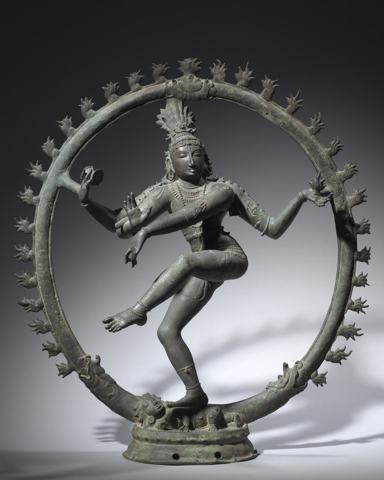
The destroyer and transformer — ascetic on the cremation ground, lord of the cosmic dance, and for millions of Shaivas the supreme reality itself.
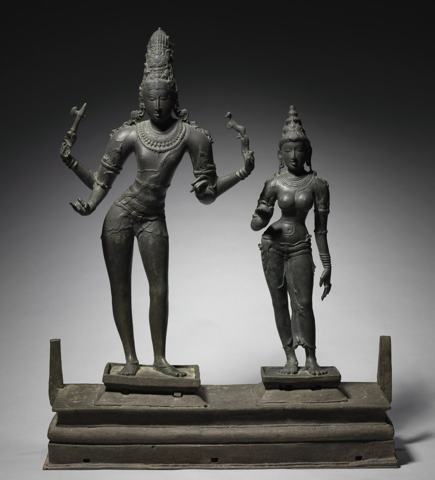
The Goddess who wins Shiva through fierce austerity, mother of Ganesha and Kartikeya, and one revealed face of the same Devi worshipped as Durga and Kali.
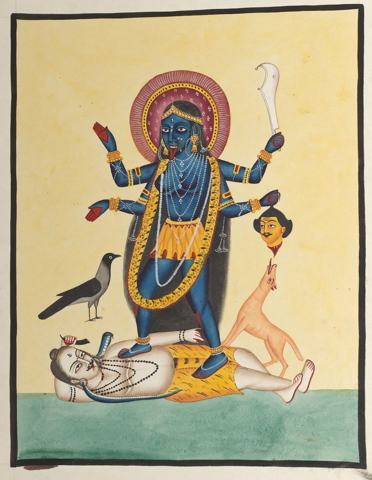
The black goddess of time and dissolution — annihilator of demons and of the ego, and to millions of Bengali devotees simply the Mother.
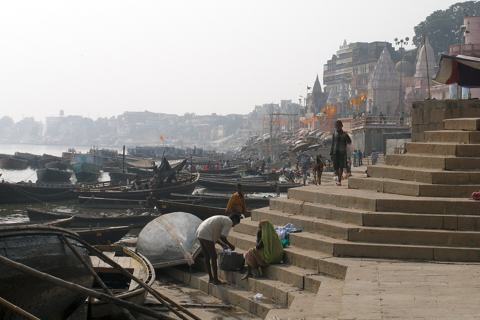
The Ganges-side city where dying is said to grant liberation outright — one of Shiva's twelve jyotirlingas and a living pilgrimage center for three millennia.
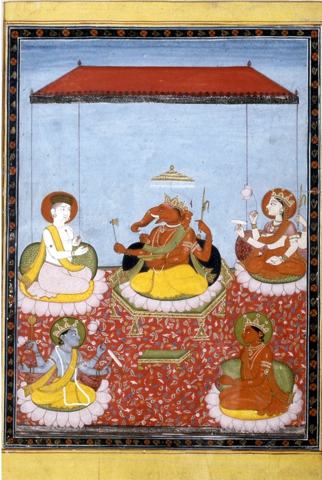
The elephant-headed son of Shiva and Parvati, lord of beginnings and remover (and placer) of obstacles, invoked before every undertaking.
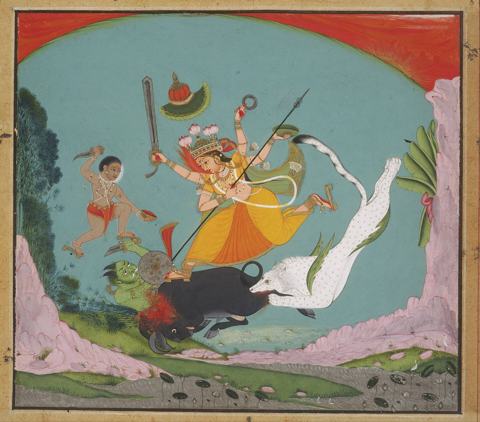
The warrior goddess assembled from the massed light of all the gods, lion-mounted slayer of the buffalo demon Mahishasura.
Sources & Further Reading
- 1.The Mahabharata.
- 2.The Shiva Purana and the Matsya Purana.
- 3.Devi Mahatmya (Markandeya Purana).
- 4.Rao, T. A. Gopinatha. Elements of Hindu Iconography. Law Printing House, 1914.
- 5.Kramrisch, Stella. The Presence of Siva. Princeton University Press, 1981.
- 6.O'Flaherty, Wendy Doniger. Asceticism and Eroticism in the Mythology of Siva. Oxford University Press, 1973.
- 7.Flood, Gavin. An Introduction to Hinduism. Cambridge University Press, 1996.
Spot an error or have a source to suggest? Write to info@viseterna.com. We cite primary sources and modern scholarship, and we correct fast.