
Hanuman
Son of the wind, greatest of the vanaras, and Rama's perfect servant — the leaper of oceans who became one of India's most worshipped gods.
Hanuman and King Rama, Pahari school, c. 1725 (unknown artist) · CC BY-SA 4.0 · source
Birth and Names
Hanuman is a vanara — a monkey-formed being of the epic's forest peoples — born to the apsara-turned-monkey Anjana and fathered, in the standard account, by Vayu, god of the wind. Hence his common names: Anjaneya ("son of Anjana"), Maruti and Pavanputra ("son of the wind"), Vayuputra 1,4. Several traditions add Shiva to the picture, treating Hanuman as an amsha or partial incarnation of that god, which is why Shaiva and Vaishnava devotion can both claim him without friction 4,6.
The name itself is unexplained. The usual folk etymology reads hanu ("jaw") plus a suffix, "one with a disfigured jaw", and ties it to the childhood story in which the infant sprang at the rising sun mistaking it for fruit, and was struck down by Indra's thunderbolt. Vayu withdrew the world's breath in fury until the gods relented, restoring the child and loading him with boons. Philologists have never been satisfied with the derivation, and some suspect a pre-Sanskritic name later given a Sanskrit gloss 4.
That same episode carries a crucial narrative device: the sages curse — or the gods arrange — that Hanuman will forget the extent of his own powers until reminded. It is why the epic can hold him back until the moment he is needed 1,4.
The Ramayana
Hanuman enters Valmiki's epic as minister to the exiled monkey king Sugriva. He meets Rama and Lakshmana disguised as a mendicant, and Rama's first reaction is to admire his Sanskrit — a small, deliberate detail marking him as learned, not merely strong 1,5.
His great sequence is the Sundara Kanda, the fifth book, which the tradition treats as the most auspicious portion of the whole poem and which is recited on its own for protection. Reminded of his strength by the bear Jambavan, Hanuman swells to enormous size and leaps the ocean to Lanka. He finds Sita in the ashoka grove, gives her Rama's ring, refuses to carry her home himself because the rescue must be Rama's, allows himself to be captured and dragged before Ravana, and — when the demons set his tail alight — uses the fire to burn the city and springs back across the water 1,5.
In the war books he twice carries a mountain. Sent for the sanjivani healing herb to revive Lakshmana, and unable to tell which plant on the Himalayan peak is the right one, he uproots the entire mountain and carries it to the battlefield 1,5. The image — a monkey aloft with a mountain in one hand and a mace in the other — is the single most common Hanuman icon in Indian temples and roadside shrines.
After the Epic
The Mahabharata has him meet Bhima in the forest, an old monkey lying across a path who asks the strongman to move his tail. Bhima cannot lift it, and learns who he is dealing with; the two are half-brothers, both sons of Vayu 3. Hanuman later agrees to sit on Arjuna's banner at Kurukshetra, which is why Arjuna is styled Kapidhvaja, "monkey-bannered" 3.
Hanuman is counted among the chiranjivi, the deathless ones who remain in the world — the boon that he lives as long as Rama's story is told, and is present wherever it is recited. Devotees leave a seat for him at readings 2,4.
From Servant to God
Hanuman's promotion from epic character to major object of worship happened largely in the second millennium. Independent Hanuman temples and images multiply from roughly the tenth century onward, and the decisive push came from the North Indian devotional (bhakti) movement — above all Tulsidas, whose sixteenth-century Ramcharitmanas and the Hanuman Chalisa attributed to him made him the accessible face of Rama devotion. Scholars generally read his rise as devotional rather than doctrinal: Hanuman models dasya bhava, the servant's love, which was reachable in a way the king-god's majesty was not 2,4,6.
Today he is arguably the most ubiquitous deity in North India — patron of wrestlers, akharas and bodybuilders, guardian against evil spirits and the malefic effects of Saturn, and Tuesday's god. Popular practice offers him vermilion paste and oil, and the coating of orange sindoor on his images is explained by a story of Sita marking her forehead for Rama's long life, which Hanuman then applied to his whole body 4,7.
Reading Him
Modern scholarship is careful about flattening him. Philip Lutgendorf's study argues that Hanuman is not one thing but a stack of overlapping figures — the epic's clever envoy, the folk power-dispenser of village shrines, the celibate strongman of the wrestling ground, the yogi of tantric texts, and the emblem picked up by twentieth-century politics — and that his popularity comes precisely from carrying all of them at once 4,7.
Related entries: Rama, Vishnu, Shiva, Indra, Garuda, Krishna.
Continue Exploring
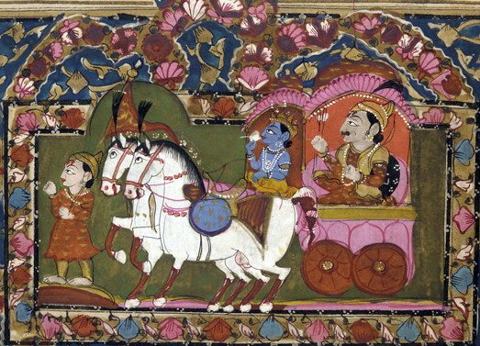
Cowherd, lover, statesman and charioteer — the avatar of Vishnu who speaks the Bhagavad Gita and anchors India's largest devotional tradition.
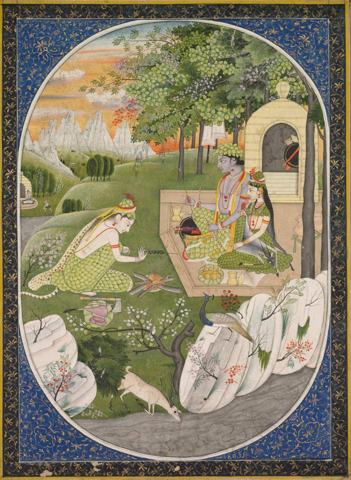
Prince of Ayodhya and seventh avatar of Vishnu — exiled hero of the Ramayana, slayer of Ravana, and the ideal of dharma.
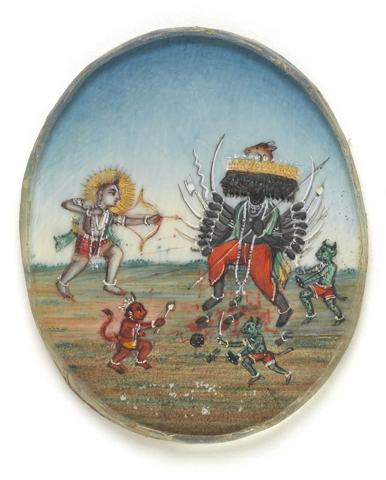
Lanka's rakshasa king, ten-headed abductor of Sita in the Ramayana and a devoted worshipper of Shiva — a villain regional traditions read very differently.
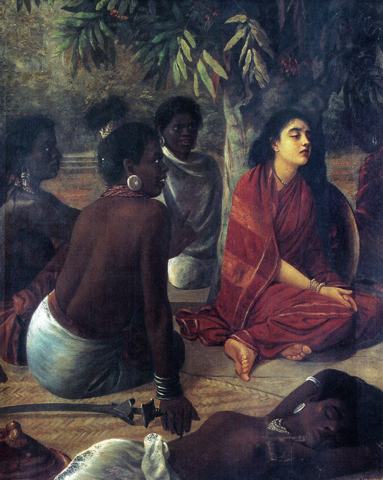
Wife of Rama and heroine of the Ramayana — found in a furrow, abducted by Ravana, tested by fire, and read differently across the tradition's many tellings.
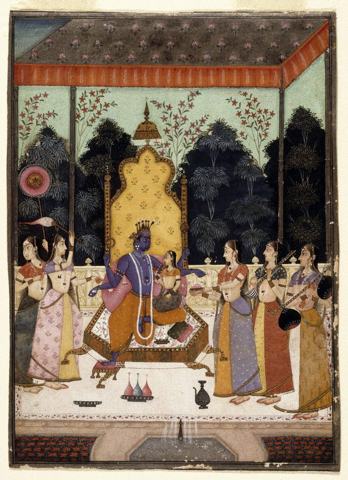
The preserver of cosmic order — the god who descends age after age, as Rama, as Krishna, and in other forms, to set dharma right when it fails.
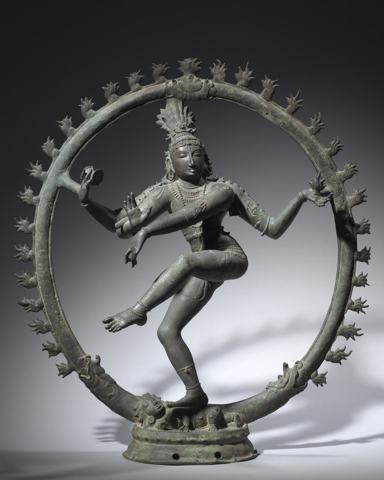
The destroyer and transformer — ascetic on the cremation ground, lord of the cosmic dance, and for millions of Shaivas the supreme reality itself.
Also mentioned inThe Ramayana
Sources & Further Reading
- 1.Valmiki, Ramayana — especially Sundara Kanda (Book V) and Yuddha Kanda (Book VI); Sanskrit epic, layers c. 3rd century BCE - 3rd century CE.
- 2.Tulsidas, Ramcharitmanas (Awadhi, 1574) and the devotional hymn Hanuman Chalisa attributed to him.
- 3.Mahabharata — Vana Parva, the meeting of Hanuman and Bhima (Sanskrit epic).
- 4.Lutgendorf, Philip. Hanuman's Tale — The Messages of a Divine Monkey. Oxford University Press, 2007.
- 5.Goldman, Robert P., and Sally J. Sutherland Goldman (trans.). The Ramayana of Valmiki — An Epic of Ancient India, Vol. V, Sundarakanda. Princeton University Press, 1996.
- 6.Richman, Paula (ed.). Many Ramayanas — The Diversity of a Narrative Tradition in South Asia. University of California Press, 1991.
- 7.Wolcott, Leonard T. "Hanuman — The Power-Dispensing Monkey in North Indian Folk Religion." Journal of Asian Studies 37, no. 4 (1978).
Spot an error or have a source to suggest? Write to info@viseterna.com. We cite primary sources and modern scholarship, and we correct fast.