
Durga
The warrior goddess assembled from the massed light of all the gods, lion-mounted slayer of the buffalo demon Mahishasura.
The Great Goddess Durga Slaying the Buffalo Demon (Mahishasuramardini), unknown Indian artist · Public domain · source
The Goddess Who Is Hard to Approach
Durga means, roughly, "the unassailable" or "hard to get past" — a fortress-word applied to a person. She is the great warrior form of the Hindu Goddess (Devi, Mahadevi), and in Shakta theology she is not one deity among many but the fundamental power, shakti, from which the gods draw their capacity to act at all 1,4,5.
Her defining text is the Devi Mahatmya, "Glorification of the Goddess", a self-contained thirteen-chapter poem embedded in the Markandeya Purana. Most scholarship places it around the sixth century CE, with some material older; Thomas Coburn's studies treat it as the moment when scattered goddess traditions crystallize into a single supreme Goddess with a coherent theology 1,4,6. Earlier traces exist — hymns to a Durga figure appear in portions of the Mahabharata, and terracottas and coins show a lion-riding, demon-killing goddess before the text was written — but the Devi Mahatmya is where she is fully argued for 2,5,6.
Mahishasura
The central myth is the killing of Mahishasura, the buffalo demon. Having won a boon that no man or god could kill him, Mahishasura drives the gods out of heaven. Powerless separately, they gather in rage, and the massed tejas — fiery energy — streaming from each god converges into a single blaze that takes the form of a woman. Each god then arms her: Shiva gives his trident, Vishnu his discus, Indra his thunderbolt, Brahma a water pot, the mountain Himavat a lion to ride 1,4.
The theological point is contested and worth stating carefully. Read one way, Durga is a composite, a weapon the gods build; read another — and this is how the text itself resolves it — the gods are only ever borrowing back what was always hers, and the assembly is a revelation rather than a manufacture. Both readings have serious defenders, and the Devi Mahatmya arguably keeps them in deliberate tension 4,5,6.
She fights Mahishasura's armies, laughs, drinks, and finally pins the demon as he shifts between buffalo and man, pressing him with her foot and driving the trident through as he emerges half-formed from the buffalo's neck. That precise moment — the demon caught mid-transformation — is what nearly every Mahishasuramardini image depicts 1,4.
Kali, Chandika, and the Many Forms
The Devi Mahatmya's third episode pits her against the demon brothers Shumbha and Nishumbha, and it is here that the Goddess splits. Enraged, Durga's brow darkens and Kali leaps out of it — black, gaunt, garlanded with skulls — to do the killing that the composed warrior form will not 1,4. Later, when Kali and the matrikas (mother goddesses emitted by the male gods) have finished, the Goddess reabsorbs them and declares that they were never separate. The passage is the tradition's clearest statement that the many goddesses are one 1,4,5.
Popular practice knows her in nine forms, the Navadurga, one for each night of Navaratri, and under names including Chandi or Chandika (the fierce), Ambika, Bhavani, Katyayani and Mahishasuramardini. In the Shaiva reckoning she is Parvati's warrior aspect and Shiva's consort; in Bengal she is also, and above all, a daughter coming home 3,5,7.
Durga Puja
The autumn festival of Navaratri — nine nights, culminating in Vijaya Dashami — is celebrated across India, but its Bengali form, Durga Puja, is the most elaborate. Clay images of Durga with her four children (Ganesha, Karttikeya, Lakshmi and Saraswati) are installed in temporary pavilions, worshipped for several days, and immersed in the river at the end. The framing is domestic rather than martial: the Goddess is visiting her parents' house, and the immersion is her leaving for her husband's 5,7. UNESCO inscribed Kolkata's Durga Puja on its Representative List of the Intangible Cultural Heritage of Humanity in 2021 7.
Ritual scholarship notes that the liturgy is unusually rich in this tradition — the invocation of the goddess into a bundle of nine plants, the possibility of animal sacrifice in some lineages, the "eye-giving" that animates the image — and that much of it is regional practice with little basis in the Sanskrit text 7.
Why She Endures
Durga solved a structural problem for the tradition: the gods, in the Puranic imagination, keep losing. Boons granted for austerity make demons invulnerable to precisely the categories the male pantheon occupies. The Goddess is what falls outside the boon's wording, and the myth turns that loophole into a claim about ultimate power 1,4,5. Some traditions hold that she is entirely independent of any consort; others fold her firmly into the Shaiva household. The disagreement is old and has never been settled.
Related entries: Kali, Shiva, Vishnu, Brahma, Indra, Lakshmi, Saraswati, Ganesha.
Continue Exploring
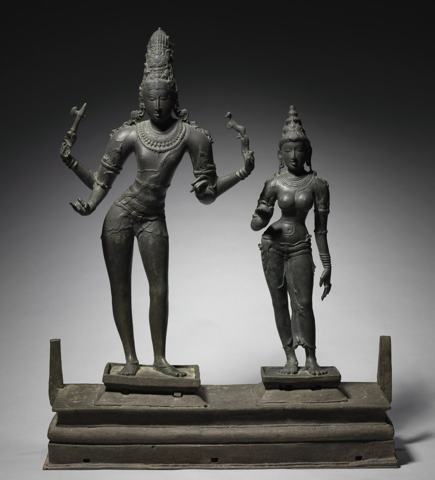
The Goddess who wins Shiva through fierce austerity, mother of Ganesha and Kartikeya, and one revealed face of the same Devi worshipped as Durga and Kali.
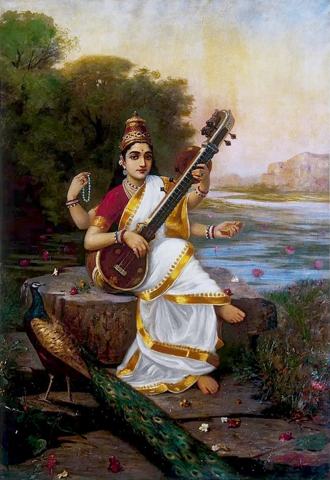
Goddess of speech, learning, music and the arts — a Vedic river who became the patron of every word written or sung.
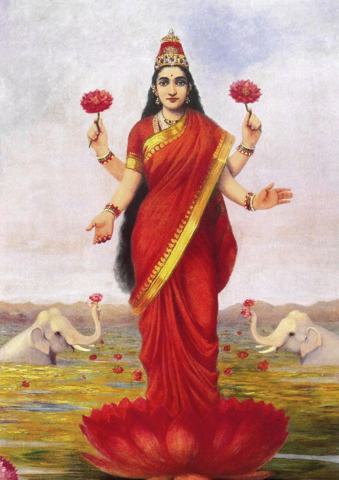
Goddess of wealth, beauty and good fortune, born from the churning of the ocean and inseparable consort of Vishnu.
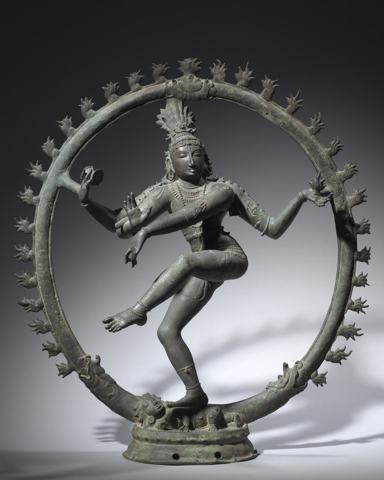
The destroyer and transformer — ascetic on the cremation ground, lord of the cosmic dance, and for millions of Shaivas the supreme reality itself.
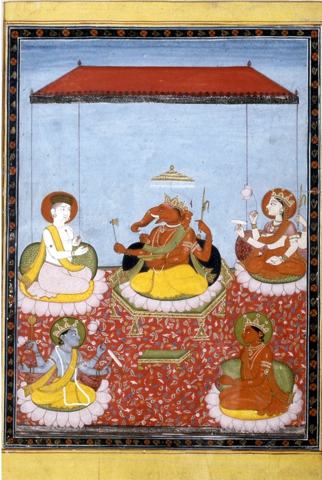
The elephant-headed son of Shiva and Parvati, lord of beginnings and remover (and placer) of obstacles, invoked before every undertaking.
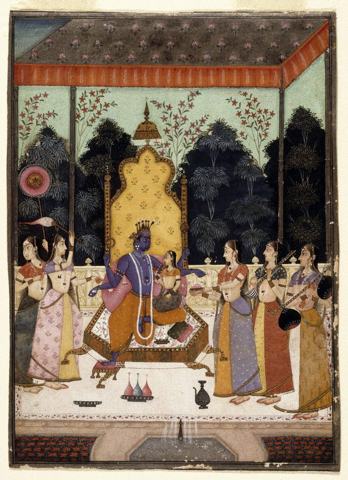
The preserver of cosmic order — the god who descends age after age, as Rama, as Krishna, and in other forms, to set dharma right when it fails.
Also mentioned inSudarshana Chakra
Sources & Further Reading
- 1.Devi Mahatmya (Durga Saptashati), chapters 81-93 of the Markandeya Purana — c. 6th century CE.
- 2.Mahabharata — the Durga stotras of the Virata Parva and Bhishma Parva (Sanskrit epic).
- 3.Devi Bhagavata Purana and Kalika Purana (later Shakta Puranas).
- 4.Coburn, Thomas B. Encountering the Goddess — A Translation of the Devi-Mahatmya and a Study of Its Interpretation. State University of New York Press, 1991.
- 5.Kinsley, David. Hindu Goddesses — Visions of the Divine Feminine in the Hindu Religious Tradition. University of California Press, 1986.
- 6.Coburn, Thomas B. Devi-Mahatmya — The Crystallization of the Goddess Tradition. Motilal Banarsidass, 1984.
- 7.Rodrigues, Hillary. Ritual Worship of the Great Goddess — The Liturgy of the Durga Puja. State University of New York Press, 2003.
Spot an error or have a source to suggest? Write to info@viseterna.com. We cite primary sources and modern scholarship, and we correct fast.