
The Lotus-Eaters
The flower-eating men — Homer's gentlest disaster, a people whose food is no weapon and yet erases the desire to go home.
Land of the Lotus Eaters, Robert S. Duncanson, 1861 (Royal Collection, Stockholm) · Public domain · source
A Danger That Does Not Fight
The Lotophagoi, the Lotus-Eaters, are the first supernatural people Odysseus meets after leaving Troy, and they are the only ones who do not try to harm him 1. They have no monster, no spell, no god behind them and no grudge. They simply offer their food, and the men who accept it stop wanting to go home 1.
Homer gives the episode about twenty lines — one of the shortest in the whole account of the wanderings — and readers have never let it go 1,3. In a book that will shortly produce a man-eating giant, it is the courteous hosts who define what the Odyssey is actually about, because the poem's subject is the will to return, and the lotus is the one thing in it that attacks the will directly 3.
The Episode in Book Nine
Odysseus tells the story himself, at the court of the Phaeacians. Sailing from Ismaros and the disastrous raid on the Cicones, his ships round Cape Malea and are driven off course by the north wind past Cythera 1. For nine days the gales carry them over the sea, and on the tenth they reach the land of the men who eat a flowery food 1.
They go ashore, draw water, and eat by the ships. Odysseus sends out a scouting party — two men and a herald as a third — to find out what kind of people live there 1. The Lotus-Eaters do them no violence: they give them lotus to taste 1.
Whoever ate the honey-sweet fruit lost all wish to report back or to return, and wanted only to stay among the Lotus-Eaters, grazing on lotus and forgetting the way home 1. Odysseus goes after them himself, drags them back to the ships weeping, ties them under the benches, and orders the rest of the crew aboard at once before anyone else can taste it and forget the voyage 1.
The detail that matters is the crying. The men are not drugged into stupor; they are unhappy to be rescued 1,3. Heubeck's commentary notes how economically Homer stages a threat that requires no antagonist at all, and how the compressed telling makes the episode function as an overture to the whole sequence of temptations that follows — Circe, Calypso, the Sirens — each of which offers a version of staying 3.
Herodotus and a Real People
Two centuries or so later, Herodotus writes about the Libyan coast and reports a people he calls the Lotophagoi living on a headland there, whose subsistence really is the fruit of a lotus 2. He describes the fruit as roughly the size of a mastic berry and about as sweet as a date, and adds that they make a wine from it 2.
Herodotus is not retelling Homer; he is describing a population within the geography he is surveying, in the same register he uses for other North African peoples 2. Later ancient geographers followed him and tried to fix the location, with the island now called Djerba off the Tunisian coast the most common candidate 2,3.
What this proves is limited but real. There was a coastal people known to Greek geography by that name, eating a fruit Greeks called lotus — and Homer's episode either draws on that knowledge or was later mapped onto it, in the way most of the Odyssey's stops eventually were 2,3. The equation should not be pushed: nothing in Herodotus suggests amnesia.
What the Lotus Was
Greek "lotus" covers several unrelated plants, which is the root of the confusion. It is used for clover-like fodder, for the Egyptian water-lily, and for a shrub bearing small sweet fruit 2,3.
The last is the one Herodotus describes, and it is generally identified with Ziziphus lotus, the wild jujube of North Africa and the Mediterranean — a thorny shrub with a small, date-like, edible fruit that can indeed be dried, stored, and fermented 2,3. It is not narcotic. Any attempt to make the Odyssey's lotus a real intoxicant runs into the plain fact that the effect Homer describes is not one any candidate plant produces, and commentators generally treat the fruit as mythic rather than pharmacological 3.
Why It Frightens
The Lotus-Eaters have proved unusually portable because the danger they pose is not exotic. Every other obstacle in the wanderings can be fought, outwitted, endured, or fled: Polyphemus can be blinded, Scylla and Charybdis can be threaded, the Sirens can be sailed past with wax and rope 1,4. The lotus removes the wish to try.
Homer measures a hero by nostos, the return — Odysseus is defined by wanting Ithaca more than anything on offer along the way 1,3. Contentment is the one thing in the poem's moral universe that cannot be resisted after the fact, only avoided beforehand. Hence the physical remedy: the men are bound to the benches, because argument is useless on someone who is no longer unhappy 1,3.
The episode also has almost no independent life in early Greek art or literature outside the Odyssey, unlike the Cyclops story, which was retold and painted for centuries 4. It was Homer's alone until much later readers rediscovered it.
Afterlives
Tennyson's "The Lotos-Eaters" (1832, revised 1842) inverts the poem's judgement. It gives the mariners their own voice in slow, heavy verse, and lets them argue their case for staying — the famous refrain that they will return no more — until the reader is half convinced 5. In doing so it turns Homer's cautionary paragraph into a study of exhaustion.
James Joyce made the episode the fifth chapter of Ulysses (1922), in which Leopold Bloom drifts through a morning of soporifics: a chemist's shop, tea, a warm bath, incense, a horse chewing at its nosebag 6. The chapter contains no lotus and no islanders, and is a precise reading of the original all the same 6.
Continue Exploring
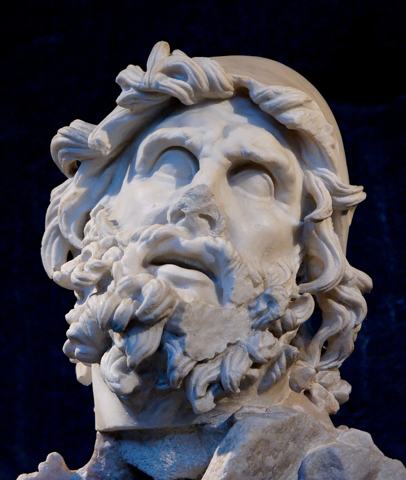
King of Ithaca and the man of many turns. Homer's cleverest hero, who took ten years to sail home from Troy and had to fight for his own house.
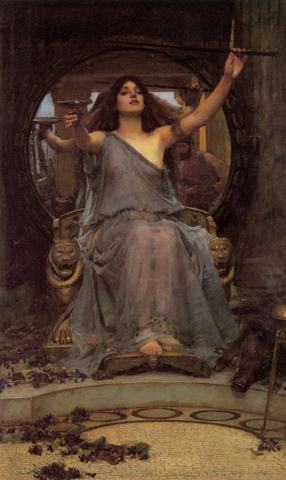
Goddess-enchantress of the island of Aiaia. She turned Odysseus' crew into swine, then became the one guide who told him how to reach the dead.
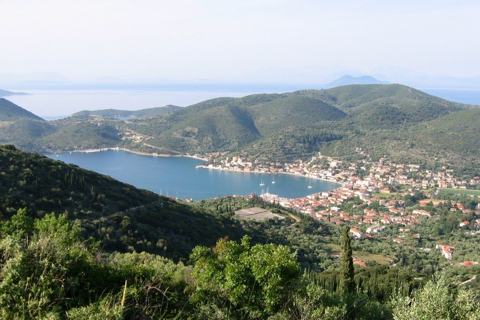
The rocky island kingdom of Odysseus and the destination of the Odyssey — a small, goat-grazed place worth ten years of sailing to get back to.
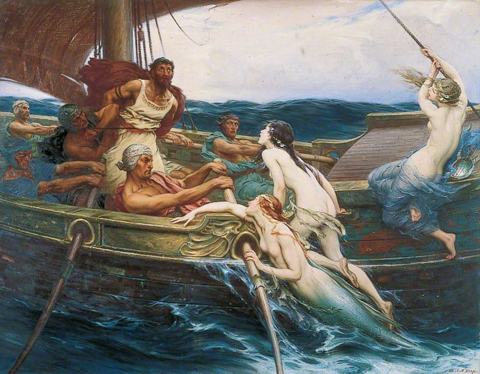
Bird-bodied singers of the Odyssey whose song promises knowledge, not romance. Odysseus heard them lashed to his mast, his crew rowing with waxed ears.
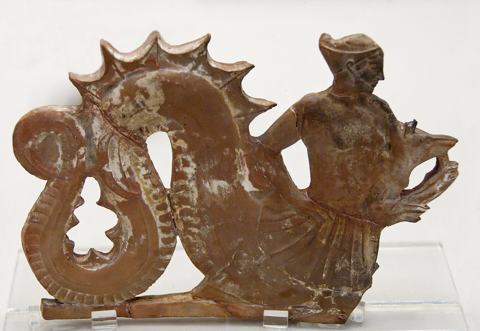
The twin sea-terrors of Odyssey 12 — a six-headed cliff monster and an all-swallowing whirlpool, set close enough that avoiding one means meeting the other.

Immortal nymph of the hidden island of Ogygia. She kept Odysseus for seven years and offered him deathlessness; he chose a mortal wife and a rocky island.
Sources & Further Reading
- 1.Homer, Odyssey 9.82–104 (the Lotophagoi; the wider wanderings, 9.39–566).
- 2.Herodotus, Histories 4.177.
- 3.Heubeck, Alfred & Arie Hoekstra. A Commentary on Homer's Odyssey, Volume II: Books IX–XVI. Clarendon Press, 1989.
- 4.Gantz, Timothy. Early Greek Myth: A Guide to Literary and Artistic Sources. Johns Hopkins University Press, 1993.
- 5.Alfred, Lord Tennyson. 'The Lotos-Eaters' (1832; revised 1842).
- 6.James Joyce, Ulysses (1922), episode 5, 'Lotus Eaters'.
Spot an error or have a source to suggest? Write to info@viseterna.com. We cite primary sources and modern scholarship, and we correct fast.