
Scylla and Charybdis
The twin sea-terrors of Odyssey 12 — a six-headed cliff monster and an all-swallowing whirlpool, set close enough that avoiding one means meeting the other.
Skylla, Greek terracotta relief, 5th c. BC (British Museum, 621) · Public domain · source
A Strait With Two Deaths
Scylla and Charybdis are the paired hazards of a narrow sea passage in the Odyssey, and their joint fame rests entirely on their arrangement. They sit within a bowshot of one another on opposite sides of a channel, so that a ship steering away from one steers into the other. There is no route between them and no third option — which is why the pair became, and remains, the standard image in European languages for a dilemma with no clean answer 1,6.
Circe briefs Odysseus on both before he sails, and her advice is unsentimental: hug Scylla's cliff and accept the loss of six men, because Charybdis takes the whole ship 1. She also tells him not to arm himself and not to try to fight — the only time in the poem the hero is instructed to simply endure a loss. He arms himself anyway, and it makes no difference 1,8.
Scylla
Homer's Scylla lives in a mist-wrapped cave high in a sheer rock, too high for a bowshot from a passing deck. She has twelve dangling feet and six long necks, each ending in a head with three rows of close-set teeth, and she barks like a newborn puppy — an unnerving detail that the Greek name plays on, since skylax means "puppy" 1,6. She fishes from her cave for dolphins, seals and whatever else the sea offers, and has never let a ship pass without taking a man from it for each head.
Marianne Hopman's study of the figure argues that "Scylla" is best understood not as a single fixed monster but as a combination of three ideas — sea, dog and woman — whose relative weight shifts from author to author across a thousand years, which is why the surviving descriptions never quite agree 6. Later sources supply an origin the Odyssey lacks: Ovid makes her a sea-nymph poisoned in her bathing pool by a jealous Circe over the affections of the sea-god Glaucus, transformed from the waist down into a ring of barking dogs and eventually turned to stone 3,7. Her parentage is variously given as the monster Crataeis, Hecate, Phorcys or Typhon and Echidna 4,7.
Charybdis
Charybdis is less a creature than a mechanism: three times a day she swallows the black water down and three times spews it back up, and Homer's image is of a cauldron boiling on a great fire, the sea-floor showing black sand at the bottom of the funnel. Under the whirlpool grows a great fig tree on the cliff 1,8. Later tradition made her a daughter of Poseidon and Gaia, greedy for stolen cattle, blasted by Zeus' thunderbolt into the water — an aetiology that adds little to Homer 4,7.
She is the deadlier of the two, and the poem proves it twice. On the outward passage Odysseus follows Circe's instruction, keeps to the cliff, and loses six of his best men, snatched squirming and calling his name — Homer says it was the most pitiable sight he saw in all his wanderings 1. On the return, alone on the wreckage of his ship after the sacrilege on Thrinacia, he is carried back to the same strait, and survives only by leaping for the fig tree and hanging from it "like a bat" until the keel and mast are spat back up and he can drop onto them 1,8.
The Argonauts and the Aeneid
The strait is a standing fixture of Greek voyaging narrative. In Apollonius' Argonautica the Argo passes safely because Hera sends the Nereid Thetis and her sisters to hand the ship through the channel like a ball, an image of divine assistance replacing Homeric endurance 2,7. Virgil sends Aeneas nowhere near it: the Trojans are warned by the seer Helenus to take the long way round Sicily rather than risk the passage at all, a characteristically Roman answer to the problem 5,7.
Ancient geographers identified the strait with the Strait of Messina between Sicily and Calabria, where a real tidal race produces standing whirlpools, and the identification held from at least Thucydides' time onward 5,7,8. Modern commentators generally treat it as a later rationalisation of a poetic landscape rather than a genuine sailing direction — the Odyssey's geography does not survive being plotted 8.
The Phrase
"Between Scylla and Charybdis" enters English through Latin and became proverbial in the Middle Ages, most famously in the twelfth-century Latin line of Walter of Chatillon advising the traveller who wants to avoid Charybdis that he runs into Scylla instead. It survives as the literate cousin of "between a rock and a hard place" and "between the devil and the deep blue sea" 6,7. James Joyce used it as the title of the ninth episode of Ulysses (1922), where the dilemma is intellectual rather than nautical.
Because the pair encode a genuinely useful idea — that some choices offer only a smaller and a larger loss — they have outlived nearly every other monster in the poem as a working metaphor, turning up in political and economic commentary far more often than in fantasy.
In Popular Culture
The two-sided passage is a recurring set-piece in adventure fiction and games, where the "choose your disaster" gate is a direct structural descendant. The renewed attention to the Odyssey around Christopher Nolan's 2026 film has brought the strait back into general circulation, usually paired with the Sirens as the poem's central sequence of sea perils.
Continue Exploring
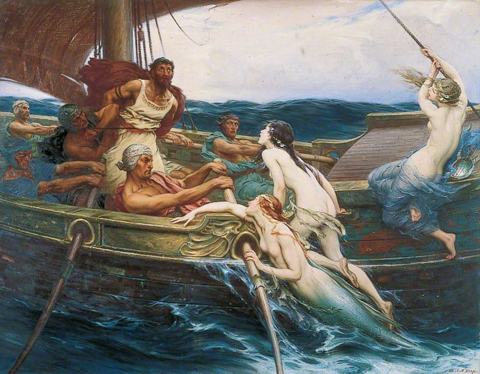
Bird-bodied singers of the Odyssey whose song promises knowledge, not romance. Odysseus heard them lashed to his mast, his crew rowing with waxed ears.
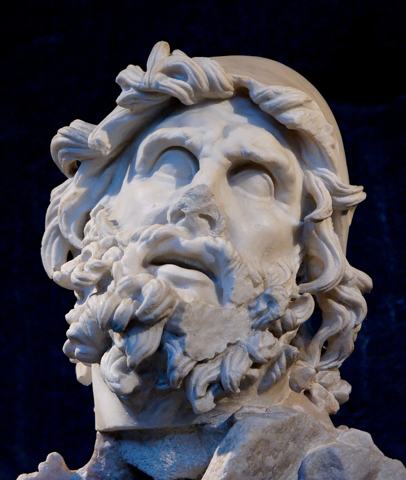
King of Ithaca and the man of many turns. Homer's cleverest hero, who took ten years to sail home from Troy and had to fight for his own house.
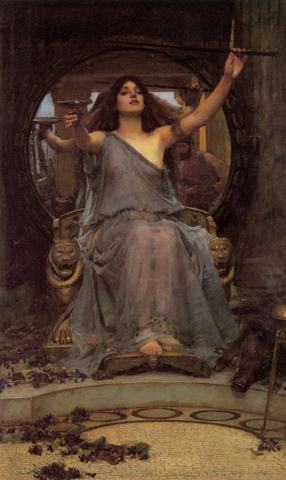
Goddess-enchantress of the island of Aiaia. She turned Odysseus' crew into swine, then became the one guide who told him how to reach the dead.
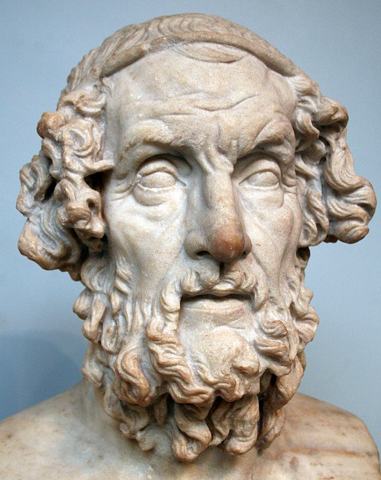
Homer's epic of Odysseus's ten-year voyage home from Troy, the founding adventure story of Western literature and the subject of a 2026 film.
The flower-eating men — Homer's gentlest disaster, a people whose food is no weapon and yet erases the desire to go home.
Messenger of the gods and guide of the dead. Patron of travellers, traders, heralds and thieves, and the only Olympian who crosses every boundary at will.
Sources & Further Reading
- 1.Homer, Odyssey (c. 8th-7th century BCE), esp. Book 12.
- 2.Apollonius of Rhodes, Argonautica, Book 4 (3rd century BCE).
- 3.Ovid, Metamorphoses, Books 13-14 (c. 8 CE).
- 4.Apollodorus, Bibliotheca and Epitome (1st-2nd century CE).
- 5.Virgil, Aeneid, Book 3 (c. 19 BCE).
- 6.Hopman, Marianne Govers. Scylla: Myth, Metaphor, Paradox. Cambridge University Press, 2012.
- 7.Gantz, Timothy. Early Greek Myth: A Guide to Literary and Artistic Sources. Johns Hopkins University Press, 1993.
- 8.Heubeck, A., S. West, J. B. Hainsworth, A. Hoekstra, J. Russo and M. Fernandez-Galiano. A Commentary on Homer's Odyssey, 3 vols. Oxford: Clarendon Press, 1988-1992.
Spot an error or have a source to suggest? Write to info@viseterna.com. We cite primary sources and modern scholarship, and we correct fast.