
Hermes
Messenger of the gods and guide of the dead. Patron of travellers, traders, heralds and thieves, and the only Olympian who crosses every boundary at will.
Hermes and the Infant Dionysus, attributed to Praxiteles, 4th c. BC (Archaeological Museum of Olympia); photo Dwaisman, CC BY-SA 4.0 · CC BY-SA 4.0 · source
The God of Crossings
Hermes is the son of Zeus and Maia, eldest of the Pleiades and a daughter of Atlas, born in a cave on Mount Cyllene in Arcadia. He is the herald of the gods, the guide of souls to the underworld, and the patron of everything that involves crossing a line: travel, trade, translation, messages, negotiation, luck, and theft 1,6,7.
Walter Burkert's account of Greek religion identifies the boundary as his central concept. The commonest cult object in the Greek world was the herm — a squared stone pillar with a bearded head on top and an erect phallus on the front — set at crossroads, property lines, city gates and doorways. It marked a limit and, by marking it, made passage across it safe. A god who belongs at the boundary belongs to travellers and merchants, but equally to housebreakers, and Greek cult was untroubled by that 6,7.
The First Day: A Hymn About a Thief
The Homeric Hymn to Hermes is the funniest surviving Greek religious poem, and it covers a single day. Born at dawn, the infant crawls out of the cave, finds a tortoise on the threshold, kills it and stretches ox-hide and seven sheep-gut strings across the shell to invent the lyre — then sings himself a song about his own parentage before lunch 1,5.
By evening he has walked to Pieria and stolen fifty cattle from the herd of Apollo, driving them backwards so the hoofprints point the wrong way, wearing wicker sandals he wove to disguise his own tracks. He sacrifices two of them by a method the hymn describes at length — dividing twelve portions for twelve gods, including himself, a claim to Olympian status made in the act — and is back in his cradle before morning, feigning innocence with the swaddling pulled up. Apollo tracks him anyway, hauls him before Zeus, and Hermes lies flatly and expertly to his father's face while Zeus laughs. The quarrel is settled when Hermes plays the lyre; Apollo, who cannot resist it, trades the cattle for the instrument 1,5.
Athanassios Vergados' commentary reads the hymn as a poem about invention and the arts as much as about theft — the cattle are the lesser prize, and what the young god really acquires is a place in the divine order by being useful and entertaining 5. Later exchanges add the shepherd's pipe, the golden staff, and a limited form of divination by lots from the bee-maidens of Parnassus, while Apollo keeps the prophetic monopoly at Delphi 1,4.
Messenger, Escort, Psychopomp
In Homer, Hermes is the god who is sent. In Iliad 24 he escorts old Priam through the Achaean sentries by night to beg the body of his son Hector from Achilles — the greatest crossing of a line in Greek epic, and Hermes both guides and disguises him 2. In the Odyssey he is sent to Ogygia to order Calypso to release Odysseus, and he intercepts the hero on Aiaia with the herb moly that protects him from Circe's drugs 2.
His other office is graver. As psychopompos he conducts the dead to the realm of Hades, and the second underworld scene of the Odyssey opens with him leading the ghosts of the slaughtered suitors down past the White Rock and the gates of the Sun, squeaking like bats in a cave 2,6. The same god who steals cattle and delivers messages is the one who walks every mortal across the last boundary; it is the most consistent thing about him.
He earned the epithet Argeiphontes, usually understood as "slayer of Argos", by killing the hundred-eyed watchman Hera had set over Io — lulling every eye to sleep with the pipes or with his staff before striking 3,4,7. His descendants are appropriately mixed: Pan the goat-god, Hermaphroditus, and Autolycus the master thief, grandfather of Odysseus, from whom the hero's cunning is explicitly said to come 2,4.
Cult and Everyday Religion
Hermes was worshipped less in grand temples than in constant small ways. Herms stood outside Athenian houses in such numbers that their mass mutilation in 415 BCE, on the eve of the Sicilian expedition, was treated as a state emergency and a religious scandal that helped ruin Alcibiades 6,7. He shared the gymnasium and palaestra with Heracles as patron of athletes and of the young; he presided over markets as Hermes Agoraios; and an unexpected windfall was a hermaion, "a gift of Hermes" 6.
He is also, uniquely among the Olympians, comfortable with the low and the practical. Hesiod credits him with giving the first woman a shameless mind and deceitful words in the Pandora story, and Greek cult accepted him as the god of the profitable lie and the sworn oath in the same breath 3,6.
Mercury and After
The Romans identified him with Mercury, whose name is tied to merx, merchandise, sharpening the commercial side of the god at the expense of the trickster 7. In late antiquity the Egyptian Thoth was syncretised with him to produce Hermes Trismegistus, "thrice-greatest", supposed author of the Hermetic writings on magic, astrology and alchemy — the reason "hermetic" still means both "sealed" and "occult" in English, and the reason Hermes has more name-recognition in Renaissance esoteric literature than in Greek theology 6,7.
In Popular Culture
The winged sandals, winged cap and snake-entwined caduceus are among the most recycled visual shorthand in Western design, from florists and courier companies to the misuse of the caduceus as a medical emblem in the United States — the physician's symbol is properly the single-snake rod of Asclepius. Hermes appears in most modern retellings of the Odyssey, where his two interventions save the hero's life.
Continue Exploring
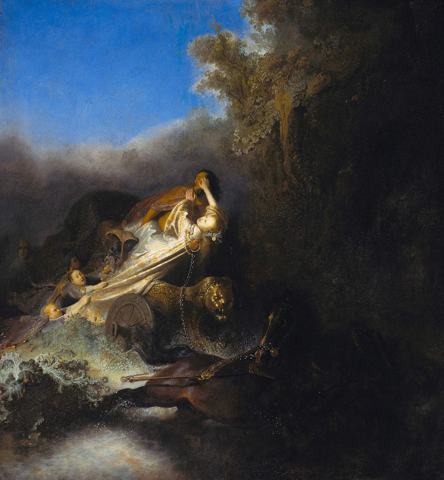
Lord of the underworld and of the wealth beneath the earth. Not a devil — a grim, lawful king whose only rule is that no one leaves.
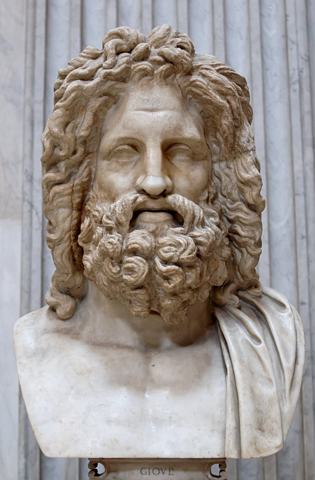
King of the gods and lord of the sky, thunder and justice. He overthrew his own father, divided the universe by lot, and guaranteed the laws of hospitality.
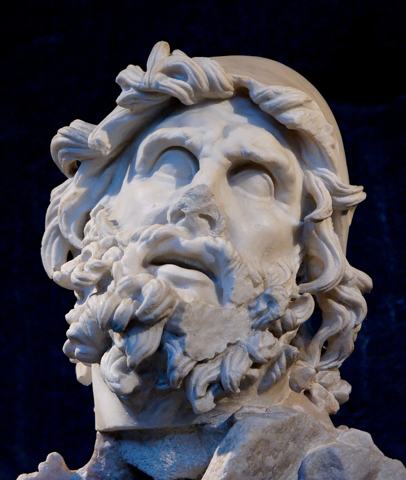
King of Ithaca and the man of many turns. Homer's cleverest hero, who took ten years to sail home from Troy and had to fight for his own house.
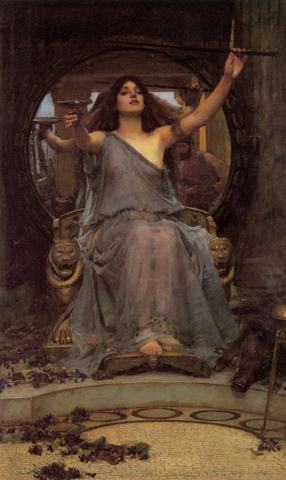
Goddess-enchantress of the island of Aiaia. She turned Odysseus' crew into swine, then became the one guide who told him how to reach the dead.

Immortal nymph of the hidden island of Ogygia. She kept Odysseus for seven years and offered him deathlessness; he chose a mortal wife and a rocky island.
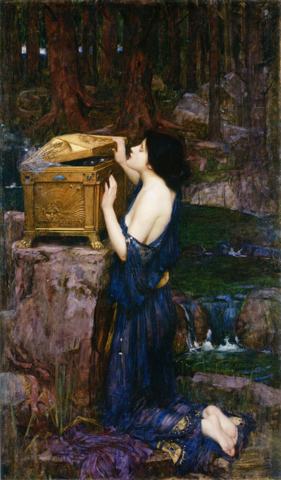
The first mortal woman, built by the gods and sent to open a sealed storage jar that let misery into the world — an ancient jar, not the box of later legend.
Also mentioned inApolloDemeterMedusaMount OlympusPersephonePerseus
Sources & Further Reading
- 1.Homeric Hymn to Hermes (c. 6th century BCE).
- 2.Homer, Iliad, Book 24, and Odyssey, Books 5, 10 and 24 (c. 8th-7th century BCE).
- 3.Hesiod, Theogony and Works and Days (c. 700 BCE).
- 4.Apollodorus, Bibliotheca (1st-2nd century CE).
- 5.Vergados, Athanassios. The Homeric Hymn to Hermes: Introduction, Text and Commentary. Berlin: De Gruyter, 2013.
- 6.Burkert, Walter. Greek Religion, trans. John Raffan. Harvard University Press, 1985.
- 7.Hornblower, S., A. Spawforth and E. Eidinow, eds. The Oxford Classical Dictionary, 4th ed. Oxford University Press, 2012.
Spot an error or have a source to suggest? Write to info@viseterna.com. We cite primary sources and modern scholarship, and we correct fast.