
Enlil
Lord of the moving air — the Sumerian executive of the gods, whose word carried out destinies, who split heaven from earth and sent the Flood.
God Enlil, seated, from Nippur, 1800-1600 BCE (Iraq Museum, Baghdad) · CC BY-SA 4.0 · source
Lord Wind
Enlil, Akkadian Ellil, is the chief active god of the Sumerian pantheon: the middle term of the great triad in which Anu holds the sky, Enlil the atmosphere and the earth's surface, and Enki the fresh waters below 8. His name is usually read as en-lil, "Lord Wind" or "Lord Air," and Jacobsen took the element seriously, describing him as the numinous power in moving air — the breath that makes music through a reed, and the storm that flattens a city, without any contradiction between the two 6.
Where Anu is remote and authority is only his in principle, Enlil is the god who actually decides and executes. Sumerian texts credit him with holding the Tablet of Destinies, with the power to name kings and to withdraw that naming, and with a word that once uttered cannot be reversed 6,8. Kingship in southern Mesopotamia was legitimate when Enlil at Nippur granted it, and rulers as far apart as Sargon of Akkad and the kings of Ur advertised the fact 8.
Nippur and the Ekur
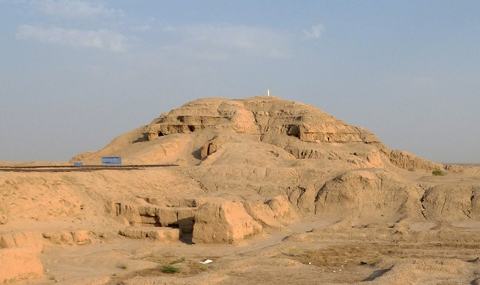
Enlil's city is Nippur, and his temple there is the Ekur, the "Mountain House" 8. Nippur was never an imperial capital and appears not to have wanted to be; it was a religious centre whose endorsement conferred legitimacy on whoever ruled from elsewhere, which is part of why its shrine survived for two and a half thousand years of political churn 8.
The Sumerian Hymn to Enlil describes the Ekur as a place where no unrighteous or violent act can be committed and where the god's inspectors watch conduct, and it credits Enlil with the whole ordered infrastructure of civilised life: without him no city is built, no cattle pen laid out, no canal dredged, no field brought to yield 2. The hymn is also candid about his other face, calling him a wild bull whose lifted eyes scan the lands and whose raised gaze makes the mountains tremble 2.
Separating Heaven from Earth
In the Sumerian cosmogony implied across several compositions, sky and earth were originally a single mass; Enlil is the one who separated them, taking the earth for himself while An carried off the heavens 6,8. He is also credited with inventing the pickaxe or hoe, the tool that breaks the crust of the earth, and with using it to let the first humans sprout up through the ground 8.
Enlil and Ninlil
The one narrative about Enlil that reads as a personal story is uncomfortable. In Enlil and Ninlil, the young goddess Ninlil is warned by her mother not to bathe in the canal; she does, Enlil sees her, and he takes her against her stated refusal 3. The assembly of the gods banishes him from the city as a ritual offender, and he walks the road to the underworld 3.
Ninlil, now pregnant with the moon god Nanna, follows him. Three times Enlil disguises himself as a gatekeeper of the underworld and lies with her again, each time engendering another underworld deity, so that these children can substitute for Nanna and allow the moon to rise into the sky rather than remain below 3. Jacobsen read the composition as a myth of substitution and release, but its plainest feature is that the head of the pantheon commits an offence, is exiled for it, and is not otherwise punished 6.
The Flood and the Noise of Mankind
Enlil's most consequential act is the Flood. In Atrahasis, humanity is created to take over the labour of the lesser gods, multiplies, and becomes noisy; Enlil, unable to sleep, sends plague, then drought, then famine to reduce them 1. Each time, Enki instructs the wise man Atrahasis in how to blunt the affliction, and each time Enlil escalates 1. Finally he binds the gods by oath to keep the secret and sends the Flood 1.
Enki keeps the letter of his oath by speaking not to Atrahasis but to a reed wall, through which the man hears everything, builds his boat, and survives 1. When the waters recede and the gods, starving without offerings, gather around the sacrifice like flies, Enlil is furious to find a survivor — and is then talked into a compromise: humanity persists, but with infant mortality, barren women, and a class of celibate priestesses to hold its numbers down 1,7. The same episode, transposed, becomes Tablet XI of the Epic of Gilgamesh 7.
When the Word Comes Back
Sumerian city laments turn Enlil's authority to devastating literary purpose. The Lamentation over the Destruction of Sumer and Ur explains the catastrophic end of the Third Dynasty of Ur as a decree of the gods, with Enlil calling in the Gutians and the storm, and the goddesses of the ruined cities pleading against a verdict already fixed 4. The genre insists that the disaster was not an accident and not a failure of the gods, but a decision — which is theologically tidy and, as poetry, merciless 4,6.
The Epic of Anzu shows the reverse case. The bird-demon Anzu steals the Tablet of Destinies while Enlil bathes, and divine authority itself goes missing until Ninurta shoots the thief and recovers it 5,7. The tablet, not the god, is where the power sits — which is worth noting when Babylonian theology later hands the same object, and the same office, to Marduk 5,8.
Continue Exploring
Father of the gods — the Mesopotamian sky, whose written sign meant "god" itself; the source of all authority, and almost never the one who uses it.
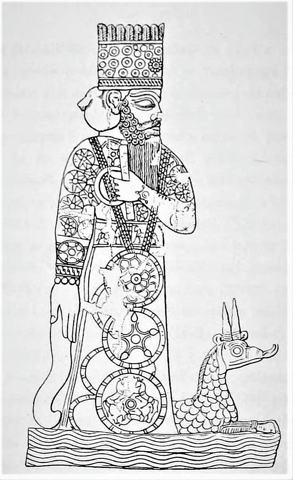
Champion of the gods — Babylon's patron, who killed the sea-dragon Tiamat, built heaven and earth out of her body, and was crowned king over all the gods.
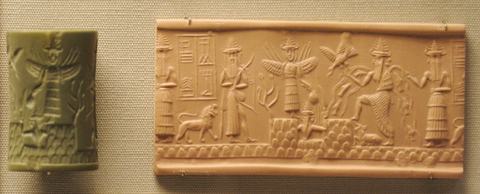
God of wisdom and the sweet water under the ground — the craftsman-trickster who made humankind, taught the crafts, and warned one man about the Flood.
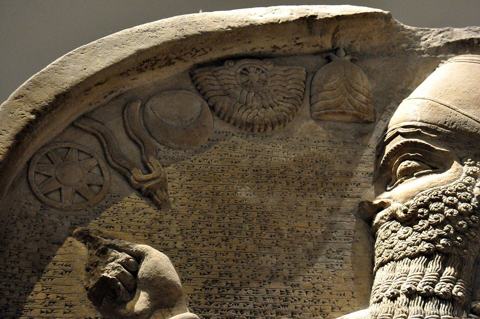
Son and champion of Enlil, who slew the demon Asag and the bird Anzu, and whose plow shaped the rivers and fields of Mesopotamia.
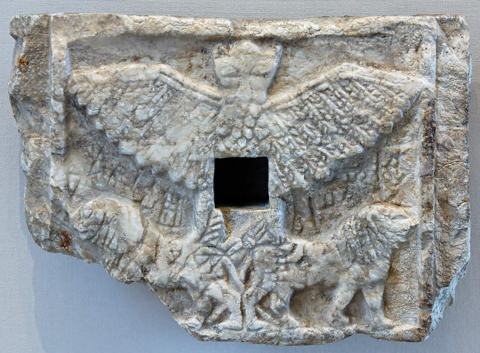
The monstrous lion-headed eagle who stole the Tablet of Destinies from Enlil's sanctuary and was hunted down by the god Ninurta.
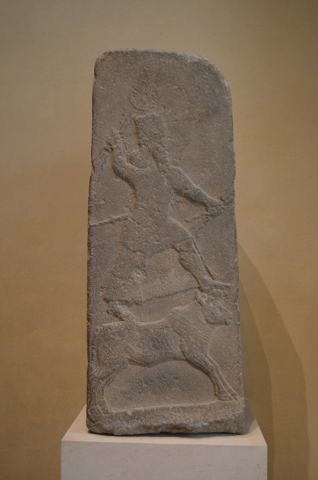
The Mesopotamian storm god who could drown the land in flood or bless it with rain, worshipped as Ishkur in Sumer and Adad across Babylonia and Assyria.
Also mentioned inAtrahasisEnkiduEreshkigalGilgameshHumbaba (Huwawa)InannaInanna's Descent to the UnderworldNanna (Sin)NergalNinhursagPazuzuShamash (Utu)The Tablet of DestiniesUtnapishtim
Sources & Further Reading
- 1.Atrahasis (Old Babylonian Flood epic, c. 1700 BCE).
- 2.Hymn to Enlil, the All-Beneficent (Enlil in the Ekur), Sumerian composition.
- 3.Enlil and Ninlil (Sumerian composition).
- 4.The Lamentation over the Destruction of Sumer and Ur (Sumerian, early 2nd millennium BCE).
- 5.The Epic of Anzu, Standard Babylonian version.
- 6.Jacobsen, Thorkild. The Treasures of Darkness: A History of Mesopotamian Religion. Yale University Press, 1976.
- 7.Dalley, Stephanie. Myths from Mesopotamia. Oxford University Press, revised edition 2000.
- 8.Black, Jeremy & Anthony Green. Gods, Demons and Symbols of Ancient Mesopotamia: An Illustrated Dictionary. British Museum Press, 1992.
Spot an error or have a source to suggest? Write to info@viseterna.com. We cite primary sources and modern scholarship, and we correct fast.