
Inanna
Queen of Heaven — Sumerian goddess of love, war, and the planet Venus, who walked into the land of the dead and was the only one to walk back out.
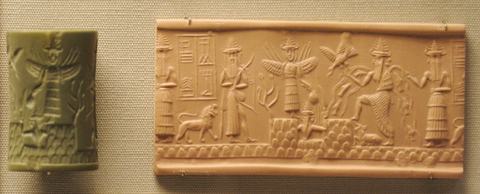
Ishtar (Inanna) on an Akkadian cylinder seal, c. 2350-2150 BCE · CC BY 3.0 · source
Queen of Heaven
Inanna is the Sumerian goddess of sexual love, of war, and of the planet Venus; the Akkadian-speaking peoples who followed called her Ishtar, and the two are treated as a single deity across three thousand years of Mesopotamian religion 5. Her Sumerian name is usually read as Nin-an-na, "Lady of Heaven," and she is the most prominent goddess in the world's oldest written literature 5,6.
She is not a goddess of one department. Her hymns pair the bedroom and the battlefield without apology: she is desire, and she is the joy of destroying, and the same texts celebrate both 6. Harris argues that this is the point rather than a muddle — Inanna-Ishtar is constructed as a coincidence of opposites, a divinity whose role is to cross and confound the boundaries that Mesopotamian society otherwise policed 6.
Symbols and the Morning Star
Her emblem is the eight-pointed star or rosette, and her most ancient sign is the looped reed gatepost that marks the storehouse and the temple door 5. In art she wears the horned crown of divinity, often with weapons rising from her shoulders, and she is attended by lions; a lion-drawn chariot and the standing figure on a lion's back are both hers 5.
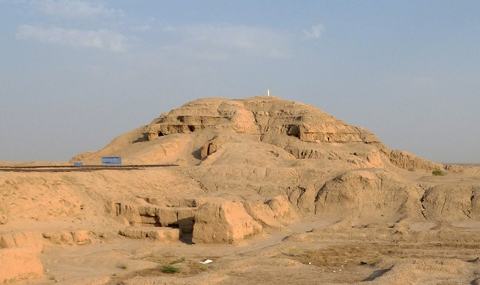
Astronomically she is Venus, which appears as both morning and evening star — a doubleness the texts exploit constantly, since the same body announces the dawn and the dusk 5,6. Her chief sanctuary was the Eanna, the "House of Heaven," at Uruk, one of the earliest cities on earth; the Assyrians later gave enormous importance to Ishtar of Nineveh and Ishtar of Arbela, the latter an oracular goddess who spoke to kings 5.
Her family shifts by tradition: daughter of the sky god Anu in some texts, elsewhere daughter of the moon god Nanna and sister of the sun god Utu, and in every version the younger sister of Ereshkigal, queen of the dead 1,5.
The Theft of the Me
In Inanna and Enki, the goddess travels to Eridu to visit Enki, god of wisdom and fresh water. He entertains her, drinks too much beer, and in his generosity hands over the me — the divine ordinances, the fundamental institutions of civilisation: kingship, priesthood, craft, music, truth, deceit, sexual practice, the arts of war 2. Inanna loads them onto the boat of heaven and sails for Uruk. Sobering up, Enki sends monsters after her six times, and six times her minister Ninshubur beats them off; the me stay in Uruk 2. The story is a charter myth for a city's cultural primacy, told as a heist 2,5.
The Descent to the Underworld
The most famous Inanna narrative sends her the other way. She "sets her mind toward the great below" and descends to the realm of her sister Ereshkigal, dressed in her full regalia 1. At each of the seven gates the gatekeeper Neti removes one item — crown, measuring rod, necklace, breast-beads, ring, breastplate, robe — until she enters the throne room naked and stripped of power 1. The seven judges of the underworld, the Anunnaki, fix her with the eye of death; she is turned into a corpse and hung on a hook 1.
Ninshubur, following instructions, petitions the great gods. Enlil and Nanna refuse; Enki agrees, and fashions two creatures from the dirt under his fingernails, sexless beings the underworld's rules do not cover 1. They find Ereshkigal groaning as if in labour and simply echo her cries back to her — sympathy no one else has offered — and she rewards them with the corpse, which they revive with the food and water of life 1.
But the underworld does not release anyone for free. Inanna must supply a substitute. She finds her husband Dumuzi enthroned and unmourning, and hands him to the demons; he flees, is caught, and in the end his sister Geshtinanna volunteers to take half his sentence, so that each spends half the year below 1. Mesopotamian audiences read the arrangement against the agricultural year and the disappearance of Venus from the sky 5.
Ishtar and Gilgamesh
Tablet VI of the Epic of Gilgamesh shows the other face. Ishtar sees Gilgamesh washing after his triumph, proposes marriage, and offers him a chariot of lapis and gold. He refuses — with a long, insulting inventory of what became of her previous lovers, Dumuzi among them 4. Enraged, she goes up to Anu and demands the Bull of Heaven, threatening to smash the gates of the underworld and let the dead out to eat the living if he refuses 4. The Bull is released, kills hundreds of men, and is butchered by Gilgamesh and Enkidu, who throws its haunch in her face — an insult the gods answer with Enkidu's death 4.
Cult, Kingship, and Enheduanna
Inanna's cult was entangled with kingship through the sacred marriage, in which the ruler took the role of Dumuzi opposite the goddess or her priestess; hymns of Shulgi and Iddin-Dagan describe the rite in explicit terms, though whether it was physically enacted or liturgically performed remains debated 5. Her temple personnel included gala singers and figures such as the assinnu and kurgarru, whose gender presentation crossed conventional lines — consistent, Harris notes, with a goddess who was herself credited with the power to turn a man into a woman and a woman into a man 6.
The single most remarkable text about her is by a named author: Enheduanna, daughter of Sargon of Akkad and high priestess at Ur, whose Nin-me-sara praises Inanna as the greatest of the gods while pleading for the goddess's help against a usurper who has driven the priestess from her office 3. It is the earliest surviving literature attributed to a named individual anywhere in the world, and it is a hymn to this goddess 3,5.
Continue Exploring
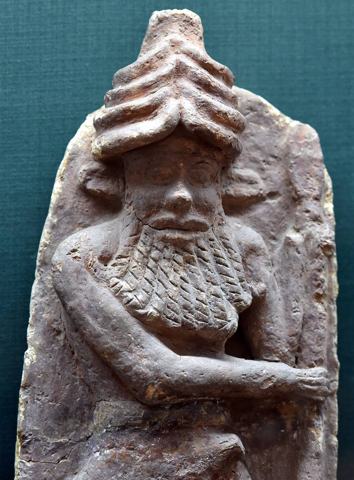
Father of the gods — the Mesopotamian sky, whose written sign meant "god" itself; the source of all authority, and almost never the one who uses it.
God of wisdom and the sweet water under the ground — the craftsman-trickster who made humankind, taught the crafts, and warned one man about the Flood.
The wild man tamed by Shamhat and bound to Gilgamesh by friendship -- until the gods condemned him to die for the Cedar Forest and the Bull of Heaven.
Inanna's shepherd husband, handed to the underworld in her place and mourned every summer across three thousand years of Near Eastern religion.
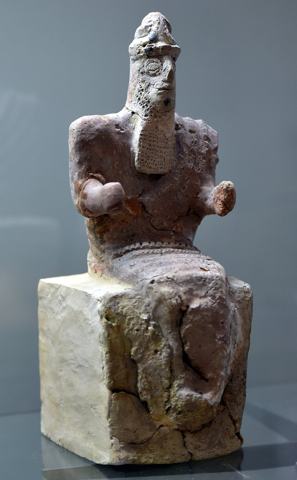
Lord of the moving air — the Sumerian executive of the gods, whose word carried out destinies, who split heaven from earth and sent the Flood.
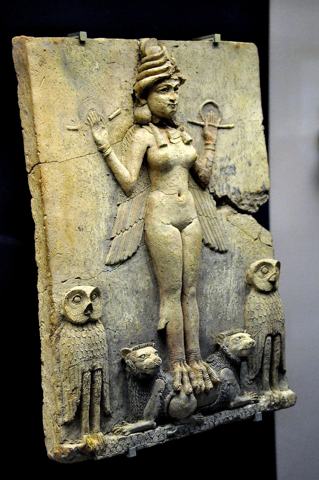
Lady of the Great Earth — the Mesopotamian queen of the dead, elder sister of Inanna, who rules the land of no return by rules even the gods obey.
Also mentioned inAkituAphroditeGilgameshInanna's Descent to the UnderworldIrkallaMushussu (the Dragon of Marduk)Nanna (Sin)Shamash (Utu)The Burney Relief (Queen of the Night)The Ishtar Gate
Sources & Further Reading
- 1.Inanna's Descent to the Netherworld (Sumerian, early 2nd millennium BCE).
- 2.Inanna and Enki (Sumerian composition).
- 3.Enheduanna, Nin-me-sara — The Exaltation of Inanna (c. 2300 BCE).
- 4.The Epic of Gilgamesh, Standard Babylonian version, Tablet VI.
- 5.Black, Jeremy & Anthony Green. Gods, Demons and Symbols of Ancient Mesopotamia: An Illustrated Dictionary. British Museum Press, 1992.
- 6.Harris, Rivkah. 'Inanna-Ishtar as Paradox and a Coincidence of Opposites.' History of Religions 30.3 (1991), 261–278.
Spot an error or have a source to suggest? Write to info@viseterna.com. We cite primary sources and modern scholarship, and we correct fast.