
Enki
God of wisdom and the sweet water under the ground — the craftsman-trickster who made humankind, taught the crafts, and warned one man about the Flood.
The Adda Seal, Akkadian Empire, c. 2300 BCE (British Museum) · CC BY-SA 2.0 · source
Lord of the Sweet Waters
Enki, called Ea in Akkadian, is the god of fresh water, of wisdom, of magic and incantation, and of every skilled craft 7. His domain is the Abzu (Akkadian apsu), the body of sweet water imagined as lying beneath the earth and feeding springs, wells, rivers, and marshes — the water that makes Mesopotamian life possible, as distinct from the salt sea 7. His city is Eridu in the far south, which Sumerian tradition held to be the first city ever founded and the first place kingship descended 7.
In art he is shown enthroned with two streams, often containing fish, arching from his shoulders or from a vase in his hands; his creature is the goat-fish, ancestor of the zodiacal Capricorn, and his servant is the two-faced vizier Isimud 7. Jacobsen characterised him as the power in water experienced as fertilising, cleansing, and above all clever — the element that finds a way around obstacles rather than through them, which is also an exact description of how he behaves in narrative 6.
Enki and the World Order
The Sumerian composition Enki and the World Order has the god make an inspection tour, assigning functions the way an administrator assigns portfolios 1. He fills the Tigris with sparkling water, appoints a god of canals and dikes, sets deities over the reed beds, the marshes, the sea, the rains, the plough, the brick mould, the herds, and the boundary stones, and confirms each in office 1.
The text ends with a complaint. Inanna protests that she has been left without an office of her own while other goddesses have theirs, and Enki answers with a list of the powers she in fact possesses 1. The exchange is characteristic: the god of wisdom is rarely shown legislating from strength, and very often shown negotiating 1,6.
The Making of Humankind
Two texts credit Enki with making people, for the same reason. In Enki and Ninmah, the lesser gods are worked to exhaustion and complain; Enki's mother Nammu wakes him, and he devises humankind, pinched out of clay from over the Abzu by birth goddesses working to his design 2. At the celebration afterwards, both he and the mother goddess Ninmah drink too much beer, and she wagers that she can make creatures whose fate he cannot settle 2.
She produces seven people with impairments — one who cannot bend the hands, one who is blind, one whose feet are paralysed, one who cannot hold back urine, a barren woman, a person without genitals — and for every one Enki finds a place in society: attendant to the king, court musician, silverworker, and so on 2. Then he makes a being of his own, Umul, so feeble it cannot sit, stand, or eat, and challenges her to find it a role; she cannot, and the argument ends 2. Whatever else the composition is doing, it is the ancient world's most direct statement that a person's place in the social order is assignable rather than natural 2,6.
In Atrahasis, the same creation is more formal: the rebel god Wê-ila is slaughtered, his flesh and blood mixed with clay, and fourteen birth goddesses shape seven male and seven female humans, with the god's spirit — the etemmu, the ghost — left permanently in the mixture 4,8.
The Flood and the Reed Wall
The Flood story is Enki's finest hour as a lawyer. In Atrahasis, Enlil reacts to human noise with plague, drought, and famine, and each time Enki quietly tells the wise man Atrahasis which god to bribe with offerings so the affliction lifts 4. Enlil, enraged, binds the gods by oath not to warn anyone about the coming Flood 4.
Enki keeps the oath and breaks it. He speaks not to Atrahasis but to the reed wall of his hut, addressing the wall aloud while the man listens on the other side: tear down the house, build a boat, abandon possessions, save life 4. The device is quoted almost verbatim in Tablet XI of the Epic of Gilgamesh, where the survivor is Utnapishtim, and it is one of the closest points of contact between Mesopotamian literature and the biblical Flood narrative 8.
The Trickster's Losses
Enki does not always win. In Inanna and Enki, the goddess visits Eridu, drinks with him, and leaves with the me — the divine ordinances of civilisation — which he has handed over while drunk; his six attempts to recover them by force all fail, and the me stay in Uruk 5. In Enki and Ninhursag, set in the pure land of Dilmun, he impregnates a chain of goddesses across successive generations, eats eight plants born from the union, and is cursed by Ninhursag with the eye of death 3. Eight parts of his body sicken, and only when a fox coaxes the goddess back does she sit him in her vulva and give birth to eight healing deities, one per afflicted part — including Ninti, whose name puns on both "lady of the rib" and "lady of life" 3,6.
Wisdom as an Institution
Enki's cult made intellectual authority itself divine. The apkallu, seven antediluvian sages sent up from the Abzu, were said to have brought humanity writing, law, temple-building, and the arts, and are shown in Assyrian palace reliefs as fish-cloaked or bird-headed attendants; exorcists later placed their figurines under floors for protection 7. Ea is the patron of the asipu, the incantation priest, and Babylonian magical texts routinely have the practitioner claim to be acting as his messenger 7.
When Babylonian theology elevated Marduk to kingship, it made him Ea's son, and Enuma Elish has the father acknowledge the promotion without resentment 8. In a tradition where every god's rank was contested, the wisdom god's dignity came out intact, largely because it was never framed as power in the first place 6,8.
Continue Exploring
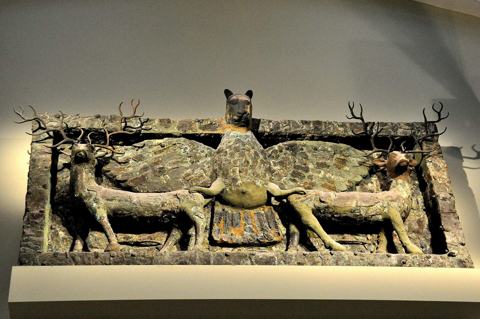
Sumer's mother goddess, who shapes the first humans from clay, births the gods of Dilmun, and heals the god she once cursed.
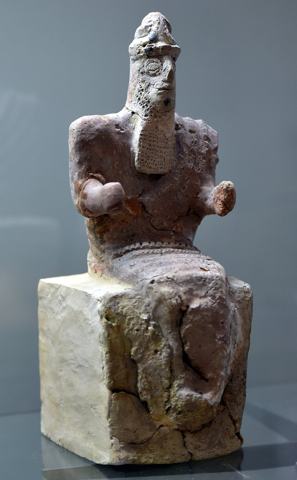
Lord of the moving air — the Sumerian executive of the gods, whose word carried out destinies, who split heaven from earth and sent the Flood.
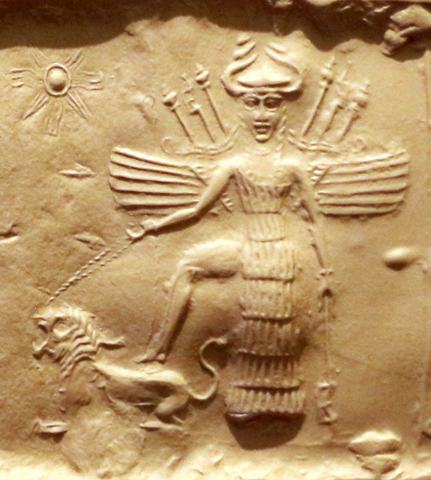
Queen of Heaven — Sumerian goddess of love, war, and the planet Venus, who walked into the land of the dead and was the only one to walk back out.
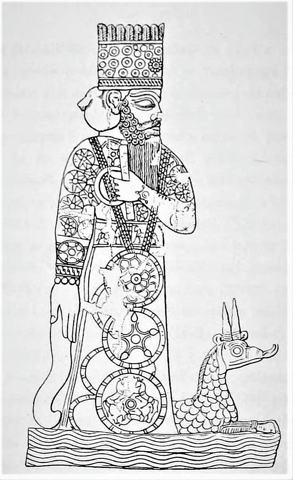
Champion of the gods — Babylon's patron, who killed the sea-dragon Tiamat, built heaven and earth out of her body, and was crowned king over all the gods.
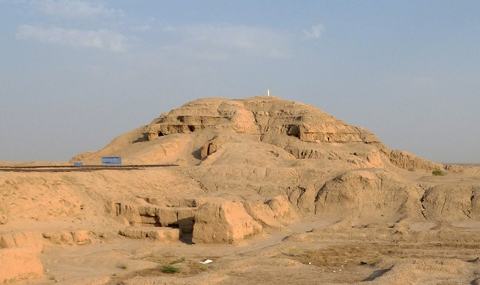
Father of the gods — the Mesopotamian sky, whose written sign meant "god" itself; the source of all authority, and almost never the one who uses it.
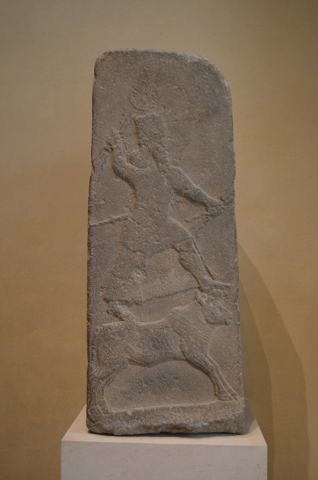
The Mesopotamian storm god who could drown the land in flood or bless it with rain, worshipped as Ishkur in Sumer and Adad across Babylonia and Assyria.
Also mentioned inApkallu (the Seven Sages)Enuma ElishEreshkigalInanna's Descent to the UnderworldIrkallaTiamatUtnapishtim
Sources & Further Reading
- 1.Enki and the World Order (Sumerian composition).
- 2.Enki and Ninmah (Sumerian composition).
- 3.Enki and Ninhursag (Sumerian composition, the Dilmun myth).
- 4.Atrahasis (Old Babylonian Flood epic, c. 1700 BCE).
- 5.Inanna and Enki (Sumerian composition).
- 6.Jacobsen, Thorkild. The Treasures of Darkness: A History of Mesopotamian Religion. Yale University Press, 1976.
- 7.Black, Jeremy & Anthony Green. Gods, Demons and Symbols of Ancient Mesopotamia: An Illustrated Dictionary. British Museum Press, 1992.
- 8.Dalley, Stephanie. Myths from Mesopotamia. Oxford University Press, revised edition 2000.
Spot an error or have a source to suggest? Write to info@viseterna.com. We cite primary sources and modern scholarship, and we correct fast.