
Marduk
Champion of the gods — Babylon's patron, who killed the sea-dragon Tiamat, built heaven and earth out of her body, and was crowned king over all the gods.
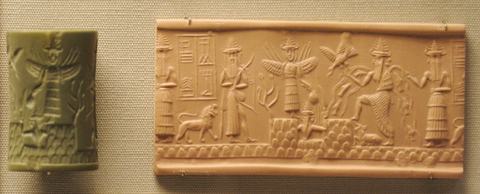
Marduk and his mushussu dragon, drawing after a Babylonian cylinder seal, 9th century BCE · Public domain · source
A God Who Was Promoted
Marduk is the city god of Babylon, and for most of Mesopotamian history that is all he was. His name appears in Sumerian sources as Amar-utu, "calf of the sun," and in the third millennium BCE he ranks nowhere near the top of the pantheon 7. What changed was politics. When Babylon became the capital of an empire under Hammurabi in the eighteenth century BCE, its god's status rose with it, and the prologue to Hammurabi's law stele records the transfer in careful theological language: Anu and Enlil called Marduk by name, gave him the Enlil-ship of all peoples, and made his rule over the land supreme 2.
The promotion was completed centuries later. Lambert argued that the great poem justifying Marduk's kingship, Enuma Elish, belongs to the reign of Nebuchadnezzar I in the twelfth century BCE, composed after that king recovered Marduk's cult statue from Elam 5. The text is therefore not a primitive creation story but a sophisticated argument, written to explain why the old order of gods had yielded to a newcomer 5,6.
Enuma Elish and the Duel with Tiamat
Enuma Elish opens before anything is named, with only two waters mingling: Apsu the fresh and Tiamat the salt 1. Their descendants are noisy; Apsu plans to kill them and is killed first by Enki/Ea, who builds his dwelling on top of him 1. There, Marduk is born — Ea's son, given four eyes and four ears and the winds as playthings 1.
When Tiamat raises an army of eleven monsters and appoints Qingu their commander, the assembled gods find no champion until Marduk offers himself, on one condition: that his word become law and his decree fix destinies ahead of theirs 1. They test him by making a constellation vanish and reappear at his command, then hail him king 1. He goes to battle armed with bow, mace, lightning, a net held by the four winds, and a chariot drawn by storm-beasts; when Tiamat opens her mouth he drives the Evil Wind into it so she cannot close it, and shoots an arrow through her belly 1,6.
The World Made From a Body
What follows is the passage that made the poem famous. Marduk splits the corpse "like a drying fish" into two halves; one becomes the sky, held up with bolts and a guard posted to keep her waters from escaping 1. He measures the Apsu, builds Esharra as its counterpart, and sets Anu, Enlil, and Ea in their stations 1. Then he organises time itself: the constellations as stations for the great gods, the year in twelve months, the moon given the crown and told exactly how to shape its horns across the month 1,6.
Humanity is an afterthought and a convenience. Qingu is condemned as the instigator, his blood is used to fashion mankind, and the purpose is stated flatly: so that the gods may be freed from labour 1,6. In gratitude the gods build Babylon and its temple Esagila with their own hands 1.
The Fifty Names
Tablets VI and VII close with the gods conferring fifty names on Marduk, each expounded in wordplay on the Sumerian signs that write it 1,5. This is not decoration. Absorbing fifty names means absorbing fifty gods, and by the end of the recitation Marduk holds the functions of the older pantheon inside himself — including the name Enlil of the gods, formerly the title of the god of Nippur 5. Lambert's study of the section shows how methodically the etymologies were engineered to make the takeover look like something the tradition had always contained 5.
Bel, Babylon, and the New Year
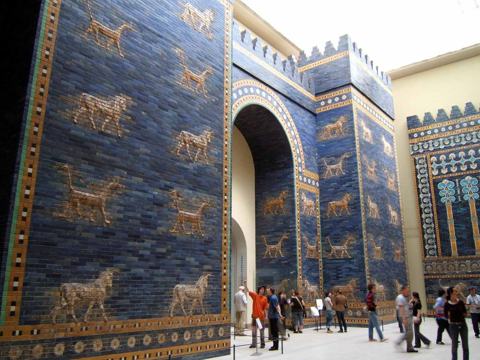
In everyday Babylonian speech Marduk is simply Bel, "the Lord," and the greeting Bel is king runs through prayers and letters 7. His symbols are the marru, a triangular spade, and the mushhushshu, the horned serpent-dragon that walks the glazed brick of the Ishtar Gate at his feet 7.
His temple complex at Babylon paired Esagila with the stepped tower Etemenanki, "House of the Foundation of Heaven and Earth," the ziggurat that stands behind the biblical Tower of Babel 7. Herodotus, visiting or reporting on the sanctuary in the fifth century BCE, describes an eight-tiered tower with a shrine on top containing a great couch and a golden table, and a lower temple with a seated golden figure 4. At the akitu, the New Year festival, Enuma Elish was recited aloud, the king was ritually stripped, struck, and made to declare his innocence before Bel, and the god's statue processed out of the city and back 7.
Doubt and the Absent God
Marduk's supremacy did not make Babylonian religion comfortable. Ludlul bel nemeqi, the long complaint of a sufferer who has lost health, standing, and the favour of his god, addresses Marduk directly and describes his mood as unfathomable: he wounds and he heals, and no diviner can predict which 3,6. The poem ends in restoration at Esagila, but its interest is the interval, and it is one of the frankest pieces of religious writing to survive from the ancient Near East 3,6.
The god's statue was also physically portable, and repeatedly stolen — by Hittites, Assyrians, and Elamites — with each abduction read as the god choosing to leave the city and each return as his choosing to come back 5,7. Kingship over the cosmos, in Babylonian terms, was not the same as being safe.
Continue Exploring
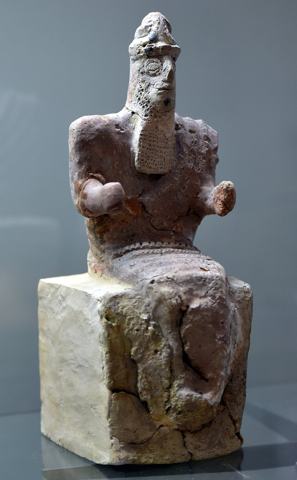
Lord of the moving air — the Sumerian executive of the gods, whose word carried out destinies, who split heaven from earth and sent the Flood.
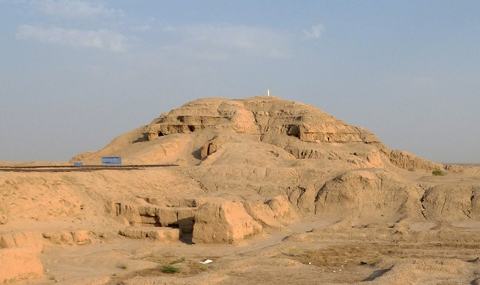
Father of the gods — the Mesopotamian sky, whose written sign meant "god" itself; the source of all authority, and almost never the one who uses it.
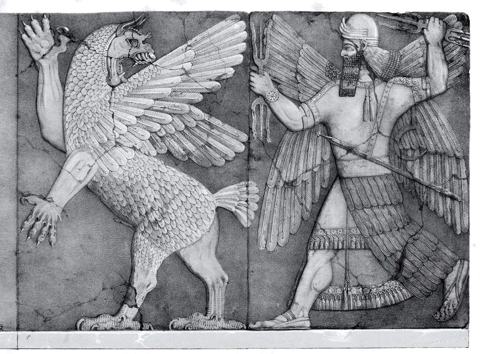
The primordial salt sea — the first mother of the gods, who turned on her children and whose split body became the sky and the earth above us.
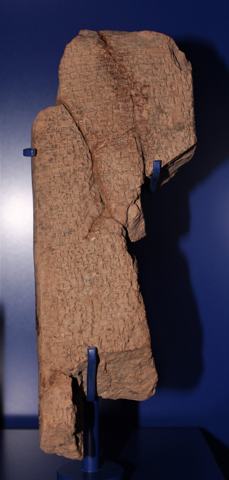
The Babylonian creation epic — seven tablets recited each New Year, telling how Marduk defeated Tiamat and became king of the gods.
God of wisdom and the sweet water under the ground — the craftsman-trickster who made humankind, taught the crafts, and warned one man about the Flood.
Babylon's spring festival, when Enuma Elish was recited, the king was ritually slapped, and a claimant to the throne had to take the hand of Bel.
Also mentioned inAdad (Ishkur, Mesopotamian Storm God)Anzu (the Lion-Headed Eagle)Apkallu (the Seven Sages)Etemenanki (the Ziggurat of Babylon)Mushussu (the Dragon of Marduk)Nanna (Sin)NergalNinhursagThe Tablet of Destinies
Sources & Further Reading
- 1.Enuma Elish (the Babylonian Epic of Creation), Standard Babylonian recension, Tablets I–VII.
- 2.The Laws of Hammurabi, prologue (c. 1750 BCE).
- 3.Ludlul bel nemeqi (The Poem of the Righteous Sufferer), Babylonian, c. 1200 BCE.
- 4.Herodotus, Histories I.181–183 (c. 430 BCE).
- 5.Lambert, Wilfred G. Babylonian Creation Myths. Mesopotamian Civilizations 16. Eisenbrauns, 2013.
- 6.Dalley, Stephanie. Myths from Mesopotamia. Oxford University Press, revised edition 2000.
- 7.Black, Jeremy & Anthony Green. Gods, Demons and Symbols of Ancient Mesopotamia: An Illustrated Dictionary. British Museum Press, 1992.
Spot an error or have a source to suggest? Write to info@viseterna.com. We cite primary sources and modern scholarship, and we correct fast.