
Utnapishtim
The Babylonian flood survivor who built the boat, released the birds, and was given eternal life — the one man Gilgamesh crossed the world to question.
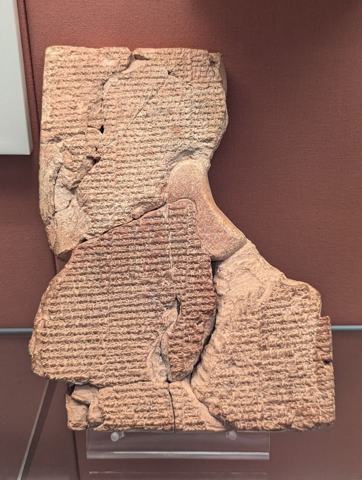
The Flood Tablet, Gilgamesh Tablet XI, Neo-Assyrian, Nineveh, 7th century BCE (British Museum) · CC0 · source
The Man Who Found Life
Utnapishtim is the survivor of the great flood in Babylonian tradition, and the only human being the sources allow to have escaped death permanently 1,6. His Akkadian name means something close to "He Found Life", and the epic gives him the standing epithet ruqu, "the Distant One", because the gods removed him from human company and settled him far away at the mouth of the rivers 1,6.
He is not a hero in the ordinary sense. He fights nothing, refuses nothing, and achieves his immortality by being warned and doing exactly as he is told 1,8. His importance in the Epic of Gilgamesh is that he is the counter-example that proves the rule: the one exception was granted under conditions that cannot be repeated 1,6.
Names Before Utnapishtim
The flood hero has several names across the Mesopotamian tradition, and comparing them is how the story's development is traced 5,8. In the Sumerian flood account he is Ziusudra — "life of long days" — king of Shuruppak, who is settled afterwards in the paradisal land of Dilmun 3,5. In the Old Babylonian poem that bears his name he is Atra-hasis, "exceedingly wise", an epithet the Gilgamesh version also applies to Utnapishtim 1,2,5. Much later, the Babylonian priest Berossus, writing in Greek, calls him Xisouthros, a transparent rendering of Ziusudra 4.
Lambert and Millard's edition of Atra-hasis established the shape of the older narrative, in which the flood is the last of a graded series of divine attempts to reduce humanity — plague, then drought, then famine, then the deluge — because the noise of the growing human population disturbs Enlil's sleep 2,5. Most scholars now hold that the flood account in Tablet XI of Gilgamesh was adapted from a version of Atra-hasis and inserted into the epic, since it sits as a self-contained recital inside a poem otherwise about something else 5,6.
The Warning at the Reed Wall
The gods swear an oath of secrecy, which puts Ea — the Akkadian Enki — in an awkward position, since he intends to break it 1,2. He evades the oath on a technicality by addressing not the man but the wall of his reed house, with the man listening on the other side: reed wall, reed wall, hear me 1,8. Utnapishtim is told to tear down the house, build a boat, and abandon possessions to save life 1.
He is also handed a cover story. Asked by the elders of Shuruppak what he is doing, he is to say that Enlil hates him, that he must go down to the Apsu to live with Ea, and that the god will rain abundance on the city — a speech that is true in the way an oracle is true and false in every way that matters to the people who hear it 1,8.
The Boat and the Flood
The vessel in Tablet XI is not ship-shaped. It is a cube of equal sides, roughly 120 cubits across, with six decks dividing it into seven levels and each level into nine compartments, caulked inside and out with bitumen 1,6. Finkel's publication of an Old Babylonian "Ark Tablet" added a further variant in which the boat is a giant round coracle of coiled rope, a real Mesopotamian river craft scaled up to impossible size — evidence that the tradition described the ark using whatever boat its audience actually knew 7.
The storm itself lasts six days and seven nights, and the poem's most striking touch is that the gods panic: they cower like dogs at the wall of heaven, and Ishtar cries out that she has destroyed her own people 1,8. On the seventh day the sea grows calm, all humanity has turned to clay, and the boat grounds on Mount Nimush 1. Utnapishtim releases a dove, then a swallow, both of which return, and finally a raven, which finds food and does not come back 1.
The Landfall and the Gift
He sets out an offering on the mountaintop, and the gods gather around the sacrifice like flies 1. Ishtar swears by her lapis necklace that she will not forget these days; Enlil arrives in fury that anyone survived, and Ea faces him down with the argument that punishment should fall on the offender rather than on all life, and that a lion or a famine would have thinned humanity without ending it 1,2.
Enlil then boards the boat, takes the couple by the hand, and blesses them: previously Utnapishtim was a man, now he and his wife shall be like gods, and shall live far off at the mouth of the rivers 1,6. The wording matters — the gift is a change of category and a removal from the world, not a reward that could be earned again 1,6.
The Test Gilgamesh Failed
When Gilgamesh finally arrives, having crossed the Waters of Death with the ferryman Ur-shanabi, he asks how to obtain the same thing, and Utnapishtim's first answer is a lecture: nothing is permanent, the sleeper and the dead look alike, and the Anunnaki fix the day of death without disclosing it 1,8. Then he offers a demonstration. If Gilgamesh cannot defeat sleep for six days and seven nights, he can hardly expect to defeat death 1.
Gilgamesh sits down and is asleep at once. A loaf is baked each day beside him, and when he wakes protesting that he only dozed, the row of loaves — one fresh, one stale, one mouldy, one hard as stone — convicts him 1,8. As a consolation his host discloses a secret of the gods: a thorny plant on the sea floor called "the old man grows young", which Gilgamesh retrieves by tying stones to his feet, and then loses to a snake at a bathing pool 1. The snake sheds its skin and leaves, which the poem offers as the only immortality actually available in this world 1,6.
Rediscovery and the Genesis Question
The Flood Tablet was identified in 1872 by George Smith, working through fragments from Nineveh in the British Museum, and the correspondences with Genesis — the divine warning, the pitched vessel, the mountain landfall, the birds, the sacrifice — caused an immediate public sensation 6,7. The consensus since has been that the biblical account belongs to the same Near Eastern narrative tradition rather than deriving from any one surviving tablet, and scholars continue to debate the route and date of transmission 5,7,8.
What the Babylonian version does not share is the moral frame. There is no wickedness to punish and no covenant afterwards; the flood is sent because humanity is loud, and the survivor is saved by a leak in the gods' security rather than by righteousness 2,5.
Continue Exploring
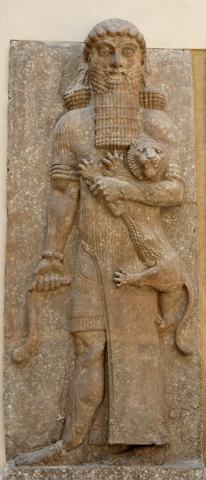
King of Uruk, two-thirds god and one-third man — the hero of the world's oldest surviving epic, who went to the ends of the earth to escape death.
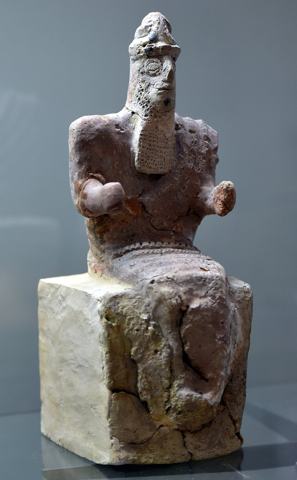
Lord of the moving air — the Sumerian executive of the gods, whose word carried out destinies, who split heaven from earth and sent the Flood.
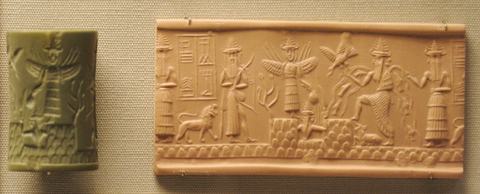
God of wisdom and the sweet water under the ground — the craftsman-trickster who made humankind, taught the crafts, and warned one man about the Flood.
The Old Babylonian flood epic — the fullest account of why the gods nearly drowned humanity, and the source behind Gilgamesh's own flood story.
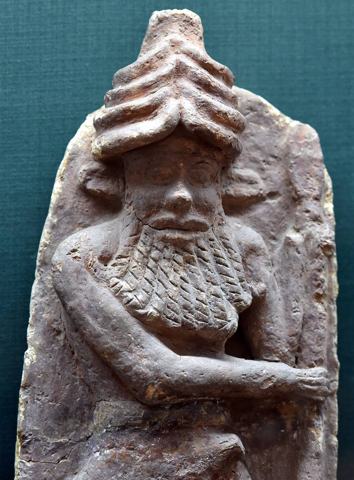
The wild man tamed by Shamhat and bound to Gilgamesh by friendship -- until the gods condemned him to die for the Cedar Forest and the Bull of Heaven.
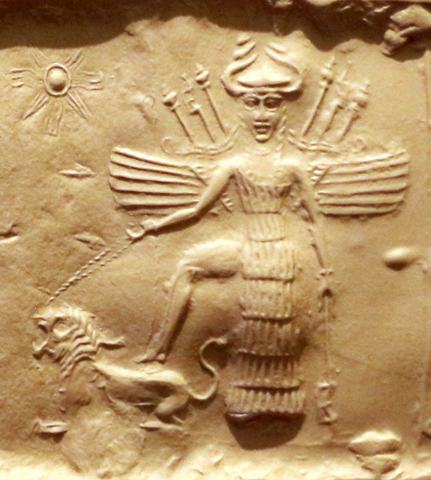
Queen of Heaven — Sumerian goddess of love, war, and the planet Venus, who walked into the land of the dead and was the only one to walk back out.
Sources & Further Reading
- 1.The Epic of Gilgamesh, Standard Babylonian version, Tablet XI (Nineveh recension).
- 2.Atra-hasis, Old Babylonian version (c. 1700 BCE).
- 3.The Sumerian Flood Story (Eridu Genesis), featuring Ziusudra of Shuruppak.
- 4.Berossus, Babyloniaca (c. 280 BCE), on Xisouthros, preserved via Alexander Polyhistor in Eusebius and Syncellus.
- 5.Lambert, W.G. & A.R. Millard. Atra-hasis: The Babylonian Story of the Flood. Oxford University Press, 1969; repr. Eisenbrauns, 1999.
- 6.George, A.R. The Babylonian Gilgamesh Epic: Introduction, Critical Edition and Cuneiform Texts. Oxford University Press, 2003.
- 7.Finkel, Irving. The Ark Before Noah: Decoding the Story of the Flood. Hodder & Stoughton, 2014.
- 8.Dalley, Stephanie. Myths from Mesopotamia: Creation, the Flood, Gilgamesh and Others. Rev. ed., Oxford University Press, 2000.
Spot an error or have a source to suggest? Write to info@viseterna.com. We cite primary sources and modern scholarship, and we correct fast.