
Atrahasis
The Old Babylonian flood epic — the fullest account of why the gods nearly drowned humanity, and the source behind Gilgamesh's own flood story.
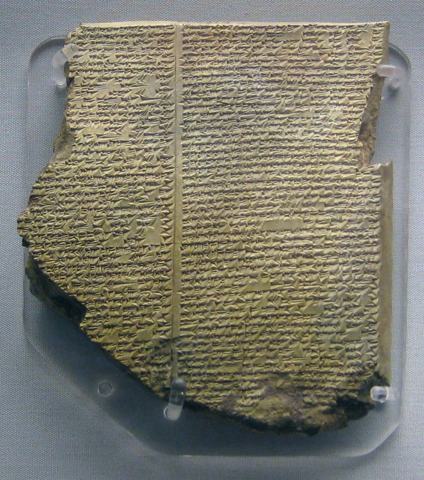
Tablet of the Epic of Atrahasis, probably from Sippar, 1635 BCE (British Museum) · CC BY-SA 4.0 · source
The Poem With a Beginning
Most Mesopotamian flood material survives as an episode lifted into a bigger story — Tablet XI of the Epic of Gilgamesh, for instance, is the flood story told to a visitor partway through someone else's adventure 1. Atrahasis is different: it is a complete, self-standing epic that begins before humanity exists and explains, in order, why the gods made people, why they came to regret it, and why they tried three times to be rid of them before finally sending the flood 1,4. Its hero's name, Atra-hasis, simply means "exceedingly wise," an epithet the Gilgamesh poem later borrows for its own flood survivor, Utnapishtim 1,4.
Misread, Then Corrected
Assyrian-period fragments of the poem reached the British Museum among the material recovered from Ashurbanipal's library at Nineveh, and George Smith worked on them in the 1870s as part of the same project that made the Gilgamesh flood tablet famous 1,5. Smith and his contemporaries did not yet have the hero's name right; the German Assyriologist Heinrich Zimmern corrected the reading to Atra-hasis only in 1899, decades after the first fragments surfaced 1. The poem's older, more complete form was not established until the twentieth century, when Old Babylonian tablets — including one exemplar whose colophon fixes its copying to a specific regnal year under King Ammi-saduqa, in the seventeenth century BCE — were assembled and published in full by Lambert and Millard in 1969, an edition that remains the foundation of everything written about the poem since 3,4.
Why the Gods Made People
The story opens with a labor dispute among the gods themselves. The senior gods have put the junior gods, the Igigi, to work digging canals and maintaining the earth, and after forty years of it the Igigi burn their tools and surround Enlil's house in open revolt 1,7. Rather than punish them, the gods negotiate a solution: the wise god Enki proposes that a rebel god be killed and that humanity be created from clay mixed with that god's flesh and blood, so that people would take over the gods' labor while carrying something of the divine — read in later texts as intelligence, or a ghost — in their own composition 1,4.
Too Loud to Sleep
The plan works too well. Humanity multiplies and grows noisy, and Enlil, unable to sleep for the racket, sends first plague, then drought, then famine to thin the population back down 1,7. Each time, Enki quietly tips off his devotee Atrahasis with a ritual workaround that blunts the disaster, and each time the human population recovers, until Enlil, furious at being repeatedly outmaneuvered, extracts an oath from the assembled gods that this time no one will warn the humans, and sends the flood 1,3.
The Wall That Was Told, Not the Man
Enki keeps his oath on a technicality that later Mesopotamian storytellers clearly loved enough to reuse: rather than warn Atrahasis directly, he addresses the reed wall of the man's house while Atrahasis listens on the other side, a device the Epic of Gilgamesh borrows almost word for word for its own flood scene 1,4. Atrahasis builds a boat, survives the storm, and offers sacrifice on dry land; Enlil is enraged that anyone survived, but Enki argues that indiscriminate destruction was never the sensible option and proposes instead a permanent brake on population growth — some women who never bear children, a class of priestess forbidden to have them, and a demon who takes infants — so the crisis need not repeat itself 1,3,7. It is a strikingly administrative resolution: not forgiveness, but population control written permanently into the design of human biology.
Ziusudra, Atrahasis, Utnapishtim, Xisouthros
The same flood hero appears under four names across four stages of the tradition. The Sumerian version, only partly preserved, calls him Ziusudra, "life of long days," and settles him afterward in the paradise land of Dilmun 2,4. Atrahasis is the fullest account of the character's motives and the divine politics behind the flood. The Standard Babylonian Epic of Gilgamesh borrows the same flood narrative nearly wholesale for its own hero, Utnapishtim, dropping most of the earlier material about why the gods acted in the first place 1,4. And centuries later still, the Babylonian priest Berossus, writing in Greek, renders the name as Xisouthros for a Hellenistic audience that had never seen a cuneiform tablet 4. Finkel's study of a separate Old Babylonian "Ark Tablet," discovered decades after Lambert and Millard's edition, adds a further variant boat description, a giant round coracle rather than the cube-shaped vessel of the Gilgamesh version, evidence that the story was told using whatever real river craft its audience actually recognized 6.
No Villains, No Covenant
What the Babylonian flood story does not share with its biblical counterpart is a moral frame. Nobody in Atrahasis is wicked, and nothing is promised for good behavior afterward; humanity is destroyed almost by accident, out of irritation, and preserved through nothing more exalted than one god's habit of tipping off a favorite worshipper 1,3. Lambert and Millard's edition remains the clearest single window onto that difference: a flood story built on noise and bureaucracy rather than sin and grace, and considerably older than the version most Western readers grew up with 3,4.
Continue Exploring
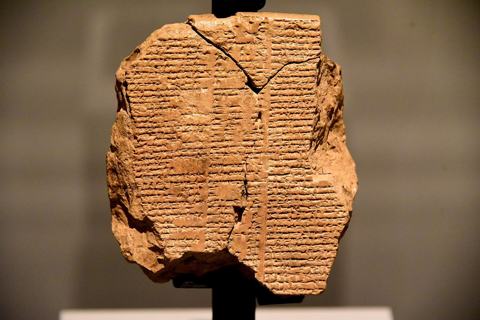
The world's oldest surviving epic — five Sumerian poems welded into an Akkadian masterpiece, lost for two thousand years until an 1872 tablet made headlines.
The Babylonian flood survivor who built the boat, released the birds, and was given eternal life — the one man Gilgamesh crossed the world to question.
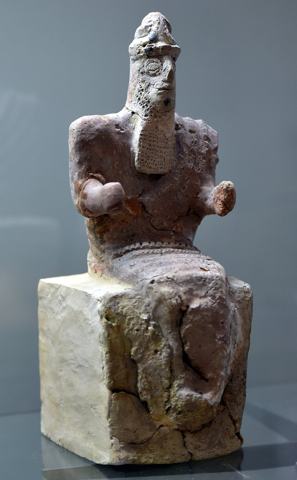
Lord of the moving air — the Sumerian executive of the gods, whose word carried out destinies, who split heaven from earth and sent the Flood.
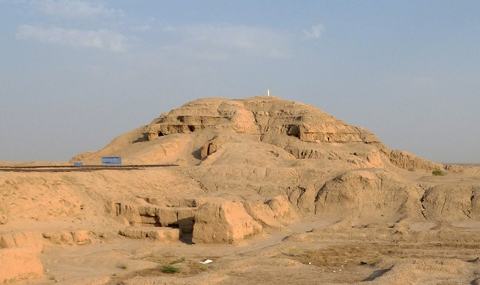
Father of the gods — the Mesopotamian sky, whose written sign meant "god" itself; the source of all authority, and almost never the one who uses it.
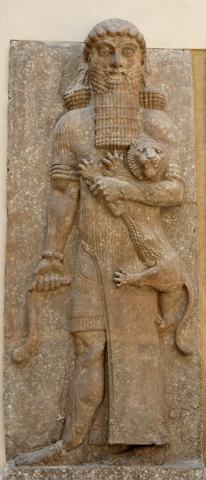
King of Uruk, two-thirds god and one-third man — the hero of the world's oldest surviving epic, who went to the ends of the earth to escape death.
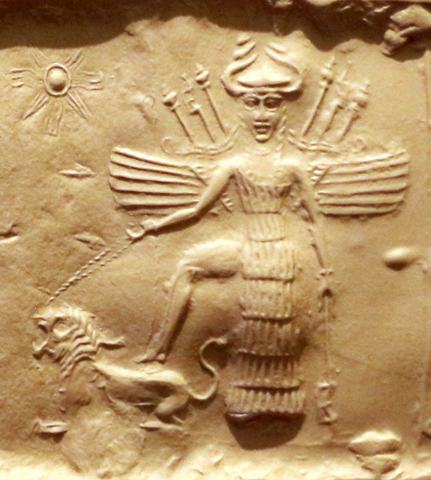
Queen of Heaven — Sumerian goddess of love, war, and the planet Venus, who walked into the land of the dead and was the only one to walk back out.
Sources & Further Reading
- 1.Atrahasis, Old Babylonian recension (c. 17th century BCE).
- 2.The Sumerian Flood Story (the Eridu Genesis), featuring Ziusudra of Shuruppak.
- 3.Lambert, W.G. & A.R. Millard. Atra-hasis: The Babylonian Story of the Flood. Oxford University Press, 1969; repr. Eisenbrauns, 1999.
- 4.Dalley, Stephanie. Myths from Mesopotamia: Creation, the Flood, Gilgamesh and Others. Rev. ed., Oxford University Press, 2000.
- 5.Foster, Benjamin R. Before the Muses: An Anthology of Akkadian Literature. 3rd ed., CDL Press, 2005.
- 6.Finkel, Irving. The Ark Before Noah: Decoding the Story of the Flood. Hodder & Stoughton, 2014.
- 7.Black, Jeremy & Anthony Green. Gods, Demons and Symbols of Ancient Mesopotamia: An Illustrated Dictionary. British Museum Press, 1992.
Spot an error or have a source to suggest? Write to info@viseterna.com. We cite primary sources and modern scholarship, and we correct fast.