
Adad (Ishkur, Mesopotamian Storm God)
The Mesopotamian storm god who could drown the land in flood or bless it with rain, worshipped as Ishkur in Sumer and Adad across Babylonia and Assyria.
Stele of the god Adad, from Til Barsip, Neo-Assyrian period (Musee du Louvre, AO 13092) · CC BY-SA 3.0 · source
A God of Two Tempers
Adad, called Ishkur in Sumerian, is the storm: the god of thunder, wind, lightning, and rain, and therefore a deity whose favor and whose fury look, from the ground, exactly alike 3. The same weather that swells a canal and fattens a harvest can just as easily strip a roof, flatten a field of barley, and drown a village, and Mesopotamian religion did not try to soften that overlap into two separate gods. It gave the whole business, both ends of it, to one figure 3,4.
That double nature runs through his whole career. Assyriologists reading Adad's hymns and omen texts find him praised in one line as the source of the rain that fills the granaries and cursed in the next as the flood that empties them, sometimes within the same composition 4. He is not a trickster and not a moral agent weighing rewards and punishments; he is closer to weather itself, a force that answers to ritual and to royal favor but is never fully tamed by either 3,4.
Ishkur of Sumer, Adad of Akkad
In the earliest Sumerian sources Ishkur is a comparatively minor figure, one storm god among several local weather powers, generally reckoned a son of the sky god An and ranked well below the executive triad of An, Enlil, and Enki 3,6. A minority tradition, recorded in later god-lists, goes so far as to make him the twin brother of Enki, an odd pairing of the rain that falls from above with the fresh water that rises from below 3.
His fortunes changed as Semitic-speaking populations rose to prominence in Mesopotamia and identified their own storm gods with him. Under the Akkadian name Adad, and further west as Hadad, he absorbs the profile of a major deity worshipped from the Persian Gulf to the Mediterranean coast, closely related to the Amorite and Canaanite storm gods of Aleppo and Ugarit and to the biblical Baal, all of them variations on the same weather-god template that ancient Near Eastern religion kept producing independently and then re-identifying with one another 4,6. Assyrian scribes sometimes called him simply Rammanu, "the Thunderer" 3.
Bull and Thunderbolt
Adad's standard animal is the bull, and Assyrian and Babylonian art shows him standing on one, brandishing a forked or triple lightning bolt in his raised hand, usually wearing the horned crown that marks any Mesopotamian deity 3,4. Neo-Assyrian stelae carve him mid-stride, weapon lifted, the bull planted beneath him as both mount and emblem of raw, snorting power 4. In the standard numeral code that Mesopotamian scribes used to write divine names in cuneiform, each great god carried a number in place of his name — Anu sixty, Enlil fifty, Sin thirty — and Adad's number was ten, a modest rank on paper for a god whose weather could ruin a season's harvest in an afternoon 3.
The Storm as Weapon
The flood story preserved in Atrahasis puts Adad in the front rank of the gods' assault on humanity. When the gods, led by Enlil, decide to destroy the noisy, overpopulated human race, it is Adad's storm that does the work: his thunder rolls across the sky, his rains do not stop, and the flood he sends alongside the collapse of the cosmic order very nearly ends mankind entirely, checked only by Enki's secret warning to Atrahasis to build a boat 1. The same episode, with the same divine cast, is retold in Tablet XI of the Epic of Gilgamesh, where Utnapishtim recalls Adad's thunder rumbling inside the black cloud that swallowed the world 1,5.
Assyrian treaty curses put the same threat to political use. The Vassal Treaties of Esarhaddon, sworn by subject rulers in 672 BCE, invoke Adad by name among the gods who will punish a broken oath, calling on him to loose devastating rains and floods, ruin the vassal's crops, and turn his land into a waste, the storm god's ordinary weather repurposed as a state instrument of terror 2.
The Storm as Gift
The same god is petitioned, in less dramatic texts, simply for rain. Adad's most common epithet, bel hegalli, "Lord of Abundance," names the other half of the job: without his rain the rain-fed fields of Assyria and the highlands north of Babylonia produce nothing, and his canals and springs keep the irrigated south alive as well 3,4. His consort Shala, a grain goddess, reinforces the connection between the storm god and agricultural plenty; a good Adad is simply a good growing season 3,6.
Temples from Aleppo to Assur
Adad's cult was never confined to one city the way Marduk's was fixed to Babylon or Shamash's to Sippar. He had a temple at Karkara in Babylonia, but his grandest sanctuaries lay north and west: a joint temple shared with Anu at the Assyrian capital of Assur, and, most importantly for the wider Semitic-speaking world, the great Temple of the Storm God at Aleppo, excavated in Syria and shown by its inscriptions and reliefs to have served the Hadad cult for well over a thousand years, from the Bronze Age deep into the Iron Age 4.
Adad Among the Gods
Adad's place in the pantheon is that of a specialist rather than a ruler: unlike Anu, whose authority is nominal and universal, or Enlil, whose word executes the gods' decrees across every domain, Adad's power is bound to one visible, recurring phenomenon, and he is invoked precisely because a king or a farmer needs that phenomenon controlled 3,6. He stands alongside Marduk, whose own defeat of Tiamat is described with storm imagery borrowed from gods like Adad, as one of several Mesopotamian figures who make the sky itself an actor in the story, dangerous exactly in proportion to how badly the land needs what it provides 4.
Continue Exploring
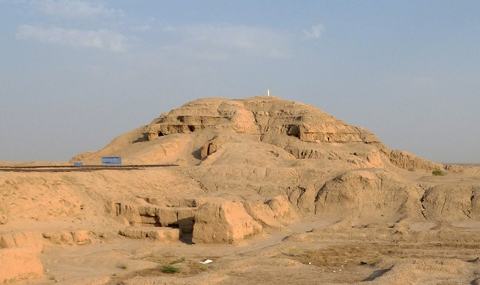
Father of the gods — the Mesopotamian sky, whose written sign meant "god" itself; the source of all authority, and almost never the one who uses it.
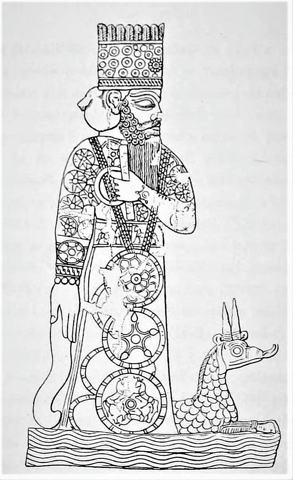
Champion of the gods — Babylon's patron, who killed the sea-dragon Tiamat, built heaven and earth out of her body, and was crowned king over all the gods.
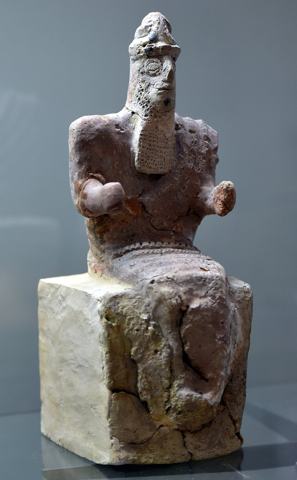
Lord of the moving air — the Sumerian executive of the gods, whose word carried out destinies, who split heaven from earth and sent the Flood.
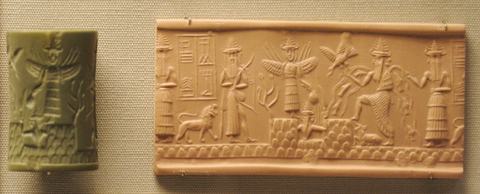
God of wisdom and the sweet water under the ground — the craftsman-trickster who made humankind, taught the crafts, and warned one man about the Flood.
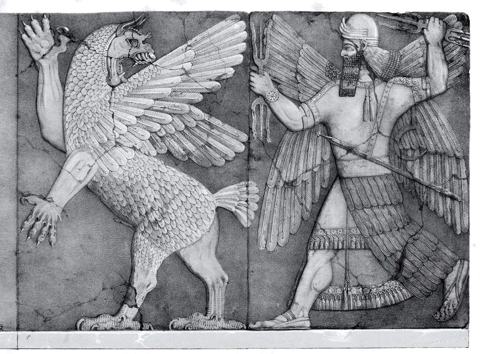
The primordial salt sea — the first mother of the gods, who turned on her children and whose split body became the sky and the earth above us.
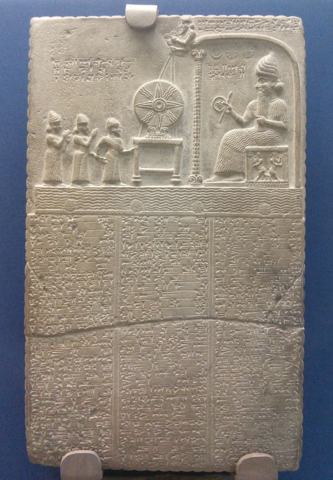
Sumerian Utu, Akkadian Shamash — the sun god who sees everything, judge of heaven and earth, patron of law, oaths, travellers and the diviner's art.
Also mentioned inMushussu (the Dragon of Marduk)NinurtaThe Ishtar Gate
Sources & Further Reading
- 1.Atrahasis, Old Babylonian recension (c. 17th century BCE).
- 2.The Vassal Treaties of Esarhaddon (672 BCE), curse section invoking the great gods.
- 3.Black, Jeremy & Anthony Green. Gods, Demons and Symbols of Ancient Mesopotamia: An Illustrated Dictionary. British Museum Press, 1992.
- 4.Green, Alberto R.W. The Storm-God in the Ancient Near East. Eisenbrauns, 2003.
- 5.Dalley, Stephanie. Myths from Mesopotamia. Oxford University Press, revised edition 2000.
- 6.van der Toorn, Karel, Bob Becking & Pieter W. van der Horst, eds. Dictionary of Deities and Demons in the Bible. 2nd ed. Brill/Eerdmans, 1999.
Spot an error or have a source to suggest? Write to info@viseterna.com. We cite primary sources and modern scholarship, and we correct fast.