
Nanna (Sin)
The Mesopotamian moon god of Ur's great ziggurat, father of the sun and Venus in most tellings, served by history's first named author, Enheduanna.
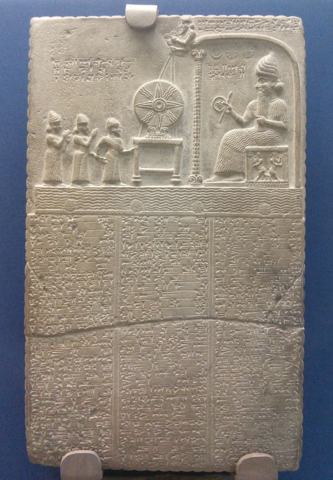
Stele of Ur-Namma (detail), limestone, Ur, c. 2100 BCE (Penn Museum) · CC BY-SA 4.0 · source
The Moon in the Sky
Nanna — Akkadian Sin — is the Mesopotamian moon, one of a visible-sky triad with his children Shamash the sun and Inanna the planet Venus, though genealogies vary enough between texts that some instead make Inanna his sister rather than his daughter 4,7. His birth is itself the subject of a story: in Enlil and Ninlil, Enlil takes the goddess Ninlil against her will and is exiled to the underworld for it; she follows him pregnant with Nanna, and Enlil fathers three substitute underworld deities specifically so that Nanna can be released to rise into the sky rather than stay trapped below with his father 2.
His symbol is the crescent, and Mesopotamian art regularly gives it a boat shape to travel in — the new moon read as the prow of a barge sailing the night sky, an image consistent enough across periods to survive from early Sumerian cylinder seals into the astrological texts of the first millennium BCE 4. His standard epithet "father of the gods" in some hymns sits oddly beside his position as Anu's and Enlil's junior in most theological schemes, a tension Mesopotamian religion never fully resolved and did not seem especially bothered by 4,7.
Ur and the Great Ziggurat
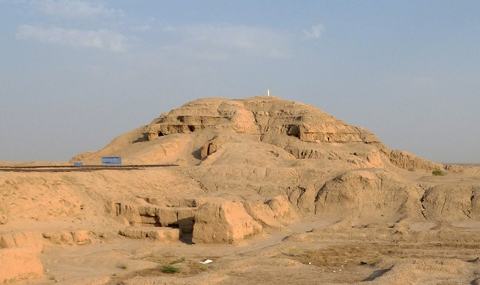
Nanna's principal cult city was Ur, in the deep south of Sumer, where his temple complex E-kishnugal stood beside the stepped tower still visible today as the Great Ziggurat of Ur 4. The ziggurat was begun or substantially rebuilt under Ur-Nammu, founder of the Third Dynasty of Ur around 2100 BCE, and remained in use and repair for the better part of two thousand years afterward, down to Neo-Babylonian kings who still recorded work on Nanna's Ur sanctuary as a mark of royal piety 4,6.
A fragmentary limestone stele of Ur-Nammu himself, found at Ur and now divided between the Penn Museum and the British Museum, shows a seated horned deity generally identified as Nanna holding out the measuring rod and coiled line with which temple foundations were laid — building the god's house pictured as literally the god's own instrument, handed down to the king who would use it 4.
Nanna Sails to Nippur
One Sumerian composition, Nanna-Suen's Journey to Nippur, imagines the god loading his barge with the produce of Ur — reeds, dates, wool, fish, and livestock — and sailing upriver to Enlil's city of Nippur to present the gifts and ask his father's blessing on Ur in return 1. The poem pauses at a sequence of cities along the way, naming the harbour and the local god at each, so the god's itinerary doubles as a kind of devotional map of the Sumerian heartland as it looked to the scribes of Ur 1,7.
Enlil's blessing, when Nanna finally receives it at journey's end, is agricultural and practical rather than cosmic — abundance for Ur's fields, canals, and harbours — which fits the wider Sumerian pattern of imagining even the gods' relationships with each other as a version of the tribute and patronage that bound a city to its overlord 1,4.
Enheduanna, Priestess of the Moon
Nanna's most historically consequential worshipper held the office of entu, high priestess, at Ur: Enheduanna, daughter of Sargon of Akkad, installed there around 2300 BCE as part of her father's project of binding the newly conquered Sumerian south to Akkadian rule through its own religious offices 6. Her surviving corpus includes the Temple Hymns, forty-two hymns addressed in turn to major Sumerian and Akkadian sanctuaries including Nanna's own house at Ur, closing with a colophon naming herself as compiler — one of the earliest instances anywhere of an author claiming a body of work by name 3,6.
She is more often remembered today for her hymns to Inanna, composed from the same office, which is itself telling: a priestess appointed to serve the moon god used her position partly to elevate a different goddess's standing, evidence that Mesopotamian religious politics ran through personal choices as much as through fixed doctrine 6,7.
Harran and the Long Reach of Sin
Nanna-Sin's other major sanctuary lay far to the north, at Harran in upper Mesopotamia, where the temple E-hulhul, "House of Rejoicing," maintained his cult for well over a thousand years 5. The city's devotion to Sin became a matter of state controversy in the sixth century BCE: Nabonidus, the last king of Babylon, whose mother Adad-guppi had served Sin at Harran, rebuilt E-hulhul and promoted the moon god's cult at what Babylon's own priesthood read as the expense of Marduk, a tension modern historians treat as a real factor in the city's poor showing when Cyrus of Persia took Babylon in 539 BCE 5.
Green's study of Harran's religious history traces Sin's cult there long past the end of cuneiform civilisation: a community of star-worshippers known as the Sabians maintained planetary and lunar observance at Harran into the Islamic period, protected for a time by a claim to be the "People of the Book" named in the Quran, so that Nanna's oldest northern sanctuary was still functioning, in some altered form, more than a thousand years after Ur's ziggurat had gone quiet 5.
Continue Exploring
Sumerian Utu, Akkadian Shamash — the sun god who sees everything, judge of heaven and earth, patron of law, oaths, travellers and the diviner's art.
Father of the gods — the Mesopotamian sky, whose written sign meant "god" itself; the source of all authority, and almost never the one who uses it.
Lord of the moving air — the Sumerian executive of the gods, whose word carried out destinies, who split heaven from earth and sent the Flood.
Queen of Heaven — Sumerian goddess of love, war, and the planet Venus, who walked into the land of the dead and was the only one to walk back out.
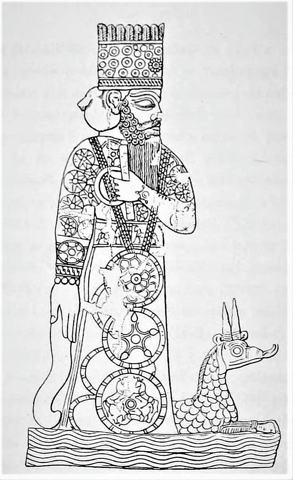
Champion of the gods — Babylon's patron, who killed the sea-dragon Tiamat, built heaven and earth out of her body, and was crowned king over all the gods.
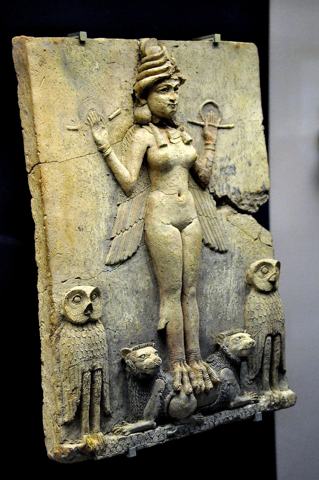
Lady of the Great Earth — the Mesopotamian queen of the dead, elder sister of Inanna, who rules the land of no return by rules even the gods obey.
Sources & Further Reading
- 1.Nanna-Suen's Journey to Nippur (Sumerian composition, ETCSL).
- 2.Enlil and Ninlil (Sumerian composition, ETCSL).
- 3.Enheduanna, the Temple Hymns (Sumerian, c. 2300 BCE).
- 4.Black, Jeremy & Anthony Green. Gods, Demons and Symbols of Ancient Mesopotamia: An Illustrated Dictionary. British Museum Press, 1992.
- 5.Green, Tamara M. The City of the Moon God: Religious Traditions of Harran. Brill, 1992.
- 6.Meador, Betty De Shong. Princess, Priestess, Poet: The Sumerian Temple Hymns of Enheduanna. University of Texas Press, 2009.
- 7.Dalley, Stephanie. Myths from Mesopotamia. Oxford University Press, rev. ed. 2000.
Spot an error or have a source to suggest? Write to info@viseterna.com. We cite primary sources and modern scholarship, and we correct fast.