
Nergal
Mesopotamian god of plague, war and the scorching sun — the violent power of inflicted death, who talked his way into the underworld and stayed as its king.
Relief carving of the god Nergal from Hatra, Parthian period, unknown Hatran sculptor · Public domain · source
The God of Inflicted Death
Nergal is the Mesopotamian god of violent, imposed death: plague, fever, sudden war, and the killing heat of high summer 5,8. He is not a god of dying as such — the ordinary end that everyone reaches and that belongs to Irkalla — but of death that arrives early and from outside, which is why his name shows up in curse formulas, treaty sanctions and medical incantations far more often than in prayers of thanksgiving 5,8.
Wiggermann's survey of the philological evidence sets out how many distinct figures were folded into him over three millennia, and the resulting profile is a composite rather than a single character: a local underworld god, a warrior, a plague demon, and an aspect of the destructive sun 8. Scholars have long debated how much of the solar association is original and how much is later theological systematising 5,8.
Kutha and the Emeslam
His principal city was Kutha (Gudua), in northern Babylonia, and his temple there the Emeslam — from which comes one of his oldest names, Meslamtaea, "he who comes forth from Meslam" 5,8. The pairing is telling: to come forth from the temple of the underworld god is also to come up out of the ground, and the name works as both cult title and description of what a plague does 8.
Kutha was so completely identified with him that its name became a byword for the netherworld itself, and the association reached the Hebrew Bible: 2 Kings lists the men of Cuth, resettled in Samaria, as the people who made Nergal 4,5. His cult is also attested at Isin, Mashkan-shapir, Ashur and Tarbisu, and Assyrian kings invoked him regularly as a war god 5,8.
Genealogically he is usually the son of Enlil and Ninlil 5,8. His earlier consorts include Laz and Mammitum, and only in later tradition is he paired with Ereshkigal — a development the great myth about him exists to explain 5,8.
How He Married the Queen of the Dead
Nergal and Ereshkigal survives in a short 14th-century BCE copy from Amarna and a fuller first-millennium version from Sultantepe and Nineveh, and the two differ enough that the story clearly kept being retold 1,6. The gods above hold a banquet the queen of the dead cannot attend; she sends her vizier Namtar to collect her portion, and one god alone fails to rise in respect 1.
Summoned below to apologise, Nergal is coached by Ea to accept nothing offered him — no chair, no bread, no meat, no beer, no washing — because to consume anything of the underworld is to belong to it 1,6. He refuses every item and then sleeps with Ereshkigal for six days, slipping away on the seventh 1. She reacts with grief and then with the standard Mesopotamian threat: she will raise the dead, and they will outnumber the living 1,6. He is sent back, and in the long version storms the gates, seizes her by the hair and drags her from the throne — at which the confrontation turns, abruptly, into a proposal, and the two rule the underworld together 1,6. Dalley reads the composition as deliberately comic in places without being any less serious about the theology it settles 6.
Erra and the Epic of Plague
From the Old Babylonian period Nergal was increasingly identified with Erra, a Semitic god of pestilence and riot, and the great literary product of that fusion is the Poem of Erra 2,5,7. In it, Erra is roused from idleness by his seven monstrous companions, the Sebitti, and persuades Marduk to leave his throne in Babylon so that his cult statue can be refurbished 2,7. With the king of the gods absent, order collapses; Erra ravages Babylon and turns the land against itself, city against city, brother against brother 2.
Only his own minister Ishum talks him down, and the poem ends with Erra's blessing on the house that recites it 2,7. The colophon claims the composition was revealed in a night to a man named Kabti-ilani-Marduk, son of Dabibi, who added nothing of his own — a rare authorial statement in Akkadian literature 2,7. The text was evidently used as a protective charm: copies and excerpts were kept on amulets, and it survives in more manuscripts than the Epic of Gilgamesh, which suggests a plague god was a practical thing to have on the wall 7.
Star, Weapon, and Image
Astronomically Nergal is the planet Mars, called Salbatanu in Akkadian and read in celestial omens as a bringer of war, disease and the death of kings 5. His weapon is a mace, often depicted with a lion's head or with a scimitar; the lion is his beast, and lion-headed demons and standards belong to his sphere 5.
Securely identified images are scarcer than the textual record would suggest, and much of what is illustrated as Nergal is inferred from attributes rather than inscribed 5. A well-known relief from Hatra, of the Parthian period, shows an armed god flanked by serpents and a hound and is labelled for Nergal in the local cult — evidence that the god was still receiving worship in northern Mesopotamia more than two thousand years after Kutha first built him a house 5,8.
The King on the Throne Below
The clearest picture of Nergal enthroned comes from a strange Assyrian text, The Underworld Vision of an Assyrian Prince, in which a man called Kummaya prays to see the land of the dead and does 3,6. He wakes among fifteen composite monsters and is brought before Nergal, who seizes him by the hair, threatens him with death, and then relents and sends him back to tell what he saw 3,6.
Nothing in the vision resembles judgement of the soul. There is rank, dust, terror, and a king who might have killed the visitor and chose not to — which is, in the end, exactly the god the incantations describe 3,5,6.
Continue Exploring
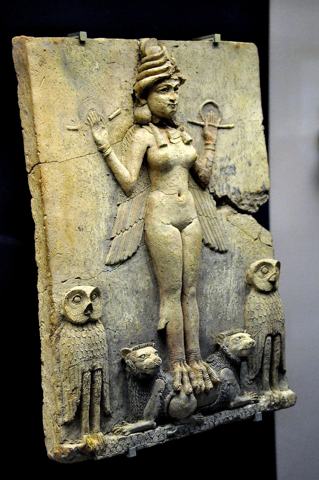
Lady of the Great Earth — the Mesopotamian queen of the dead, elder sister of Inanna, who rules the land of no return by rules even the gods obey.
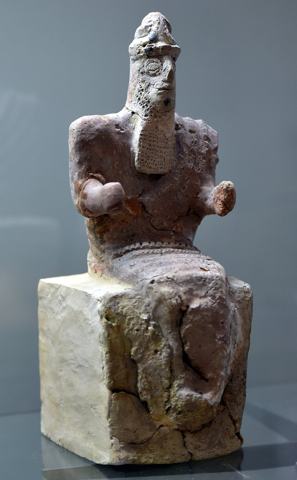
Lord of the moving air — the Sumerian executive of the gods, whose word carried out destinies, who split heaven from earth and sent the Flood.
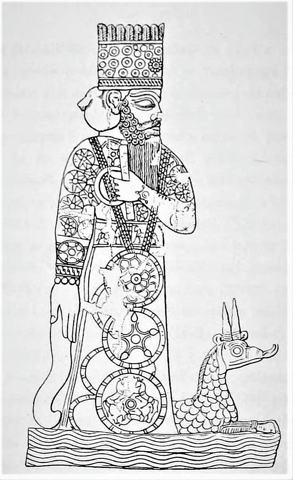
Champion of the gods — Babylon's patron, who killed the sea-dragon Tiamat, built heaven and earth out of her body, and was crowned king over all the gods.
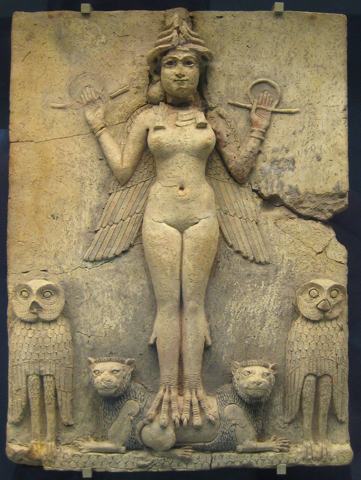
The land of no return — the dusty house below the earth where every Mesopotamian dead person went, ruled by Ereshkigal and locked behind seven gates.
God of wisdom and the sweet water under the ground — the craftsman-trickster who made humankind, taught the crafts, and warned one man about the Flood.
Father of the gods — the Mesopotamian sky, whose written sign meant "god" itself; the source of all authority, and almost never the one who uses it.
Sources & Further Reading
- 1.Nergal and Ereshkigal (Amarna version, 14th century BCE; Sultantepe and Nineveh versions, 1st millennium BCE).
- 2.The Poem of Erra (Erra and Ishum), Babylonian, early 1st millennium BCE.
- 3.The Underworld Vision of an Assyrian Prince (7th century BCE).
- 4.2 Kings 17:30 (the men of Cuth and their god Nergal).
- 5.Black, Jeremy & Anthony Green. Gods, Demons and Symbols of Ancient Mesopotamia: An Illustrated Dictionary. British Museum Press, 1992.
- 6.Dalley, Stephanie. Myths from Mesopotamia: Creation, the Flood, Gilgamesh and Others. Rev. ed., Oxford University Press, 2000.
- 7.Foster, Benjamin R. Before the Muses: An Anthology of Akkadian Literature. 3rd ed., CDL Press, 2005.
- 8.Wiggermann, F.A.M. 'Nergal A. Philologisch.' Reallexikon der Assyriologie 9 (1998-2001), 215-223.
Spot an error or have a source to suggest? Write to info@viseterna.com. We cite primary sources and modern scholarship, and we correct fast.