
Ninhursag
Sumer's mother goddess, who shapes the first humans from clay, births the gods of Dilmun, and heals the god she once cursed.
Frieze of Imdugud grasping a pair of stags, temple of Ninhursag, Tell al-'Ubaid, c. 2500 BCE (photograph by Osama Shukir Muhammed Amin, 2014) · CC BY-SA 4.0 · source
Lady of the Mountain
Ninhursag's name means "lady of the sacred mountain," and Sumerian tradition treats her as one of the four or seven ranking deities of the pantheon, the great mother figure standing beside Anu, Enlil, and Enki 5,6. She carries an unusually large stock of alternate names for a single Mesopotamian goddess: Ninmah, "great queen"; Nintu, "lady who gives birth"; Mami or Mama; Aruru; Damgalnuna; and the Akkadian Belet-ili, "mistress of the gods," each name attached to a slightly different role or local cult rather than freely interchangeable 5,6. Lagash's kings addressed her plainly as "the midwife who suckled them," and Sumerian royal ideology across several city-states claimed her as the divine mother who legitimized kingship itself, nursing rulers at her own breast in the language of royal hymns 5,6.
The Womb of Every Living Thing
Her iconography is built around mountains and birth. She is shown seated on or beside a mountain, sometimes crowned with one, and her hair is dressed in a distinctive omega-shaped loop that appears already on boundary stones by around 3000 BCE; scholars disagree on whether the symbol represents a stylized womb or simply an elaborate hairstyle, but either reading keeps her tied to fertility 5,6. Deer and stags, animals of the wild mountain slopes rather than the tended fields of the river valley, are hers specifically, and temple friezes pair them with the eagle-headed lion Imdugud in a composition repeated at several of her sanctuaries 5,6. That combination survives physically at Tell al-Ubaid, near Ur, where excavators recovered a copper relief of Imdugud grasping a stag in each outstretched claw from the facade of a temple whose foundation inscription names Ninhursag as the goddess it was built for, one of the clearest direct links anywhere between a surviving building and a specific Mesopotamian deity 4.
Shaping the First Humans
In "Enki and Ninmah," she and Enki run a contest after the minor gods complain of endless labor: Enki proposes that humanity be created to take over the work of the gods, and once the first human is molded from clay and the birth-goddesses have done their part, Ninmah, drinking beer, begins deliberately fashioning flawed bodies, a blind man, a crippled one, a barren woman, daring Enki to find each one a place in society 2. He does, assigning trades and roles to every flawed creation in turn; Enki then turns the game around, fashioning a being so incapacitated, unable to speak, eat, or move, that Ninmah cannot find it any place at all, and by the poem's own account she loses the contest she started 2. Read as theology rather than comedy, the myth explains disability and social marginality as built into creation from the start rather than as later misfortune, and assigns the mother goddess herself responsibility for that variety 2,6.
Cursing and Healing a God
Her best-known myth, "Enki and Ninhursag," is set in Dilmun, a paradise-land free of sickness and old age, usually identified with the Persian Gulf island of Bahrain 1,3. Enki impregnates a chain of goddesses descended from Ninhursag across several generations, fathering daughter after daughter in swift succession until he turns to the last of the line, his own great-granddaughter Uttu; afterward Ninhursag draws his semen from Uttu's body and plants it in the earth, and when eight plants spring up in its place, Enki eats them one by one 1. Furious, she curses him, and Enki begins dying by organ, one plant's poison lodging in each part of his body, until the other gods, at a fox's urging, persuade Ninhursag to relent 1. She returns, seats the dying god by her vulva, and births eight healing deities, one for each ailing organ, naming each birth-goddess for the body part she cures, a wordplay-driven resolution scholars since Kramer and Albright's original translation have read as both a fertility myth and a small, wry treatise on Sumerian anatomical vocabulary 1,3.
A Goddess Filed Under Many Names
Ninhursag's cult was never centered on one city the way Marduk's was on Babylon; she held temples at Nippur, Kesh, Adab, Girsu, Ur, and Babylon itself, most called E-mah, "exalted house," and by the second millennium she had been absorbed into or equated with mother goddesses across the wider Near East, from Elamite Kiririsha to the Hittite Hannahanna 5,6. That diffusion is exactly what her stack of alternate names records: not one goddess with many titles so much as several regional mother-goddess cults gradually folded into a single figure by Sumerian and Akkadian scribes compiling god-lists, leaving modern readers a composite whose different faces, midwife, mountain, healer, still show through the seams 5,6.
Continue Exploring
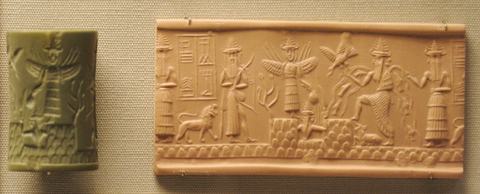
God of wisdom and the sweet water under the ground — the craftsman-trickster who made humankind, taught the crafts, and warned one man about the Flood.
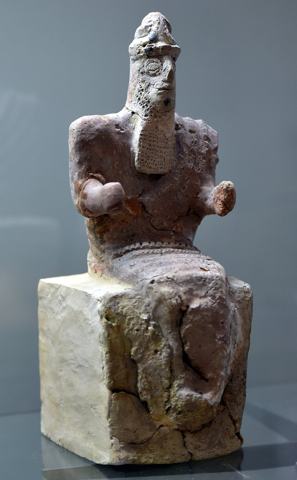
Lord of the moving air — the Sumerian executive of the gods, whose word carried out destinies, who split heaven from earth and sent the Flood.
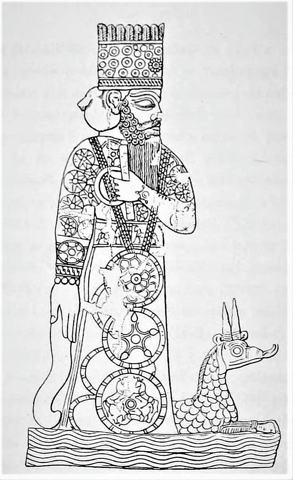
Champion of the gods — Babylon's patron, who killed the sea-dragon Tiamat, built heaven and earth out of her body, and was crowned king over all the gods.
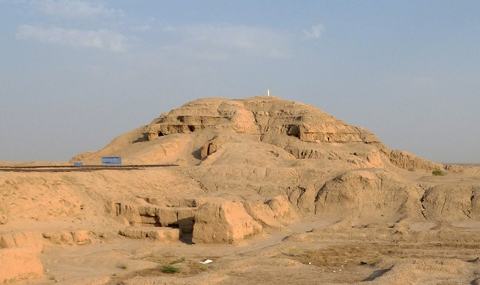
Father of the gods — the Mesopotamian sky, whose written sign meant "god" itself; the source of all authority, and almost never the one who uses it.
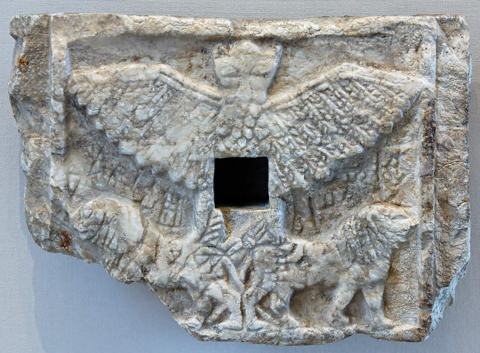
The monstrous lion-headed eagle who stole the Tablet of Destinies from Enlil's sanctuary and was hunted down by the god Ninurta.
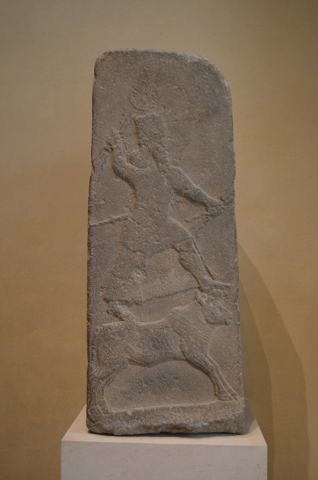
The Mesopotamian storm god who could drown the land in flood or bless it with rain, worshipped as Ishkur in Sumer and Adad across Babylonia and Assyria.
Sources & Further Reading
- 1."Enki and Ninhursag" (Sumerian composition, early 2nd millennium BCE).
- 2."Enki and Ninmah" (Sumerian composition, early 2nd millennium BCE).
- 3.Kramer, Samuel Noah & W. F. Albright. "Enki and Ninhursag: A Sumerian 'Paradise' Myth." Bulletin of the American Schools of Oriental Research, Supplementary Studies 1 (1945), 1-40.
- 4.Hall, H. R. & C. L. Woolley. Ur Excavations, Vol. I: Al-'Ubaid. Oxford University Press for the Joint Expedition of the British Museum and the Museum of the University of Pennsylvania, 1927.
- 5.Black, Jeremy, Graham Cunningham, Eleanor Robson & Gabor Zolyomi. The Literature of Ancient Sumer. Oxford University Press, 2004.
- 6.Black, Jeremy & Anthony Green. Gods, Demons and Symbols of Ancient Mesopotamia: An Illustrated Dictionary. British Museum Press, 1992.
Spot an error or have a source to suggest? Write to info@viseterna.com. We cite primary sources and modern scholarship, and we correct fast.