
Gilgamesh
King of Uruk, two-thirds god and one-third man — the hero of the world's oldest surviving epic, who went to the ends of the earth to escape death.
Hero mastering a lion, Khorsabad (Dur-Sharrukin), c. 713-706 BCE (Louvre, AO 19862) · Public domain · source
The King of Uruk
Gilgamesh — Sumerian Bilgames — is remembered as a king of Uruk in the centuries around 2700 BCE, and as the hero of the longest and most ambitious poem to survive from ancient Mesopotamia 5,8. The Sumerian King List places him fifth in the First Dynasty of Uruk and gives him a reign of 126 years, naming his father as a lillu-spirit or, in another line of tradition, the priest of Kullab; the epic instead makes him the son of the hero-king Lugalbanda and the goddess Ninsun, "the Wild Cow" 4,5.
Whether a historical king stands behind the figure is not provable, but most Assyriologists accept it as likely: he appears in early god lists and offering records, and Ur III rulers such as Shulgi styled themselves his brother, which is odd behaviour toward a pure invention 5,7. The epic's opening arithmetic — two-thirds god, one-third man — is not a mistake so much as a statement that he is not classifiable, and the poem's tragedy follows directly from the fraction that is mortal 1,5.
From Sumerian Poems to a Single Epic
There was no one Gilgamesh text. Five separate Sumerian poems about Bilgames circulated in the scribal schools of the early second millennium: the killing of Huwawa in the cedar mountain, the Bull of Heaven, the descent of Enkidu into the netherworld, the hero's death, and his defence of Uruk against Aga of Kish 2,5. An Old Babylonian poet then welded some of this material into a continuous Akkadian narrative beginning shutur eli sharri, "surpassing all other kings" — the Pennsylvania and Yale tablets are its best witnesses 3,7.
The version most people read today is the Standard Babylonian recension of roughly 1200 BCE, opening sha naqba imuru, "he who saw the deep", and attributed by ancient catalogues to the scholar Sin-leqi-unninni 1,5. Tigay's study traced the stages of that growth in detail, and it remains the standard account of how a cycle of short poems became an epic with a philosophical argument 7. Tablet XII, a fairly literal Akkadian rendering of the second half of the Sumerian Bilgames and the Netherworld, sits awkwardly after the narrative has already concluded and is generally treated as a later appendix 1,5.
Enkidu
The epic begins with Gilgamesh as a tyrant. His people complain that he leaves no son to his father and no girl to her mother, and the gods answer by creating an equal: Enkidu, formed from clay by the goddess Aruru, hairy, living with the gazelles and pulling up the trappers' snares 1,3. He is drawn into human society by Shamhat, a woman of the temple, after which the animals flee from him — a passage frequently read as a myth of civilisation and of what it costs 1,5.
Enkidu comes to Uruk to block Gilgamesh at the door of a wedding house. They wrestle, break the doorpost, and then embrace; from that point the poem is about friendship rather than kingship 1,3. It is a striking structural choice, and the Old Babylonian version already has it, so it is not a late refinement 3,7.
The Cedar Forest and the Bull of Heaven
The two set out for the Cedar Forest to kill Humbaba (Sumerian Huwawa), the ogre whom Enlil appointed as its guardian. Ninsun adopts Enkidu and petitions Shamash, who pins Humbaba with thirteen winds; the monster begs for his life, Enkidu urges the killing, and the cedars come down 1,2. The episode reads as heroic conquest and as trespass at the same time, and the poem never fully resolves which it is 5.
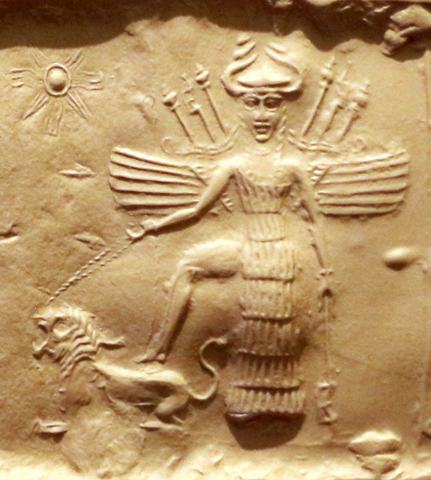
Back in Uruk the goddess Ishtar — Inanna — proposes marriage, and Gilgamesh refuses with a catalogue of her ruined lovers. She extorts the Bull of Heaven from her father Anu by threatening to break the gates of Irkalla and let the dead out to eat the living; the bull kills hundreds of men before the pair butcher it, and Enkidu throws its haunch in her face 1,8. The gods hold council and decide one of the two must die. Enkidu dreams his sentence, sickens, curses and then blesses Shamhat, and dies over twelve days 1.
The Search for Life
Grief turns Gilgamesh into what he had fought. He refuses to bury the body until a worm falls from its nose, dresses in a lion skin, and goes out into the wild 1. His route runs through the twin-peaked mountain Mashu, guarded by scorpion-people, along the sun's own night-road in total darkness, to a garden of jewelled trees and the alewife Siduri at the edge of the sea 1. Beyond it lies Utnapishtim, the survivor of the Flood, reachable only across the Waters of Death with the ferryman Ur-shanabi 1.
Utnapishtim tells him the Flood story and then sets a test: stay awake six days and seven nights. Gilgamesh sleeps immediately, and a loaf baked each day marks the failure in mould 1. As a parting gift he is told of a thorny plant on the sea floor that restores an old man to youth; he ties stones to his feet, takes it, and loses it at a pool to a snake, which sheds its skin and leaves 1. He returns to Uruk and shows the ferryman its walls — the same lines that opened the poem 1,5.
Rediscovery and Afterlife
The epic was lost for two thousand years until tablets from Ashurbanipal's library at Nineveh reached the British Museum, and in 1872 George Smith identified the Flood account on Tablet XI, an event that caused a public sensation because of its resemblance to Genesis 5,7. Fragments have since surfaced across the Near East, in Hittite and Hurrian versions as well as Akkadian, and the text is still being edited as new pieces appear 5.
In later Mesopotamian belief Gilgamesh was not primarily a warrior but a judge of the dead, invoked in funerary and exorcistic texts as a governor of the netherworld — a quieter ending than the poem's, and arguably the one it earned him 5,8. The Sumerian Death of Bilgames already puts him there, honoured below rather than immortal above 2,5.
Continue Exploring
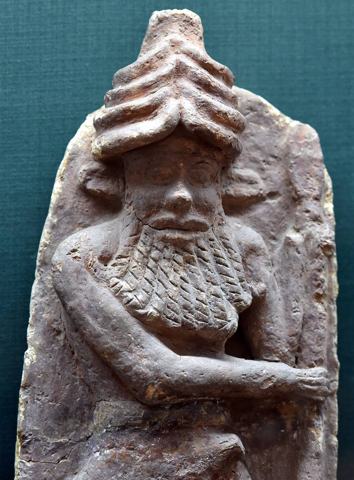
The wild man tamed by Shamhat and bound to Gilgamesh by friendship -- until the gods condemned him to die for the Cedar Forest and the Bull of Heaven.
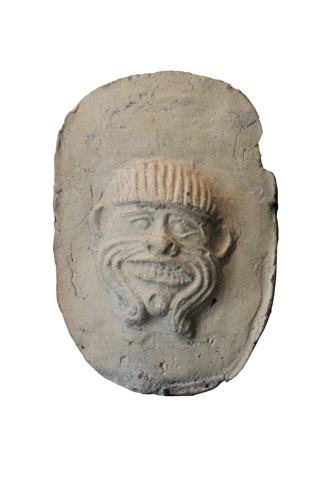
Guardian of the Cedar Forest, killed by Gilgamesh and Enkidu -- and, since a 2015 tablet turned up, a monster who kept court to a chorus of monkeys.
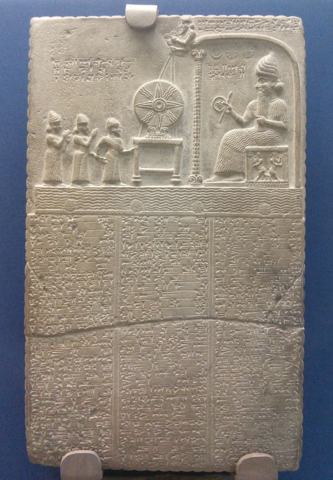
Sumerian Utu, Akkadian Shamash — the sun god who sees everything, judge of heaven and earth, patron of law, oaths, travellers and the diviner's art.
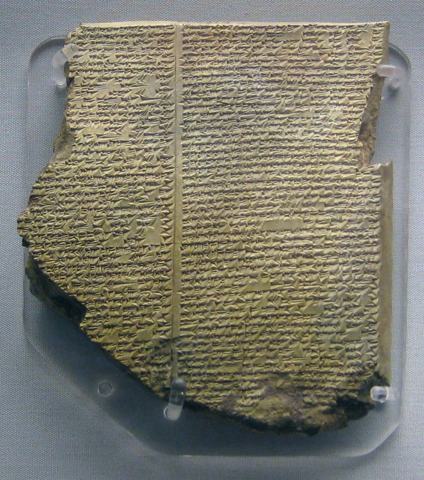
The Babylonian flood survivor who built the boat, released the birds, and was given eternal life — the one man Gilgamesh crossed the world to question.
Queen of Heaven — Sumerian goddess of love, war, and the planet Venus, who walked into the land of the dead and was the only one to walk back out.
Father of the gods — the Mesopotamian sky, whose written sign meant "god" itself; the source of all authority, and almost never the one who uses it.
Also mentioned inApkallu (the Seven Sages)The Epic of Gilgamesh
Sources & Further Reading
- 1.The Epic of Gilgamesh, Standard Babylonian version (Tablets I-XII), Nineveh recension traditionally ascribed to Sin-leqi-unninni.
- 2.The Sumerian Bilgames poems: Bilgames and Huwawa, Bilgames and the Bull of Heaven, Bilgames and the Netherworld, The Death of Bilgames (early 2nd millennium BCE).
- 3.The Old Babylonian Gilgamesh tablets (Pennsylvania and Yale tablets, c. 1800 BCE).
- 4.The Sumerian King List (Old Babylonian recensions).
- 5.George, A.R. The Babylonian Gilgamesh Epic: Introduction, Critical Edition and Cuneiform Texts. Oxford University Press, 2003.
- 6.George, A.R. (trans.). The Epic of Gilgamesh. Rev. ed., Penguin Classics, 2003.
- 7.Tigay, Jeffrey H. The Evolution of the Gilgamesh Epic. University of Pennsylvania Press, 1982.
- 8.Black, Jeremy & Anthony Green. Gods, Demons and Symbols of Ancient Mesopotamia: An Illustrated Dictionary. British Museum Press, 1992.
Spot an error or have a source to suggest? Write to info@viseterna.com. We cite primary sources and modern scholarship, and we correct fast.