
Humbaba (Huwawa)
Guardian of the Cedar Forest, killed by Gilgamesh and Enkidu -- and, since a 2015 tablet turned up, a monster who kept court to a chorus of monkeys.
Mask of the demon Humbaba, terracotta, Old Babylonian period, from Eshnunna (Musee du Louvre, AO 12460) · CC BY-SA 3.0 fr · source
Guardian of the Cedar Forest
Humbaba — Sumerian Huwawa — is the monstrous keeper of the Cedar Forest, posted there by Enlil specifically to terrify human beings away from trees that belong to the gods 1,5. The Standard Babylonian epic describes him before anyone meets him: his roar is the flood-storm, his mouth is fire, his breath is death, and he can hear a footstep or a cracking branch from sixty leagues off in his own forest 1,4.
His real defence is not size or teeth but seven melammu — auras of divine terror, given to him by Enlil one at a time, so that anyone who approaches loses courage before coming close enough to strike 1,5. Shamash explains the mechanics to Gilgamesh directly: Humbaba is wearing only one at any moment he is not alarmed, and the plan for killing him amounts to provoking him into shedding the rest, aura by aura, until he stands defenceless 1,5.
Huwawa Before Humbaba
The Sumerian poem conventionally called Bilgames and Huwawa survives in two versions and predates any Akkadian retelling; its Huwawa is already the forest's guardian, already begging for his life once caught, and already killed on Enkidu's urging rather than the king's 2,5. What changes between the Sumerian and the Akkadian Humbaba is less the plot than the weighting: the Sumerian poem treats the killing as a straightforward feat and cedar-cutting as a straightforward economic ambition — the Sumerian south had no cedar of its own — with Huwawa's pleading read as plain cowardice 2,7.
The Akkadian epic keeps the same events but is visibly less comfortable with them. Humbaba's plea for mercy is longer and more specific — he offers to serve Gilgamesh as he served Enlil, to fell the trees for him, to build his house — and it is only Enkidu's insistence, overriding Gilgamesh's hesitation, that ends the argument 1,4. Humbaba's last act is to curse them both, wishing that neither should live to grow old in comfort, a curse the poem takes seriously enough to fulfil against Enkidu within a few tablets 1,5.
The Sulaymaniyah Tablet and the Forest Reconsidered
In 2011 the Sulaymaniyah Museum in Iraqi Kurdistan acquired a previously unknown tablet from the antiquities market; Farouk Al-Rawi and Andrew George identified it as a copy of Tablet V and published it in 2014, adding roughly twenty lines unknown from any other source and correcting the order of the episode 3. The addition that drew the most attention is domestic rather than violent: it describes monkeys in the cedar canopy, mother monkeys calling and infants squeaking, compared to "a band of musicians and drummers" performing daily in Humbaba's presence, as though the forest were his court rather than his wilderness 3.
The same tablet gives Humbaba a household of exotic birds alongside the monkeys, and lets Gilgamesh and Enkidu register, in so many words, that they have destroyed something beautiful to reach him 3,5. George reads the passage as evidence that the Standard Babylonian poets were alert to the cost of the heroes' triumph well before modern readers began asking the question themselves, without letting that awareness cancel Humbaba's status as a monster who has to die 3,5.
The Face of Entrails
Humbaba's other career is nowhere near Uruk. Old Babylonian diviners practising extispicy — reading omens in a sacrificed sheep's organs — recognised a face in the coiled shape of the animal's colon, and modelled small oval terracotta masks that render that coil as Humbaba's single continuous, grimacing feature: one uninterrupted line forming his brows, eyes, nose, beard and mouth at once 6. One well-known example, made in the region of Eshnunna and now in the Louvre, is inscribed on the back with the omen it recorded and the name of the diviner who read it, tying the monster's face directly to a specific prediction rather than to the epic at all 6.
The logic is ritual as much as literary: a mask carrying Humbaba's face was also credited with turning danger away, since a demon's own image was routinely deployed against demons in Mesopotamian apotropaic practice 6,7. Plenty of these masks and plaques survive from Old Babylonian sites in southern and central Iraq, evidence that Humbaba's face was doing ordinary ritual work in households and diviners' kits for centuries after — and largely independent of — any particular telling of his story from the epic 6.
What the Monster Guarded
Later Mesopotamian art keeps returning to the killing rather than to the guardian himself: terracotta plaques and cylinder seals show two armed heroes standing over a decapitated, grimacing head, an image popular enough that its identification as Gilgamesh and Enkidu over Humbaba is one of the more secure readings in Old Babylonian glyptic art 6,7. Whether audiences also remembered the monkeys is impossible to know — the epic itself kept being recopied for another thousand years, and until the Sulaymaniyah tablet surfaced, that gentler picture of the forest had been lost for as long as Uruk had been a ruin 3,5.
Continue Exploring
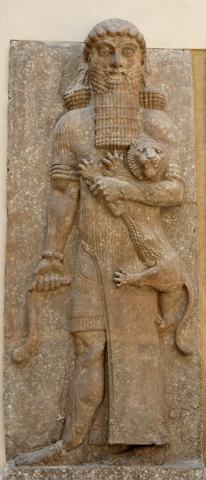
King of Uruk, two-thirds god and one-third man — the hero of the world's oldest surviving epic, who went to the ends of the earth to escape death.
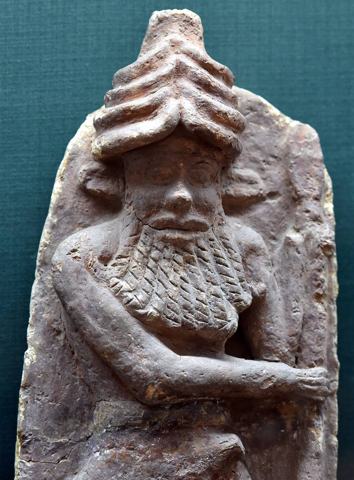
The wild man tamed by Shamhat and bound to Gilgamesh by friendship -- until the gods condemned him to die for the Cedar Forest and the Bull of Heaven.
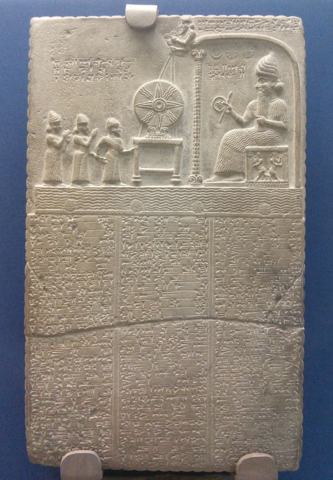
Sumerian Utu, Akkadian Shamash — the sun god who sees everything, judge of heaven and earth, patron of law, oaths, travellers and the diviner's art.
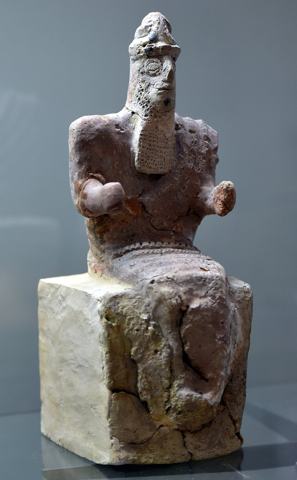
Lord of the moving air — the Sumerian executive of the gods, whose word carried out destinies, who split heaven from earth and sent the Flood.
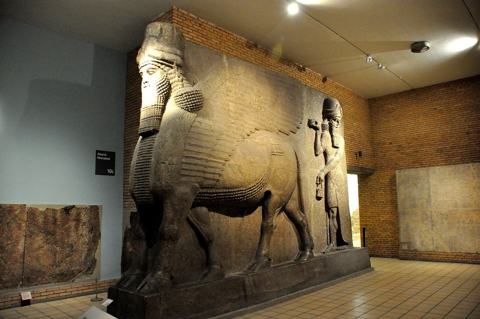
The human-headed winged bull that guarded Assyrian palace gates, sculpted with five legs so it reads correctly as both standing and walking.
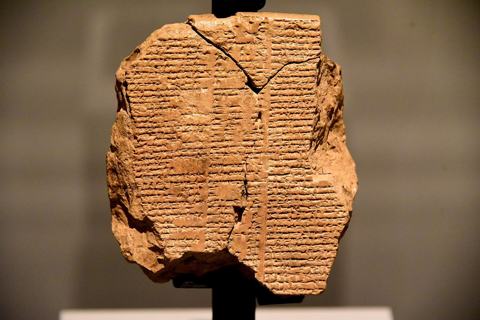
The world's oldest surviving epic — five Sumerian poems welded into an Akkadian masterpiece, lost for two thousand years until an 1872 tablet made headlines.
Sources & Further Reading
- 1.The Epic of Gilgamesh, Standard Babylonian version, Tablets II-V.
- 2.The Sumerian poem Bilgames and Huwawa, Versions A and B (ETCSL).
- 3.Al-Rawi, F.N.H. & George, A.R. 'Back to the Cedar Forest: The Beginning and End of Tablet V of the Standard Babylonian Epic of Gilgames.' Journal of Cuneiform Studies 66 (2014), 69-90.
- 4.George, A.R. (trans.). The Epic of Gilgamesh. Penguin Classics, 1999.
- 5.George, A.R. The Babylonian Gilgamesh Epic: Introduction, Critical Edition and Cuneiform Texts. Oxford University Press, 2003.
- 6.Black, Jeremy & Anthony Green. Gods, Demons and Symbols of Ancient Mesopotamia: An Illustrated Dictionary. British Museum Press, 1992.
- 7.Dalley, Stephanie. Myths from Mesopotamia. Oxford University Press, rev. ed. 2000.
Spot an error or have a source to suggest? Write to info@viseterna.com. We cite primary sources and modern scholarship, and we correct fast.