
Inanna's Descent to the Underworld
The Sumerian myth of a goddess who died in her sister's throne room and returned — at the price of a substitute sent down in her place.
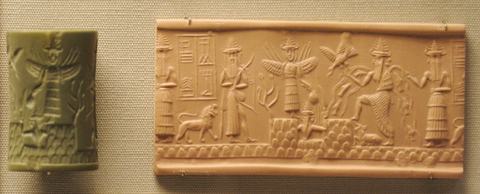
Cylinder seal impression depicting Dumuzi, Akkadian period, c. 2600-2300 BCE (British Museum) · Public domain · source
Two Tellings of One Journey
Two ancient poems put a goddess into the land of the dead and bring her back out. The older is Sumerian, Inanna's Descent to the Netherworld, reconstructed from dozens of school tablets copied at Nippur, Ur, and other scribal centers in the early second millennium BCE, no single one of them a complete manuscript on its own 1,3. The younger is Akkadian, The Descent of Ishtar, a shorter and more compressed retelling from the first millennium BCE that keeps the plot but shifts its emphasis 2. Both describe Inanna leaving heaven for the domain of her elder sister Ereshkigal, and both end with a substitute sent below in her place, but they do not agree on what the whole journey was actually for 1,2,3.
Going Down for a Funeral, or for a Throne
The Sumerian poem's opening lines give a specific, easily missed reason for the trip: Inanna sets out, the text says, to attend the funeral rites of Gugalana, the Bull of Heaven, who was Ereshkigal's husband 1. Katz's study of the Sumerian netherworld sources treats that stated motive with some caution, since funerary attendance sits oddly next to a visitor arriving in full royal regalia and being treated by the netherworld's judges as a hostile intruder the moment she reaches the throne room 3. The more common modern reading takes the funeral as a pretext and the real subject to be a bid for power: Inanna wants some share of her sister's realm, and the ordeal that follows is the cost of testing an authority that will not simply be walked into 3,7.
The Gate-by-Gate Ordeal, and the Rescue
Whatever her purpose, the procedure that meets her is fixed and impersonal. At each of the netherworld's seven gates the gatekeeper Neti strips her of one piece of regalia, crown, jewelry, breastplate, robe, on Ereshkigal's own instruction, until she stands naked before the throne; the Anunnaki judges then fix her with the eye of death, and she hangs there as a corpse on a hook 1,7. She does not get up on her own. Her minister Ninshubur, following instructions left before the descent, petitions the great gods for help; Enlil and the moon god refuse in turn, and only Enki acts, fashioning two sexless creatures from the dirt under his fingernails whom the netherworld's rules do not cover, and sending them down with the food and water of life 1,7. Nothing about the scene reads as personal cruelty on Ereshkigal's part. It reads as bureaucratic process, the fixed entry rite applied to any visitor regardless of rank, which is precisely what makes her authority frightening in Mesopotamian terms 3,4.
A Different Ending in Akkadian
The later Akkadian version keeps this skeleton but bolts a new consequence onto it. While Ishtar is trapped below, the text states plainly that on earth the bull no longer mounts the cow and the man no longer impregnates the girl; all sexual generation stops with the goddess of love removed from the world 2. The Sumerian version never makes this claim; its stakes are the netherworld's internal politics and Inanna's own fate, not agricultural fertility 1,3. The difference is a useful reminder that a single "myth" can be told twice, centuries apart, to make two different arguments about what the goddess is actually for.
Dumuzi, and a Label That Doesn't Quite Fit
The price of Inanna's release is a substitute, and she finds hers close to home: her husband Dumuzi, discovered enthroned in her absence and showing no sign of mourning her, is seized by the demons who escorted her back 1. His sister Geshtinanna volunteers to take half his sentence, and the arrangement settles into an annual cycle, six months below and six above 1,7. Twentieth-century comparative mythology, following James Frazer, filed this alongside Adonis, Attis, and Osiris as a "dying and rising god," but Jacobsen's study of Mesopotamian religion pushed back hard on the label: Dumuzi does not rise in any text that actually survives, and what the sources describe is closer to a temporary, negotiated exchange of a life than to a resurrection with religious meaning attached to it 4. Alster's study of the related poem Dumuzi's Dream, in which the god is warned of the demons coming for him and tries and fails to escape, treats his death as a genuinely tragic ordeal rather than a seasonal formality 5.
Mourning on a Schedule
The myth was not only read; it was performed. Sumerian temple archives preserve a whole genre of laments, balag and ershemma compositions, sung for Dumuzi and for the related god Damu at fixed points in the ritual calendar, evidence that his disappearance was mourned as real cultic grief rather than treated as a settled, comfortable story 4,7. The myth's substitution logic gave that grief a shape: the god's absence was explained, and expected, rather than simply endured.
From Clay Tablets to a 1983 Bestseller
The composite modern text of Inanna's Descent did not exist as a single readable document until Assyriologists pieced it together from the Nippur and Ur school tablets over the course of the twentieth century 1,3. Its widest audience by far came later still, from Diane Wolkstein and Samuel Noah Kramer's 1983 Inanna, Queen of Heaven and Earth, which paired Kramer's philological translations with Wolkstein's own retellings for a general readership and became the version most non-specialists have actually read 6. Wolkstein's sections are frankly literary rather than line-by-line translation, smoothing gaps and supplying transitions the tablets do not provide, and readers using the book for more than a first encounter with the story are usually pointed back toward Katz or the line-by-line Sumerian editions for what the ancient sources actually say 3,6.
Continue Exploring
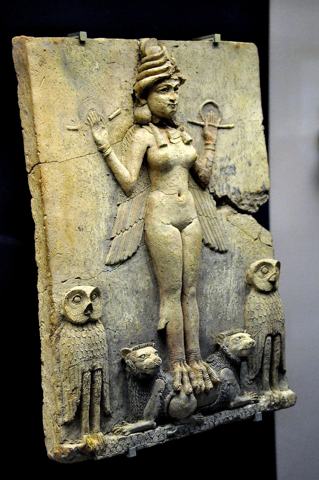
Lady of the Great Earth — the Mesopotamian queen of the dead, elder sister of Inanna, who rules the land of no return by rules even the gods obey.
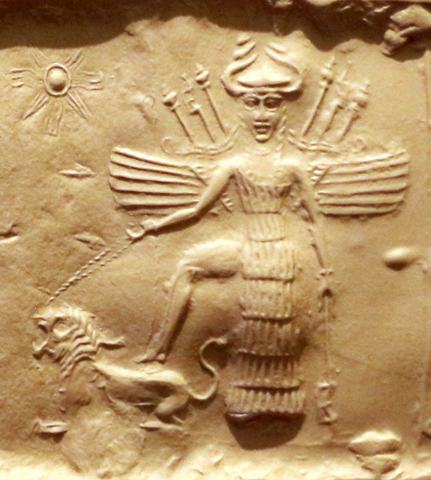
Queen of Heaven — Sumerian goddess of love, war, and the planet Venus, who walked into the land of the dead and was the only one to walk back out.
God of wisdom and the sweet water under the ground — the craftsman-trickster who made humankind, taught the crafts, and warned one man about the Flood.
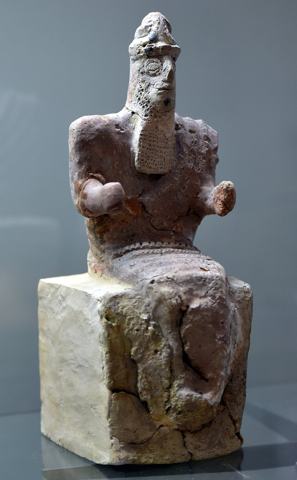
Lord of the moving air — the Sumerian executive of the gods, whose word carried out destinies, who split heaven from earth and sent the Flood.
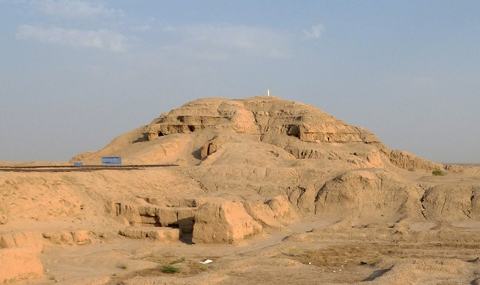
Father of the gods — the Mesopotamian sky, whose written sign meant "god" itself; the source of all authority, and almost never the one who uses it.
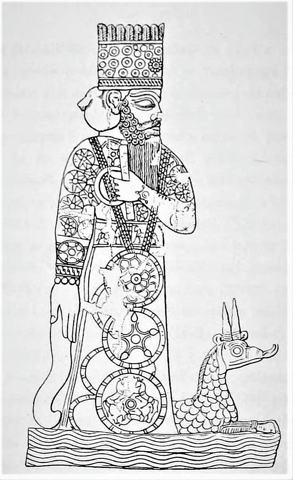
Champion of the gods — Babylon's patron, who killed the sea-dragon Tiamat, built heaven and earth out of her body, and was crowned king over all the gods.
Sources & Further Reading
- 1.Inanna's Descent to the Netherworld (Sumerian, early 2nd millennium BCE composite text).
- 2.The Descent of Ishtar to the Netherworld, Standard Babylonian version.
- 3.Katz, Dina. The Image of the Netherworld in the Sumerian Sources. CDL Press, 2003.
- 4.Jacobsen, Thorkild. The Treasures of Darkness: A History of Mesopotamian Religion. Yale University Press, 1976.
- 5.Alster, Bendt. Dumuzi's Dream: Aspects of Oral Poetry in a Sumerian Myth. Akademisk Forlag, 1972.
- 6.Wolkstein, Diane & Samuel Noah Kramer. Inanna, Queen of Heaven and Earth: Her Stories and Hymns from Sumer. Harper & Row, 1983.
- 7.Black, Jeremy & Anthony Green. Gods, Demons and Symbols of Ancient Mesopotamia: An Illustrated Dictionary. British Museum Press, 1992.
Spot an error or have a source to suggest? Write to info@viseterna.com. We cite primary sources and modern scholarship, and we correct fast.