
Ninurta
Son and champion of Enlil, who slew the demon Asag and the bird Anzu, and whose plow shaped the rivers and fields of Mesopotamia.
Stela of Ashurnasirpal II (detail), from the Temple of Ninurta, Nimrud, 9th century BCE (British Museum) · CC BY-SA 4.0 · source
Champion of Enlil
Ninurta is the son and enforcer of Enlil, the god the Sumerian pantheon sends when a problem cannot be solved by decree alone. Where Enlil issues the destinies that run the cosmos, Ninurta is the one who marches out to fight for them, and Sumerian and later Akkadian literature casts him again and again as the warrior who restores an order that something monstrous has broken 3,4. He is closely bound up with Ningirsu, the tutelary god of the city of Girsu in the state of Lagash: the two share myths, hymns, and iconography so thoroughly that scholars generally treat them as the same figure worshipped under two names in two cities rather than as separate gods 4,6,7.
Family and a Double Portfolio
Ninurta's mother is usually given as Ninhursag or Ninlil, depending on the text, and his home temple is the Eshumesha at Enlil's own city of Nippur, a location that keeps him permanently in his father's shadow even at the height of his own cult 4,6. What makes him unusual among Mesopotamian gods of war is that his portfolio is not purely military. He is also, simultaneously, a farmer god, patron of the plow and of the irrigation works that make Mesopotamian agriculture possible, and the myths that made him famous treat his martial and his agricultural sides as one and the same achievement rather than two separate jobs 4.
Lugal-e: Slaying Asag and Shaping the Land
The Sumerian composition modern scholars call Lugal-e, "O King," after its opening word, tells Ninurta's central myth. The demon Asag, born of An and the mountain range Kur, has grown monstrous, wounding the earth itself with disease and drought and leading an army of stone allies against the gods 1,4. Ninurta's talking mace Sharur flies ahead of him to Nippur to warn Enlil and returns with the order to attack, and Ninurta advances on Asag in a storm of his own making, killing the demon after a fight the poem describes with the same weather imagery used for storm gods like Adad — wind, flood, and fire all at once 1,4.
The poem does not stop at the killing. Ninurta turns immediately from destroyer to engineer: he sorts the stones of Kur into friends and enemies, cursing some to permanent worthlessness and blessing others — lapis lazuli, diorite, and the rest — with the values and uses they hold ever after, an origin myth for the mineral world folded into a monster-slaying epic 1,4. He then piles up a wall of stones to hold back the waters that Asag's death has unleashed, channels the floodwater into the Tigris, and makes the river fit for irrigation for the first time — the plow god's real credential, earned in the same episode as his war god's 1,4.
Angim: The Hero's Return to Nippur
A companion poem, Angim dimma, "The Return of Ninurta to Nippur," picks up after the victory and follows the god home in a mood closer to a triumphal procession than a battle report. Ninurta arrives at Nippur's gates loaded with trophies and monstrous heads, terrifying enough that even the Anzu bird's likeness mounted on his chariot makes the assembled gods flinch, until his father Enlil calms him and welcomes him into the Ekur in state 2,4. The text is a study in how Sumerian poetry handled a returning war god: not by denying his violence but by staging its transformation, publicly, into something the city can safely house 2,4.
Ninurta and the Bird Anzu
Ninurta's other great feat is defeating Anzu, the monstrous eagle who steals the Tablet of Destinies from Enlil's sanctuary and, holding the instrument that fixes the gods' powers, briefly outranks the entire pantheon. In the Standard Babylonian Epic of Anzu, it is Ninurta whom the gods send against him, arming him with bow and arrows enchanted to fail against Anzu's stolen authority until Ea instructs him to loose the south wind against the bird's own feathers and unbalance his flight; Ninurta then kills him and restores the tablet 3,4,5. Older, Sumerian-language versions of the same confrontation assign the victory to Ningirsu rather than Ninurta by name, which is exactly the kind of variation scholars point to when arguing the two names name one god 3,4.
Plow and Mace
Neo-Assyrian and Kassite art marks Ninurta with two emblems that sum up the whole career: a plow, sometimes mounted on a pedestal or a boundary stone as a divine symbol in its own right, and a perched bird of prey, standing in for both his own martial ferocity and his old opponent Anzu, permanently subdued into a heraldic ornament 3. The pairing is the point. A Mesopotamian audience did not need the myths spelled out to read a plow and a bird of prey side by side as Ninurta's signature: the same god who broke a demon's army also broke the ground open for planting 3,4.
Cult at Kalhu and Later Memory
Ninurta's cult, always significant at Nippur, gained new prominence when the Assyrian king Ashurnasirpal II made him a patron of the new capital Kalhu (modern Nimrud) in the ninth century BCE, building him a major temple there and having his own dedicatory inscriptions carved beneath the god's protective symbols 4. The Greek and Hellenistic-era identification of Nimrud's ruins with the biblical hunter-king Nimrod, still visible in the site's modern Arabic name, likely preserves a garbled folk memory of Ninurta's own reputation as Mesopotamia's premier divine hunter and warrior, carried forward long after the cuneiform texts that named him correctly had gone unread 4.
Continue Exploring
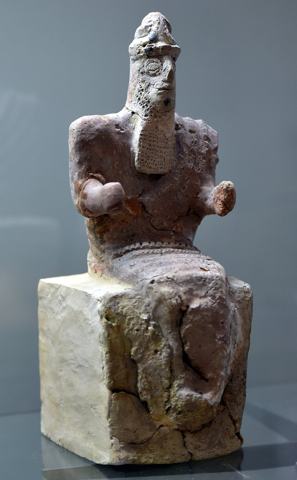
Lord of the moving air — the Sumerian executive of the gods, whose word carried out destinies, who split heaven from earth and sent the Flood.
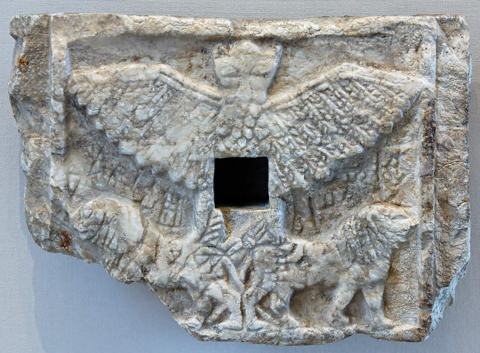
The monstrous lion-headed eagle who stole the Tablet of Destinies from Enlil's sanctuary and was hunted down by the god Ninurta.
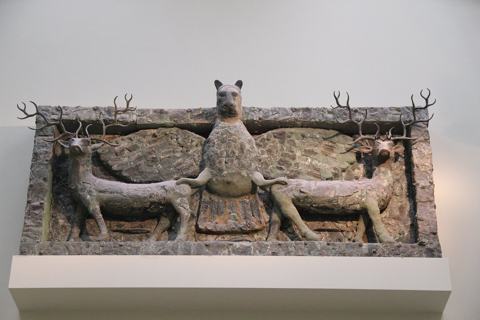
The cuneiform tablet that fixes the fates of gods and things — fought over by Marduk and Tiamat, stolen by the bird-demon Anzu, always worth a war.
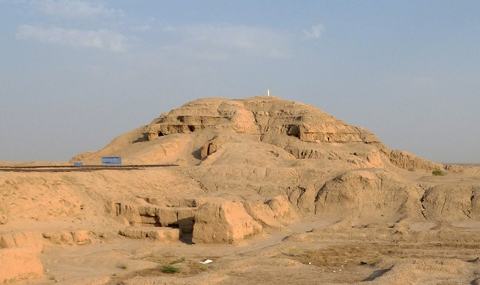
Father of the gods — the Mesopotamian sky, whose written sign meant "god" itself; the source of all authority, and almost never the one who uses it.
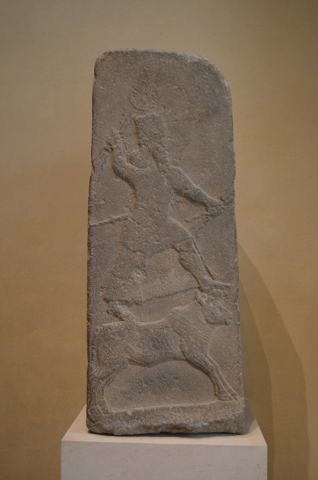
The Mesopotamian storm god who could drown the land in flood or bless it with rain, worshipped as Ishkur in Sumer and Adad across Babylonia and Assyria.
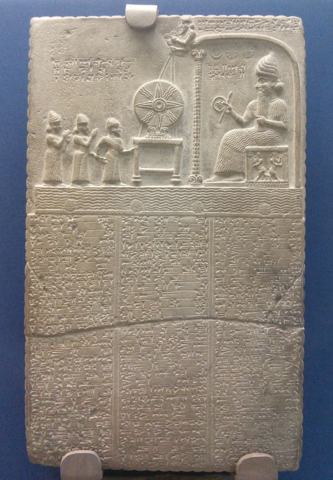
Sumerian Utu, Akkadian Shamash — the sun god who sees everything, judge of heaven and earth, patron of law, oaths, travellers and the diviner's art.
Sources & Further Reading
- 1.Lugal-e (Ninurta's Exploits), Sumerian composition.
- 2.Angim dimma (Ninurta's Return to Nippur), Sumerian composition.
- 3.The Epic of Anzu, Standard Babylonian version.
- 4.Black, Jeremy & Anthony Green. Gods, Demons and Symbols of Ancient Mesopotamia: An Illustrated Dictionary. British Museum Press, 1992.
- 5.Foster, Benjamin R. Before the Muses: An Anthology of Akkadian Literature. CDL Press, 2nd edition, 1996.
- 6.Penglase, Charles. Greek Myths and Mesopotamia: Parallels and Influence in the Homeric Hymns and Hesiod. Routledge, 1994.
- 7.van der Toorn, Karel, Bob Becking & Pieter W. van der Horst, eds. Dictionary of Deities and Demons in the Bible. 2nd ed. Brill/Eerdmans, 1999.
Spot an error or have a source to suggest? Write to info@viseterna.com. We cite primary sources and modern scholarship, and we correct fast.