
Enkidu
The wild man tamed by Shamhat and bound to Gilgamesh by friendship -- until the gods condemned him to die for the Cedar Forest and the Bull of Heaven.
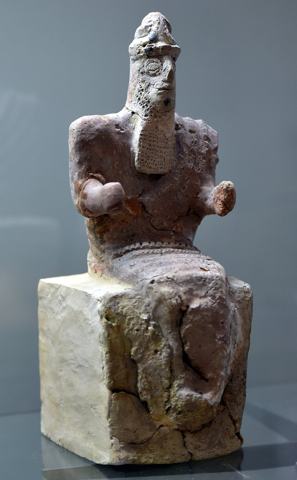
Plaque identified as Enkidu, Gilgamesh's friend, from Ur, 2027-1763 BCE (Iraq Museum) · CC BY-SA 4.0 · source
Made From Clay
Uruk's people cry out that their king has no equal to check him, wearing out the young men and claiming a bride's first night as if by right; the goddess Aruru answers by pinching off clay, casting it into the steppe, and shaping Enkidu, "made in the image of Anu," a match for Gilgamesh in strength 1,3. He is born already grown, covered in hair, grazing grass with the gazelles, drinking at their waterhole, and filling in the pits and traps a hunter sets, so that the man's family starves for lack of game 1,3.
The trapper, frightened by the sight of him, goes to his father, who sends him on to Gilgamesh with a plan: a woman of the city can draw the wild man away from the herd better than any weapon 1. This premise — that civilisation is a seduction rather than a conquest — belongs, as far as the surviving tablets show, to the Akkadian tradition rather than to the older Sumerian poems about Bilgames and his servant 4,5.
Shamhat and the Price of Wisdom
The woman sent to find him is Shamhat, a temple woman of Ishtar, and the encounter that follows is described at length: she lies with him for six days and seven nights, "for that is the way of a woman" 1,3. When it is over, the gazelles bolt at his approach and his own body will no longer keep pace with them — he has lost his animal speed and gained what the poem calls wide understanding 1.
Shamhat tells him this is a promotion, not a loss: "you are wise, Enkidu, you are become like a god," and describes the city waiting for him, its feasts, its music, and its king 1,3. Tigay reads the sequence as a deliberate myth of humanisation, staged as a loss of kinship with the animal world purchased with sex, bread, beer, and clothing, all of which a shepherd on the road to Uruk has to teach Enkidu to use for the first time 5.
The Friend at the Door
Enkidu reaches Uruk and blocks the door of a wedding house against Gilgamesh, an episode clearer in the Old Babylonian tablets than in the later Standard Babylonian text, where the exact grievance is left vaguer 3,4. They grapple in the street and shake the doorposts, and the fight ends not in a winner but an embrace; from that moment the epic changes subject, from a tyrant king to a pair of friends 1,3. In glyptic art the two are hard to tell apart: a bearded hero grappling lions or bulls appears constantly on Akkadian and later cylinder seals, sometimes beside a companion with a bull's horns, ears or tail, and museum captions still hedge between "Gilgamesh and Enkidu" and a generic contest scene for exactly that reason 7.
Ninsun, Gilgamesh's mother, formally adopts Enkidu as a son so the friendship carries a family's weight, and the two become functionally inseparable for the rest of the poem 1,4. It is Enkidu, not any court advisor, who argues Gilgamesh both into and out of dangerous plans across the tablets that follow, objecting to the Cedar Forest expedition and then going anyway 1.
Cedar Forest and the Bull of Heaven
Enkidu's objection to marching on Humbaba is specific: he learned the forest and its guardian's ways while he still ran with the herds, and knows exactly how dangerous the errand is 1,3. He goes anyway, and once the monster is beaten down and begging, it is Enkidu who tells Gilgamesh to finish the kill before the gods notice, overriding his friend's hesitation 1. Humbaba's dying words curse Enkidu by name, wishing that of the two of them he should be the one not to live to grow old 1,4.
Back in Uruk, Enkidu is just as decisive when Inanna-Ishtar's Bull of Heaven rampages through the streets: he seizes the bull by the tail while Gilgamesh drives the blade home, then tears off a haunch and hurls it at the goddess watching from the wall 1. Two open acts of defiance — against a monster under a god's protection, and against a god herself — and the assembly of gods holds Enkidu responsible alongside Gilgamesh for both 1,6.
The Dream of the House of Dust
The gods debate who must die for the cedar and the bull; Enlil insists it be Enkidu, and Shamash alone speaks against the sentence and is overruled 1. Enkidu falls sick and tells Gilgamesh a dream in which a lion-faced being drags him down to the House of Dust, where the dead are clothed like birds in feathers and eat clay in darkness — a vision that anticipates, almost word for word, the underworld the epic's audience already expected 1,6.
Before he dies, Enkidu curses the trapper and Shamhat for drawing him out of the wild life he misses; Shamash calls down from heaven and reminds him of everything the city gave him in exchange — food fit for a god, beer fit for a king, fine clothes, and Gilgamesh's friendship — and Enkidu, persuaded, turns the curse on Shamhat into a blessing instead 1,3. He dies after twelve days of illness, and Gilgamesh's refusal to let the body go is the hinge the rest of the poem turns on 1.
Servant, Companion, Ghost
The Enkidu of the Sumerian poems is a different figure. In compositions such as Bilgames and Huwawa and The Death of Bilgames, he appears already at Gilgamesh's side as a servant and counsellor, with no wild origin, no Shamhat, and no taming narrative at all; that whole backstory looks to be a contribution of the Akkadian tradition, built up between the Old Babylonian version and the Standard Babylonian text George and Tigay have reconstructed tablet by tablet 2,4,5. What stays constant across both languages is Enkidu's death and Gilgamesh's grief at it, which the Sumerian Death of Bilgames uses to foreshadow the king's own mortality rather than the reverse 2,5.
One more Sumerian composition gave Enkidu an afterlife of sorts. In Bilgames and the Netherworld, he descends to retrieve objects Gilgamesh has dropped down a crack in the earth, breaks the netherworld's rules of conduct by drawing attention to himself, and is held there; his ghost is finally allowed up long enough to report on how the dead fare, sorted by how many sons survive them and how they died 2,6. A close Akkadian translation of that report was appended to the Standard Babylonian epic as Tablet XII — an ending that answers a question the main poem never quite lets go of, not whether death can be escaped, but what it is actually like 1,6.
Continue Exploring
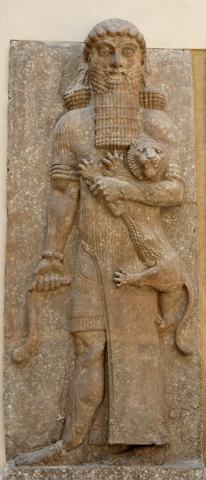
King of Uruk, two-thirds god and one-third man — the hero of the world's oldest surviving epic, who went to the ends of the earth to escape death.
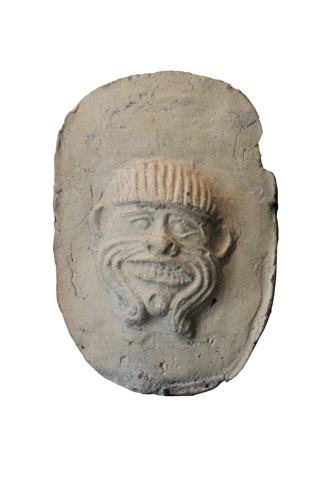
Guardian of the Cedar Forest, killed by Gilgamesh and Enkidu -- and, since a 2015 tablet turned up, a monster who kept court to a chorus of monkeys.
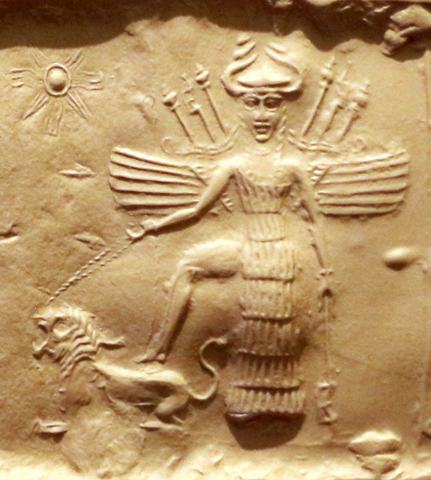
Queen of Heaven — Sumerian goddess of love, war, and the planet Venus, who walked into the land of the dead and was the only one to walk back out.
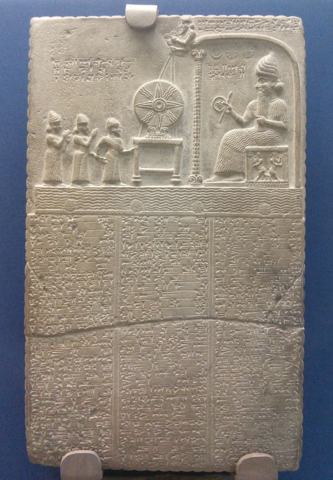
Sumerian Utu, Akkadian Shamash — the sun god who sees everything, judge of heaven and earth, patron of law, oaths, travellers and the diviner's art.
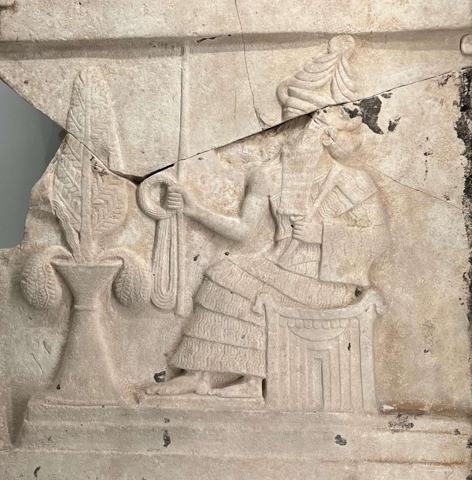
Lord of the moving air — the Sumerian executive of the gods, whose word carried out destinies, who split heaven from earth and sent the Flood.
The Mesopotamian moon god of Ur's great ziggurat, father of the sun and Venus in most tellings, served by history's first named author, Enheduanna.
Sources & Further Reading
- 1.The Epic of Gilgamesh, Standard Babylonian version (Tablets I-XII), Nineveh recension.
- 2.The Sumerian Bilgames poems: Bilgames and Huwawa, Bilgames and the Netherworld, The Death of Bilgames (ETCSL, early 2nd millennium BCE).
- 3.George, A.R. (trans.). The Epic of Gilgamesh. Penguin Classics, 1999.
- 4.George, A.R. The Babylonian Gilgamesh Epic: Introduction, Critical Edition and Cuneiform Texts. Oxford University Press, 2003.
- 5.Tigay, Jeffrey H. The Evolution of the Gilgamesh Epic. University of Pennsylvania Press, 1982.
- 6.Dalley, Stephanie. Myths from Mesopotamia. Oxford University Press, rev. ed. 2000.
- 7.Black, Jeremy & Anthony Green. Gods, Demons and Symbols of Ancient Mesopotamia: An Illustrated Dictionary. British Museum Press, 1992.
Spot an error or have a source to suggest? Write to info@viseterna.com. We cite primary sources and modern scholarship, and we correct fast.