
Ereshkigal
Lady of the Great Earth — the Mesopotamian queen of the dead, elder sister of Inanna, who rules the land of no return by rules even the gods obey.
Queen of the Night (Burney) Relief, Old Babylonian, c. 1800-1750 BCE (British Museum) · CC BY-SA 4.0 · source
Lady of the Great Earth
Ereshkigal — Sumerian Eresh-ki-gal, "Lady of the Great Earth" — is the queen of the Mesopotamian land of the dead, and one of the very few major Mesopotamian deities who is female, unmarried for most of her history, and sovereign in her own right 5,6. Her name is also used, by extension, for the realm itself, which the texts otherwise call Kur, Kurnugi or Irkalla 6.
Her authority is territorial rather than moral. She does not weigh souls or assign reward and punishment; she governs a place that everyone enters and no one leaves, and her power consists in the fact that its procedures are not negotiable 5,6. Katz's study of the Sumerian sources stresses how uneven the surviving picture is — the netherworld and its ruler are described differently from city to city and period to period — and cautions against reading the literary compositions as a single settled theology 5.
Household and Family
Her court is an administrative household. The vizier Namtar, whose name means "fate" and who is also the demon of plague, carries her orders; the gatekeeper Neti manages the seven gates; and the Anunnaki, seven judges, sit in her throne room and fix the visitor with the eye of death 1,2,6. Scribes record the dead as they arrive, because a Mesopotamian palace without paperwork would have been unimaginable 5,6.
Her genealogy varies by tradition, as Mesopotamian genealogies generally do. Inanna's Descent makes her the elder sister of Inanna, and some texts accordingly treat her as a daughter of the moon god Nanna; other traditions give her the god Ninazu as her son, and one line of tradition names Namtar as her son by Enlil 5,6. A short mythological passage prefixed to Bilgames and the Netherworld says she was carried off below as a prize, which would make her rule the consequence of an abduction rather than a birthright — a version scholars debate the weight of, since the passage is brief and stands apart from the rest of the poem 5.
The Descent of Her Sister
The narrative that made her famous is the descent of Inanna-Ishtar. When the goddess of love arrives at the outer gate demanding entry, Ereshkigal's response is procedural: she instructs Neti to bolt the seven gates and admit her according to the ancient rites of the netherworld, which means stripping one item of regalia at each threshold so that the visitor stands naked before the throne 1. The seven judges then look at her and she becomes a corpse hung on a hook 1.
What makes the poem more than a power struggle is what happens next. Enki fashions two sexless creatures whom the rules of the place do not cover, and they find Ereshkigal in the state of a woman in labour, groaning with pain 1. They offer no gifts and make no demands; they simply repeat her cries back to her. It is the only sympathy anyone in the composition extends to her, and she is so disarmed by it that she hands over the body — on the standing condition that a living substitute be sent down in exchange 1,5. The Akkadian Descent of Ishtar keeps the frame, adds the goddess's rage and her threat to raise the dead so that they outnumber the living, and ends with the mourning rites of Dumuzi 2,7.
The Coming of Nergal
The poem Nergal and Ereshkigal, preserved in a short Amarna version and a much longer first-millennium one, explains how the underworld acquired a king 3,7. The gods above hold a feast Ereshkigal cannot attend, since she may not come up and they will not come down; she sends Namtar as her deputy, and one god fails to stand for him 3. Summoned below to answer for it, Nergal is warned to refuse the chair, the bread, the meat, the beer and the bath — and refuses them all, and then does not refuse the queen 3.
After six days he slips away. In the longer version she weeps, then threatens the gods with the formula that is her ultimate sanction, and he is sent back down; the confrontation that follows — he seizes her by the hair and pulls her from the throne — resolves not in her defeat but in marriage and joint rule 3,7. The poem is unusual in Akkadian literature for how much interior life it gives a deity, and Dalley notes its comic register alongside the theology 7.
Cult, Image, and Reputation
Worship of Ereshkigal is thinly attested compared with her literary prominence. Offerings and invocations occur, and she is named in incantations, curses and boundary stones, but she had few temples of her own; her cult is bound up with that of Nergal at Kutha rather than standing alone 6. This is not surprising: the Mesopotamian dead were fed by their families and the underworld's rulers were placated rather than courted 5,6.
No securely identified image of her survives. The famous Old Babylonian "Queen of the Night" relief in the British Museum, a winged and taloned goddess standing on lions between two owls, has been read as Ishtar, as Ereshkigal, and as a demon; the identification remains open, and museum labels hedge it 6.
The Name Travels
Her name outlived her religion. In Greek magical papyri and lead curse tablets of the Roman period, Ereschigal appears as a name of power, often bound together with Hekate and Persephone in formulas whose authors plainly no longer knew the Akkadian texts but had inherited a very old association between that name and the world below 6. It is a modest afterlife for a queen, and a durable one — the syllables kept working long after the gates and the scribes had gone 5,6.
Continue Exploring
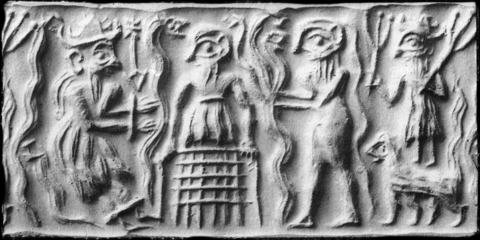
The Sumerian myth of a goddess who died in her sister's throne room and returned — at the price of a substitute sent down in her place.
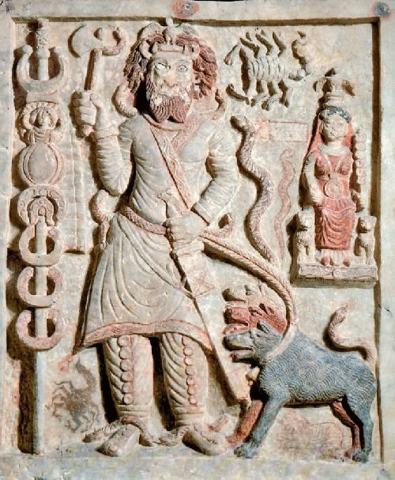
Mesopotamian god of plague, war and the scorching sun — the violent power of inflicted death, who talked his way into the underworld and stayed as its king.
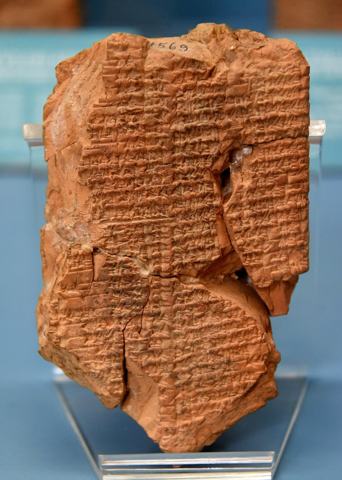
Inanna's shepherd husband, handed to the underworld in her place and mourned every summer across three thousand years of Near Eastern religion.
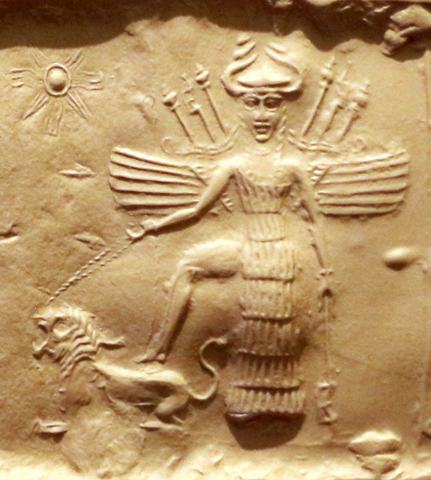
Queen of Heaven — Sumerian goddess of love, war, and the planet Venus, who walked into the land of the dead and was the only one to walk back out.
God of wisdom and the sweet water under the ground — the craftsman-trickster who made humankind, taught the crafts, and warned one man about the Flood.
The Mesopotamian moon god of Ur's great ziggurat, father of the sun and Venus in most tellings, served by history's first named author, Enheduanna.
Sources & Further Reading
- 1.Inanna's Descent to the Netherworld (Sumerian, early 2nd millennium BCE).
- 2.The Descent of Ishtar to the Netherworld (Standard Babylonian version).
- 3.Nergal and Ereshkigal (Amarna version, 14th century BCE; Sultantepe and Nineveh versions, 1st millennium BCE).
- 4.The Epic of Gilgamesh, Standard Babylonian version, Tablet XII.
- 5.Katz, Dina. The Image of the Netherworld in the Sumerian Sources. CDL Press, 2003.
- 6.Black, Jeremy & Anthony Green. Gods, Demons and Symbols of Ancient Mesopotamia: An Illustrated Dictionary. British Museum Press, 1992.
- 7.Dalley, Stephanie. Myths from Mesopotamia: Creation, the Flood, Gilgamesh and Others. Rev. ed., Oxford University Press, 2000.
Spot an error or have a source to suggest? Write to info@viseterna.com. We cite primary sources and modern scholarship, and we correct fast.